Best Residential Ground Mount Solar Kits for Efficient Open-Space Installations
Answering the common buyer question, these residential ground mount solar kits are designed for open spaces, farms, cabins, and off-grid properties. They help you optimize sun exposure, improve stability, and support various panel counts. This guide highlights five reliable options and who each is best for, with practical considerations to help you choose.
| Product | Best For | Key Benefit |
|---|---|---|
| ECO-WORTHY Upgraded Ground Mount Brackets (4×200W / 3×300W / 2×400W) | Small-to-mid installations, homes and cabins | Flexible angles and solid load support |
| ECO-WORTHY Ground Mount Kit (5×400W / 6×300W / 8×200W) | Medium-to-large systems on open land | High load capacity, seven preset angles |
| SUNGOLDPOWER Ground Mount Bracket (2×300W–590W) | Expandable, multi-panel setups | Heavy-duty, easy expansion |
| SUNGOLDPOWER Ground Mount Brackets (2×300W–590W) | Two-panel to moderate large arrays | Durable steel construction, flexible tilt |
| CMYYANGLIN Ground Mount Kit (1–4 panels, 30°–45°) | Simple, rust-free aluminum option | Lightweight, corrosion-resistant |
ECO-WORTHY Upgraded Solar Ground Mount Brackets Kit

- Features: 118″Lx39″W front frame, taller front and rear pillars for larger panels; supports 3×300W, 4×200W configurations; rated to bear 160 lbs with upgraded mid-span support; adjustable hole positions for 30°–60° tilt to improve sun capture.
- Best for: Small to medium roofless installations near homes, farms, cabins, or off-grid cabins with up to four panels.
- Limitation: Maximum load and span depend on chosen panel count; ensure ground anchors are properly installed for your soil type.
The ECO-WORTHY kit emphasizes adaptability and improved stability to reduce sagging and mid-span deflection. Choose this if you value adjustable tilt and a sturdy multi-panel framework that can be configured for 4×200W or 3×300W arrays.
ECO-WORTHY Ground Mount System for Large Installations

- Features: Long 236″L framework with 59″ spacing; supports up to 330 lbs without sagging; seven preset tilt angles from 30° to 60°; cement blocks recommended for base stability in certain sites.
- Best for: Large-scale ground installations on farms or expansive open spaces requiring multiple panels (up to 5×400W or 6×300W ranges).
- Limitation: Requires careful site preparation and anchoring; longer run demands more foundation planning.
Opt for this system when planning a substantial ground-mount array and you need robust support that tackles heavier panel loads with a broad tilt range.
SUNGOLDPOWER Ground Mount Bracket for Large Modules

- Features: Supports 2 large panels per rack (300W–590W); expandable by linking racks; galvanized steel build; tilt adjustment 20°–40° for seasonal sun optimization.
- Best for: Home or farm setups needing scalable, modular mounting that can grow with additional panels.
- Limitation: Municipal or local wind load requirements should be assessed; expansion requires compatible panel sizes.
Choose this when you want a modular system that combines strong structural integrity with straightforward expansion as your solar needs grow over time.
SUNGOLDPOWER Brackets – Modular and Expandable
- Features: Supports 2 large panels per rack (300W–590W); galvanized steel with reinforced load-bearing; tilt 20°–40°; compatible with SUNGOLDPOWER and most standard panels.
- Best for: Practical expansion from a base two-panel rack to larger arrays without replacing the entire mounting system.
- Limitation: Ensure alignment when expanding across multiple racks to avoid misalignment of tilt.
Better for homeowners who anticipate growing an existing ground mount as solar capacity increases or new panels are added over time.
CMYYANGLIN Ground Mount Kit System
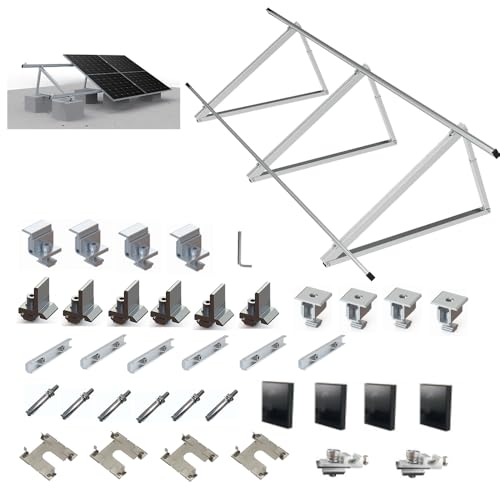
- Features: Aluminum alloy, rust-free; adjustable 30°–45° tilt; compact for 1–4 panels; durable in various weather conditions; includes cross beams for extra stability.
- Best for: Simpler, lighter ground-mount setups with up to four panels; ideal where weight and corrosion resistance are priorities.
- Limitation: Aluminum brackets may provide less raw load capacity than heavy-duty steel systems; confirm load requirements for larger arrays.
Ideal for users seeking an easy-to-handle, corrosion-resistant option that stays lightweight while offering reliable tilt control for moderate panel counts.
Buying Guide: How to Choose the Right Residential Ground Mount
- Panel count and expansion potential: Start with the current panels and plan for future growth. Choose modular systems if you expect to add panels later.
- Tilt range and sun optimization: A wider tilt range (around 20°–60°) helps maximize annual energy capture, especially if you’re in a variable latitude.
- Material and weather durability: Galvanized steel offers high strength in heavy wind or snow, while aluminum is lighter and corrosion-resistant for coastal areas.
- Foundation and soil considerations: Some kits require cement blocks or solid footings. Check local soil conditions and regulations for anchoring requirements.
- Installation complexity: Lighter, modular kits may be easier for DIY installation; larger kits may require professional mounting and leveling tools.
- Adequate clearance and ground space: Ensure there’s enough room for maintenance and for safe panel access with proper spacing to avoid shading.
Frequently Asked Questions
- What is the best ground mount material for windy areas? – Galvanized steel brackets generally offer higher wind resistance and greater load-bearing capacity than lighter aluminum options.
- Do ground mounts require professional installation? – Some kits are designed for DIY installation, but complex installations or larger arrays may benefit from professional mounting services.
- How do I choose the tilt angle? – Tilt angles are typically set between 30° and 60° based on latitude and seasonal sun path to maximize energy intake.
- Can I expand a ground mount later? – Yes, modular racks and expandable brackets allow incremental growth without replacing the entire system.
- What maintenance is needed for ground mounts? – Periodically check fasteners, inspect for corrosion or damage, and clear debris around mounting feet to prevent corrosion or instability.
- Are there any terrain restrictions for ground mounts? – Flat or gently sloped open spaces are ideal; avoid terrains with high erosion risk or poor drainage unless bases are properly stabilized.