Best Remote Switches for Ceiling Fans: Top 5 Options for Easy, Wire-Free Control
The right remote switch can transform any ceiling fan into a smarter, more convenient device. This guide highlights five reliable remote control kits that work with a variety of fan brands, offering easy installation, multiple speeds, timers, and even app or voice control where available. Read on to compare options and find the best remote switch for your ceiling fan needs.
Summary of Selected Products
| Product | Brand | Key Features |
|---|---|---|
| Ceiling Fan Remote Control Kit, Universal Ceiling Fan Remote Control Kit UC9050T | GREENBELL | 3-wire setup, wall switch included, compatible with Hunter and Hampton Bay models |
| Smart WiFi Fan Switch Ceiling Fan and Light Remote Control Kit | Aubric | WiFi with Alexa/Google, phone app control, universal compatibility, no hub required |
| LPHUMEX Universal Ceiling Fan Remote Kit, 3-in-1 | LPHUMEX | 3-in-1 control (fan speed, light dimmer, timing), wide compatibility |
| addlon Ceiling Fans With Lights, 52 Inch | addlon | Remote control with wall switch option, 3-speed with dimmable light, energy efficient |
| Nexete Universal Ceiling Fan Remote Kit | Nexete | Wireless wall-mounted/removable remote, compact receiver, multi-function |
Note: None of the products listed require in-wall wiring beyond the receiver installation, and each provides straightforward options to activate fan speed, light control, and timers where available.
Greene Bell UC9050T Universal Ceiling Fan Remote Kit

The GREENBELL UC9050T is a universal remote kit designed as a replacement for common ceiling fan remotes. It emphasizes a straightforward three-wire wiring approach and includes a wall switch for convenient, on-wall operation. Compatibility extends to popular brands such as Hunter and Hampton Bay, along with a range of listed fan models. Important installation note: this kit requires wiring to the receiver for proper operation, and it does not support WiFi connectivity. Ideal for users seeking a reliable, traditional remote experience with minimal setup.
Key features include: a compact receiver, compatibility with a broad set of fans, and a robust wall switch designed to pair with the remote for quick access. Installers should verify that their ceiling wiring aligns with the 3-wire configuration and that the receiver is correctly connected with the fan motor. For households prioritizing a non-smart, dependable remote solution, this kit remains a solid pick.
Aubric Smart WiFi Fan Switch Kit

The Aubric smart controller brings WiFi-enabled control to most ceiling fans with lights, enabling management via smartphone apps and voice assistants. It supports Amazon Alexa and Google Home through the Smart Life app, allowing you to turn the fan on or off, adjust speeds, and control the light from anywhere with an internet connection. The receiver fits inside the fan canopy (approximately 4.5 x 2 x 1 inches), so space inside the canopy is a consideration during installation. This kit is ideal for users seeking hands-free control and remote access without a dedicated smart hub. It works with common fan brands but confirm canopy space prior to purchase.
Pros include wide compatibility, remote access from anywhere, and voice control integration. A potential limitation is dependence on WiFi stability and the need to pair with the Smart Life app for full functionality. Batteries for the included RF remote are typically not included, so plan accordingly.
LPHUMEX Universal Ceiling Fan Remote Kit
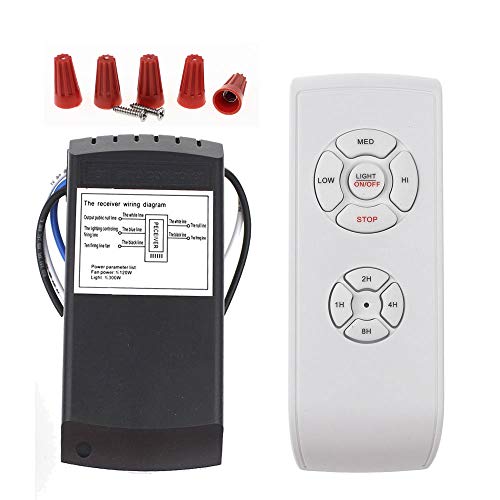
The LPHUMEX 3-in-1 remote kit offers fan speed control, light dimming, and timing functionality in a compact package. Its installation is described as straightforward, requiring only a 5-wire setup with the receiver installed in the canopy. The kit is designed to work with many popular brands, including Hunter, Harbor Breeze, Westinghouse, and Honeywell. A notable feature is the 3-in-1 approach, which consolidates fan and light control into a single remote, reducing the need to reach for multiple devices. It’s suitable for upgrading older fans or replacing a failing remote control kit.
Users should note that the remote’s light dimmer may have limitations with some LED bulbs. The kit emphasizes good signal range, allowing control from other rooms or levels of the home, which is a strong selling point for larger living spaces.
Addlon 52 Inch Ceiling Fan With Lights

The addlon 52-inch ceiling fan combines a modern, low-profile design with a practical remote control system. This fan includes a wall switch option and a remote-control-enabled light dimmer, plus a timer feature for energy management. The energy efficiency is highlighted with an A rating, and the dual-control setup allows independent operation of light and fan. Its forward and reverse rotation can be managed from the remote, with a wall switch included for convenience. This makes it a good option for bedrooms and living areas where you want flexible, space-saving control without adding extra smart home devices.
Considerations include ensuring dimmable compatibility for your lighting and confirming that the provided wall switch will meet your wall space and aesthetic requirements. The unit aims to balance performance with straightforward, user-friendly control.
Nexete Universal Ceiling Fan Remote Kit

The Nexete wireless wall-mounted remote kit emphasizes a battery-free installation concept by enabling remote control without in-wall wiring. The receiver is compact and designed to fit most standard ceiling fans, including Hampton Bay, Harbor Breeze, Westinghouse, and Honeywell models. It supports high/medium/low speeds, on/off lights, and multiple timing options, making it a flexible option for both new installations and replacements. The inability to dim lights varies by bulb type, but the device is focused on convenient wireless control from anywhere in the room or even from a different floor.
Warmly suited for users who want easy placement of a wall remote and minimal wiring, the Nexete kit combines simplicity with broad compatibility. Ensure the receiver and fan are compatible with the included functions for best results.
Buying Guide: Key Considerations For Choosing A Ceiling Fan Remote
- Wiring needs: Some kits require direct wiring to a receiver inside the fan canopy (3-wire setups), while others are designed for wireless operation without new wall wiring. Consider whether you prefer a simple, do-not-want-to-wire approach or are comfortable with canopy wiring.
- Compatibility: Check fan brands and models listed in product descriptions. Common compatible brands include Hunter, Hampton Bay, Harbor Breeze, Westinghouse, Honeywell, and others. If you have a specific model, verify compatibility before purchasing.
- Controls and features: Decide if you want basic on/off and speed control, or additional features such as light dimming, timers, reverse rotation, and WiFi/app integration. Some kits offer voice control via Alexa/Google Home, while others provide traditional wall-remote experiences.
- Installation space: Some receivers are compact but require sufficient canopy room. Measure the canopy and ensure there is space for the receiver and wiring. This is especially important for tight-fitted or newer, low-profile designs.
- Wall control vs. wall switch: Some kits include a detachable wall remote or wall switch to provide convenient access without repeatedly bending to the canopy. Consider where you want the control to be located (near the bed, doorway, or standard light switch area).
- Power and reliability: WiFi-connected options require a stable network and power supply. If reliability and offline operation are priorities, a traditional remote kit may be preferable.
- Bulb compatibility: Light dimming features depend on the type of bulbs used (dimmable LEDs, CFLs, or incandescent). Some dimming functions may not work with all bulbs. Verify compatibility with your current lighting setup.
- Energy efficiency: Some fans emphasize energy-saving efficiency with DC motors or high-efficiency ratings. If energy savings are important, compare motor technology and potential electricity usage.
When selecting a remote kit, balance ease of installation, compatibility with your fan, desired features, and whether you prefer a traditional remote experience or a smart, connected setup. The five options reviewed here provide a range of choices from purely mechanical/wired kits to WiFi-enabled, app-controlled systems to meet different homeowner needs.