Best Solar Battery Charger Regulators for 12v/24v Systems
Choosing the right solar battery charger regulator is essential for protecting batteries and maximizing energy capture in off-grid setups. The following five regulators are highlighted for 12V and 24V systems, including PWM and MPPT types. Each option supports multiple battery chemistries and offers protection features to extend battery life and ensure safe operation in varying conditions. Use this guide to compare capabilities like efficiency, charging curves, protection mechanisms, and ease of installation.
| Product | Brand | Key Benefit |
|---|---|---|
| [Upgraded] 30A Solar Charge Controller | Depvko | Dual USB, 12/24V, PWM, memory parameters |
| Renogy Wanderer Li 30A | Renogy | Flexible battery compatibility, robust protections |
| SOLPERK MPPT 10A 12V Solar Charge Controller | SOLPERK | MPPT efficiency, IP65 durability, USB output |
| ACEIRMC 2pcs 30A Solar Charge Controller | ACEIRMC | Two-pack value, LCD display, adjustable 3-stage PWM |
| [Upgraded] 30A MPPT Solar Charger Controller | TCEUMIK | High MPPT efficiency, auto 12/24V recognition |
The following sections present each regulator with a concise overview of its design, supported battery types, charging philosophy, safety features, and practical use cases to help you decide which model fits your off-grid needs.
Depvko 30A Solar Charge Controller
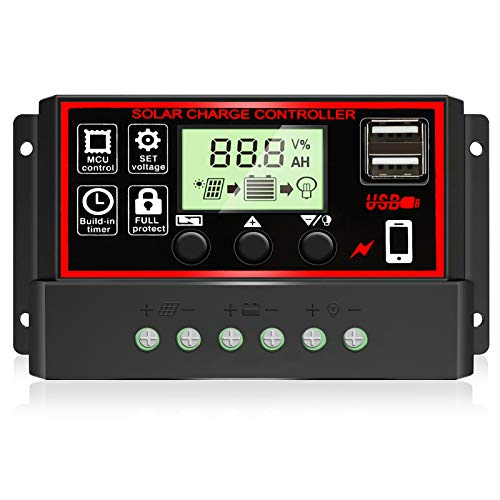
This upgraded PWM regulator supports 12V and 24V systems and uses a built-in microcontroller to manage solar panel output and battery state automatically. It memorizes user-set parameters so you do not need to reset configurations after a battery discharge. The device provides dual USB outputs (5V/2.5A total) for charging mobile devices and includes multiple protection features such as overcurrent, short-circuit, reverse polarity, low voltage, and overcharge protection. It employs a three-stage PWM charging profile designed to prolong battery life, particularly for lead-acid types (OPEN, AGM, GEL). The regulator will automatically shut down if battery voltage falls below 8V to prevent deep discharge. Suitable for RVs, cabins, and off-grid setups where safety and battery longevity are priorities.
Renogy Wanderer Li 30A 12V PWM Controller

The Renogy Wanderer Li 30A PWM controller is designed for 12V systems with support for lithium, sealed, gel, and flooded lead-acid batteries. It features a four-wheel charging profile that adapts between Bulk, Boost, Float, and Equalization to optimize charging speed and battery health. Real-time monitoring is provided by LEDs, and a protected design guards against reverse polarity, overcharging, overload, and short circuits. The device is compact, fits into tight spaces, and is well-suited for RVs, boats, and off-grid cabins where reliable, multi-battery compatibility is essential.
SOLPERK MPPT 10A 12V Solar Charge Controller

The SOLPERK MPPT 10A controller uses maximum power point tracking to improve energy harvest, achieving up to 99% conversion efficiency and enabling a 30% increase in electricity generation compared with PWM controllers. It supports multiple battery types including lead-acid variants and LiFePO4 with safeguards like overcharge, over-discharge, short circuit, and reverse connection protections. The IP65-rated housing provides weather resistance, and the device includes an LCD status display for easy monitoring. It is suitable for off-grid setups needing higher efficiency in a compact form factor and works well with mid-sized solar arrays on RVs and boats.
ACEIRMC 2pcs 30A Solar Charge Controller

This two-pack regulator from ACEIRMC provides 30A capacity for 12V or 24V systems, with dual USB outputs (5V, 2.5A) and a user-friendly LCD. It uses a three-stage PWM charging algorithm to deliver direct charge, boost, and float charging cycles, designed to extend battery life for lead-acid types such as OPEN, AGM, and GEL. The LCD allows clear status updates and parameter configuration, and the controls support protective functions to guard against over-discharge and other electrical faults. It is a practical option for installations needing multiple controllers or a budget-friendly deployment across several charging stations.
[Upgraded] 30A MPPT Solar Charger Controller

This MPPT regulator delivers high-efficiency charging with an industrial-grade controller chip and an MPPT tracking efficiency up to 99.9%. It continuously detects the charging state to optimize bidirectional tracking and improve overall efficiency by 15–30% versus PWM equivalents. It supports lead-acid batteries, including open, sealed, and AGM variants, with automatic 12V/24V recognition to simplify installation. A built-in anti-backflow circuit reduces heat and ensures stable operation, making it a strong option for compact, high-efficiency solar setups where space and performance are priorities.
Buying Guide: Key Considerations for Solar Charge Regulators
- Voltage and system type: Ensure the regulator supports your battery bank (12V or 24V) and battery chemistry (lead-acid, AGM, GEL, LiFePO4).
- PWM vs MPPT: PWM regulators are simple and affordable, suitable for smaller arrays. MPPT regulators are more efficient, especially under partial shading or higher voltage panels, and better for larger systems.
- Current rating: Match the regulator’s amperage rating to your panel output and battery charging needs. Oversizing slightly can help accommodate future expansion.
- Protection features: Look for overcharge/over-discharge protection, short-circuit protection, reverse polarity, temperature compensation, and reverse current blocking, especially in outdoor enclosures.
- Temperature management: Some regulators include heat sinks or require ventilation; harsh environments benefit from robust casing and IP ratings (IP65/IP67).
- Display and programming: LCD/LED displays simplify setup and monitoring. Consider models with user-configurable charging profiles and timer settings for advanced control.
- Installation and form factor: Check physical dimensions, mounting options, and ease of wiring, particularly for compact or marine installations.
- Battery compatibility: Verify compatibility with your battery type, especially lithium options, as some regulators are optimized for lead-acid systems and require proper parameter configuration for LiFePO4.
When selecting a regulator, weigh efficiency gains against cost, installation complexity, and the environmental conditions where the system will operate. For small to mid-size off-grid projects, PWM units offer reliable, economical charging, while MPPT units deliver superior efficiency for larger arrays or shading conditions. Battery longevity, safety protections, and ease of use should guide the final choice to ensure dependable solar performance.