Best Regulated AC Power Supplies for Reliable Bench Work
Choosing a regulated AC-to-DC power supply is essential for consistent voltage and current in electronics projects, testing equipment, and lab experiments. The following selections emphasize precision, versatility, and safety features suitable for American hobbyists and professionals. Each option offers adjustable output, protection mechanisms, and robust connectors to support a wide range of devices—from microcontrollers to radio gear and test benches.
Summary At A Glance
| Product | Brand | Key Strength | Output Range |
|---|---|---|---|
| Jesverty SPS-3010 | Jesverty | 4-Digit display, CV/CC auto-switch | 0-30V, 0-10A |
| ALITOVE 12V 30A | ALITOVE | High current, multi-channel capability | 12V, up to 30A |
| BTECH RPS-30PRO | BTECH | Compact, multiple output connections | 13.8V, 9-15V adjustable |
| Jesverty SPS-30II | Jesverty | Voltage control, auxiliary outputs | 9-15V (13.8V fixed) |
| Pyramid PSU990KX | Pyramid | Dual USB, versatile terminals | 13.8V, 7A (continuous 4.5A) |
Jesverty SPS-3010: Precision CV/CC Bench Power Supply

The Jesverty SPS-3010 is a versatile bench power supply with a wide 0-30V and 0-10A adjustable output. It features a bright 4-digit LED display that shows voltage, current, and power in real time, with a resolution as fine as 0.01V, 0.001A, and 0.1W. The unit automatically switches between constant-voltage (CV) and constant-current (CC) modes as load conditions change, ensuring safe operation for sensitive electronics. Coarse and fine adjustment controls help users converge on precise settings. A built-in 5V/2A USB port adds convenient auxiliary power for microcontrollers and small peripherals. This model is suitable for lab benches, repair shops, and educational environments where accurate power delivery is critical.
Key features to note include the real-time V/A/W display, CV/CC auto-switching, and a clear crossover point for CV/CC behavior. Users should ensure load impedance remains within the CC range to avoid tripping the protection circuits. The unit’s precision makes it a strong candidate for electronics tinkering, education demonstrations, and device testing where stable power sources are essential.
LitStar 12V 2A Regulated Power Supply with 8 Tips

The LitStar 12V 2A AC adapter delivers a regulated 12V output with 2A maximum current, suitable for LED strips, CCTV cameras, and small electronics. It includes eight interchangeable DC plug connectors, enabling compatibility with a variety of devices. The adapter can automatically identify the current draw of connected equipment, offering flexibility for mixed loads and DIY projects. It supports worldwide input ranges of 100-240V and 50/60Hz, making it a practical option for travel workshops or multi-region usage. While not a high-current bench supply, its automatic current identification and plug variety simplify simple, low-power projects and testing setups.
Consider this option when you need a versatile, compact solution that supports quick device swaps and DIY experiments. The eight-tip set and auto-identification help reduce connector guesswork, but users should match it to devices that require up to 2A to prevent overheating. For light bench tasks or home electronics, this supply provides dependable, regulated output with broad compatibility.
ALITOVE 110V/220V to DC 12V 30A Regulated Power Supply

The ALITOVE universal switching power supply handles 110V/220V input and provides a regulated 12V output capable of up to 30A. It features three output channels and built-in protection against overload, over-voltage, over-temperature, and short circuits, with minimal voltage fluctuations during operation. The broad voltage stability and strong current capability make it well-suited for LED strip installations, CCTV systems, or other equipment requiring reliable, high-current 12V power. Users should ensure proper heat dissipation and verify compatibility with the connected devices’ input connectors and polarity before deployment.
Prospective buyers should consider the balance between high current capability and thermal performance, especially in enclosed enclosures or long-duration runs. The three-channel arrangement adds flexibility for multi-device setups, though it requires careful distribution to avoid overloading a single channel. Overall, this unit is a solid choice for projects demanding steady 12V power at higher currents.
BTECH RPS-30PRO 30 Amp Regulated Bench Power Supply
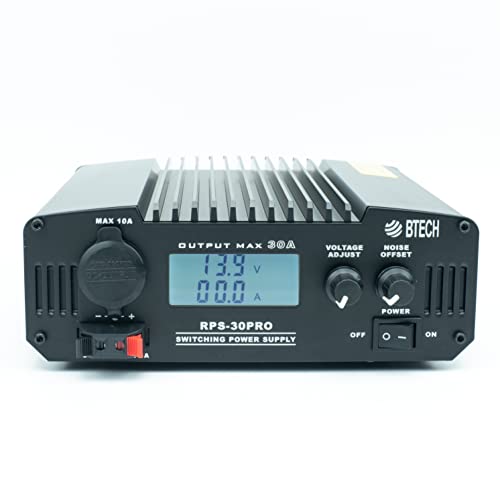
The BTECH RPS-30PRO is a compact, 30A-capable bench supply designed for reliable AC-to-DC conversion. It provides a selectable output around 13.8V with a range of 9-15V for flexible DC applications, making it a strong match for CB radios, ham radios, scanners, and other DC-powered gear. It includes cigarette plug and screw-type terminals, enabling quick, secure connections to various devices. The unit emphasizes straightforward plug-in operation and a switch-activated control for consistent power delivery. For users needing a robust mid-range bench supply with multiple connection options, the RPS-30PRO offers a balanced combination of current capability and versatility.
When evaluating this model, consider the need for an adjustable output within a narrow DC range and the convenience of multiple connection formats. Its focus on compatibility with radio equipment and test benches makes it ideal for hobbyists and professionals performing field repairs or lab experiments in 13.8V ecosystems.
Pyramid PSU990KX Universal Bench Power Supply

The Pyramid PSU990KX represents a compact, universal bench power supply designed for 13.8V DC operation with dual USB ports and screw-type terminals. It emphasizes easy plug-in operation and stable AC-to-DC conversion, suitable for charging phones, powering CB radios, scanners, and other DC devices. With 7A continuous output and a peak of higher current, it supports a range of bench testing scenarios while maintaining straightforward connections and quick setup. The dual USB ports add convenience for powering small devices concurrently, making it a practical choice for multi-device test benches.
Key considerations for this supply include its 13.8V design, the availability of dual USB ports, and the plug-in simplicity. While not the highest-current option in this list, it provides reliable performance for standard lab tasks, education demonstrations, and everyday electronics work. Ensure that connected devices do not exceed the cumulative current rating and that output terminals are compatible with your equipment’s input jacks.
Buying Guide: Key Purchase Considerations
When selecting a regulated AC power supply, consider these factors to ensure the best fit for your applications.
- Voltage and current range: Match the supply’s adjustable voltage and current to your devices’ requirements. Some models excel at low-current, high-precision work, while others handle higher currents for power-hungry gear.
- CV/CC operation: Look for automatic switching between constant-voltage and constant-current modes, especially for charging batteries or testing variable loads. Precision in the crossover behavior reduces device stress.
- Precision and display: A clear, high-precision display (voltage, current, power) helps monitor real-time changes during experiments. Four-digit LED readouts are common in higher-end units.
- Protection features: Overload, over-voltage, short-circuit, and thermal protection are essential for safe operation and protecting connected devices. Thermal management matters for continuous use.
- Connectors and terminals: Screw terminals, cigarette plugs, and diverse DC jacks improve compatibility with a wide range of devices. Ensure connectors match your equipment’s plug type and polarity.
- Size, weight, and cooling: Bench setups vary; compact units save space but may require improved cooling for sustained loads. Consider enclosure and airflow in your workspace.
- Build quality and certifications: Look for sturdy enclosures, reliable switching regulators, and compliance with safety standards for peace of mind in educational and professional settings.
- Accessories: USB power ports, multiple output channels, and a broad accessory ecosystem (plugs, cables) add flexibility for a busy lab bench.
In practice, users often weigh high current capability against price and physical footprint. For hobbyists who need precise control for electronics assembly, a compact unit with CV/CC and a bright display may be preferable. For RF enthusiasts and lab technicians requiring higher current or multiple rails, larger bench supplies with several output channels provide greater flexibility. Always verify device compatibility with your equipment’s input connectors and recommended operating voltages to prevent unintended damage during testing.