Best R22 Refrigerant Leak Detectors for HVAC Technicians
Answering the need for accurate and reliable R22 leak detection, this guide compares top detectors that identify halogen refrigerants and R22 variants. The listed models suit professional HVAC technicians, service teams, and DIYers who require quick, actionable readings in tight spaces. Each product section explains who benefits most, why it was selected, and any practical limitations to consider.
| Product | Brand | Best For |
|---|---|---|
| Elitech ILD-100H | Elitech | Prospecting leaks across multiple halogen refrigerants in residential and light commercial systems |
| SENSYX SFD200 | SENSYX | Cordless, portable detection with high sensitivity for quick checks on-the-go |
| GL77A Halogen Detector | ZLLJYBLG | Hard-to-reach areas and rapid, visual concentration readings |
| Elitech ILD-200 | Elitech | Infrared sensor longevity and broad halogen gas detection in larger systems |
| Elitech CLD-100 | Elitech | Fast triggers and flexible probing for car HVAC and small spaces |
Elitech ILD-100H R22 Detector

The ILD-100H uses a Heated Diode Sensor for improved accuracy across halogen refrigerants, including R22, R410A, R134A, and R1234YF. It features a TFT screen for clear readings of sensitivity, leakage alerts, battery levels, and more. With adjustable sensitivity (High/Medium/Low) and a maximum sensitivity around 0.1 oz/yr, it is best for technicians performing ongoing service work in homes and light commercial equipment. A limitation is the reliance on diode-based sensing, which can be affected by strong background signals in certain environments.
SENSYX SFD200 Rechargeable Detector

This model uses a rechargeable lithium battery for cordless use and sports a high-sensitivity sensor with a Japanese-made heat dioxide semiconductor for reliable leaks. It offers adjustable sensitivity with High/Low levels, helping technicians balance speed and accuracy in busy work environments. Best for mobile technicians who need quick checks without frequent recharging; battery life and charging time are practical considerations to note in extended field work.
GL77A Halogen Detector, 0-1000PPM
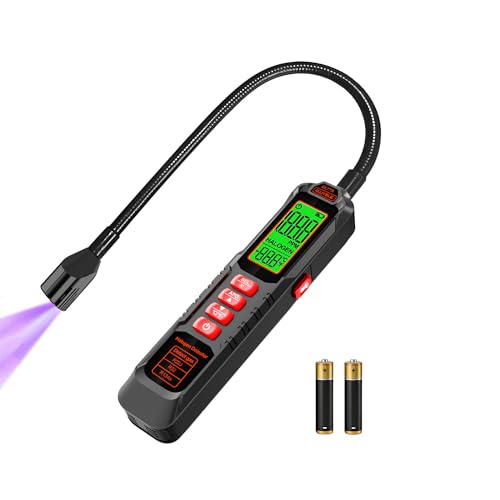
GL77A combines ultra-high sensitivity with a fast 0.5-second response and a 0-1000 PPM display. Dual-detection technology—diode heating plus UV detection—boosts reliability across R134a, R22, R410a, and other gases. The 30 cm flexible probe helps reach tight spaces in HVAC units, cars, and refrigerators. Best for technicians needing rapid pinpointing in cramped equipment; the long probe adds durability and reach, but users should handle the PVC sleeve with care to maintain sensor longevity.
Elitech ILD-200 Infrared Leak Detector
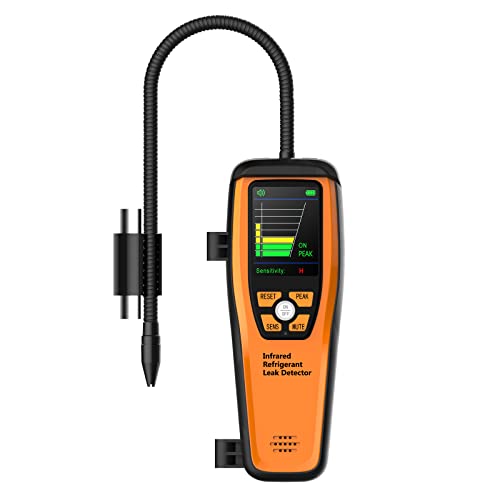
The ILD-200 uses an infrared sensor for strong anti-interference, faster response, and longer service life. It detects all halogenated gases, including CFCs, HFCs, HCFCs, HCs, HFOs, and various blends like R11, R22, R404a, and R410a. With adjustable sensitivity (High/Medium/Low) and a maximum of about 0.14 oz/yr, it suits mid- to large-scale systems where stable operation over time matters. Best for shops and service fleets; note that infrared models may have higher initial cost and require periodic calibration checks.
Elitech CLD-100 Freon Leak Detector

The CLD-100 is an upgraded version with a traditional corona sensor, offering fast triggering on common refrigerants like R11, R22, R134A, R404a, and others. It features a 6-second preheating time, adjustable sensitivity (up to 0.21 oz/yr), and a flexible 8.26-inch probe for hard-to-reach spots. Best for technicians who need quick responses in car HVAC or compact equipment; the detector may require careful calibration for longer-term accuracy in noisy environments.
Buying Guide: Choosing the Right R22 Refrigerant Leak Detector
- Sensor technology: Healed diode vs infrared vs corona. Heaters offer good general detection; infrared provides longer life and lower interference in busy shops; corona sensors are fast but may be sensitive to environmental factors.
- Sensitivity range: Consider maximum detectable leak rate (ppm or oz/yr) and whether you need ultra-high sensitivity for tiny leaks or broader coverage for quick sweeps.
- Ease of use: Look for adjustable sensitivity, clear displays, and intuitive alerts. A TFT or large LCD display helps readouts in bright or dim conditions.
- Probe design: A long, flexible probe improves access to tight spaces. Check probe durability and whether it’s replaceable or shielded.
- Power and mobility: Rechargeable batteries offer cord-free operation. Check runtime and charging options; USB-C is common for modern devices.
- Versatility: If you handle multiple refrigerants, a detector that identifies a wide range of halogen gases is advantageous.
- Durability and service life: Consider sensor life, especially for infrared units, and whether the device supports easy maintenance or calibration.
Frequently Asked Questions
- What refrigerants can these detectors identify?
- Do infrared detectors have longer lifespans than diode-based detectors?
- Is a longer probe always better for HVAC systems?
- How important is a brightness-adjustable display for field use?
- Can these detectors be used for automotive air conditioning as well as residential systems?
- Do these devices require regular calibration?
All models listed above are designed to help technicians locate leaks efficiently in R22-containing and other halogen refrigerants. When selecting a detector, prioritize sensor type, sensitivity range, ease of use, and probe accessibility to match your typical service scenarios. The best choice balances quick, reliable readings with practical field durability.