Best Push Pull Solenoid With Long Stroke for DIY and Automation
Answering the best options for a long-stroke push-pull solenoid helps buyers choose reliable linear actuators for automation, home projects, or automotive controls. The top picks below are selected for a 35mm stroke or longer, clear installation, and stable performance. This guide targets builders, hobbyists, and technicians seeking dependable, long-travel solenoids.
| Product | Stroke | Voltage | Best For | |
|---|---|---|---|---|
| Abletop Push Pull Solenoid DC 12V | 35 mm | DC 12V | Small automation projects in vehicles or compact machinery | Spring return is relatively soft; ensure mounting supports shock loads |
| TOMSHIELE AC 110V Open Frame Push Pull | 35 mm | AC 110V | Fixed installations and heavier-duty open-frame applications | AC wiring requires appropriate safety precautions and isolation |
| TOMSHIELE DC24V 35mm Stroke Push Pull | 35 mm | DC 24V | Open-frame or durable DC control systems | Electrical specs should match supply and load requirements |
| TOMSHIELE Push Pull Solenoid 35mm | 35 mm | DC 12V | DIY projects needing reliable linear motion | Ensure proper heat management for continuous operation |
| YQSIYU DC12V Push Pull 35mm | 35 mm | DC 12V | Office or small automation equipment | Wiring must be correct to avoid reverse polarity issues |
Below is a concise at-a-glance comparison to help you pick quickly:
- Best for compact spaces: Abletop DC12V 35mm
- Better for fixed, enclosed setups: TOMSHIELE AC110V
- Durable DC control systems: TOMSHIELE DC24V 35mm
- Great DIY all-rounder: TOMSHIELE Push Pull 35mm (DC12V)
- Good option for office automation: YQSIYU DC12V 35mm
Abletop Push Pull Solenoid — 12V, 35mm Long Stroke

The Abletop unit uses a pure iron shell with integrated molding to reduce residual magnetism and improve magnetic permeability. It includes a built-in core with a spring-return mechanism. Best for compact automotive or small appliance projects where a low-power, quick reset is beneficial. The design supports fixed object applications with a reliable push action. A potential limitation is that the spring is relatively soft, which may affect durability under heavy repetitive impact.
TOMSHIELE DC12V 2A Push Pull Solenoid — 65N, 20mm Stroke

Designed for moderate-load applications, this 12V solenoid delivers 65N with a 20mm stroke. It offers a straightforward wiring method that does not require a specific polarity within the rated voltage. It is best for compact devices where space constraints favor a shorter stroke, but it is included here for contrast with true long-stroke options. Choose this if you need a simple solution in smaller assemblies and can accept a shorter travel distance.
TOMSHIELE AC 110V Open Frame 35mm Solenoid
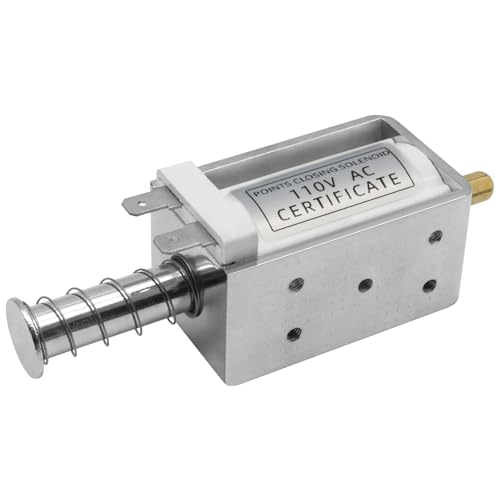
This open-frame solenoid operates at 110V AC with a 35mm stroke, delivering strong linear thrust suitable for fixed installations or manufacturing control panels. It features a simple terminal connection and copper coils for stable performance across temperature changes. Best for higher-power, stationary equipment where a durable, long-stroke action is required. A limitation is the absence of integrated cables; wiring must be added by the installer.
TOMSHIELE DC12V 35mm Push Pull Solenoid — Wiring Connection

This 12V solenoid offers a 35mm stroke with a straight pull-push action and a frame-type construction. It uses an all-copper coil designed for stable temperature rise and longevity, making it suitable for continuous operation in DIY automation or hobby robotics. Best for projects that require a reliable, low-friction plunger and a simple wired setup. A limitation is the need for proper heat management in high-duty scenarios.
Heschen DC Solenoid — 20mm Stroke

Although this Heschen model has a 20mm stroke, it is included here for comparison of long-stroke options. It uses a copper coil and open-frame design for straightforward installations. Best for smaller projects where space is not a critical constraint. Do not rely on this part where a 35mm stroke is required.
YQSIYU DC12V Push Pull 35mm

This 12V, 35mm stroke unit from YQSIYU features a simple wiring connection and a robust linear actuation profile. It is suitable for DIY projects and office equipment that require stable pull/push actions. Best for environments where precise installation and straightforward electrical wiring are priorities. A limitation is that the unit relies on correct polarity handling and may require guidance for first-time users.
Buying Guide: Long-Stroke Push Pull Solenoids
What is a long-stroke push pull solenoid, and when should you choose one?
Long-stroke solenoids provide 30+ mm of travel to move components farther than compact models. They are ideal for latching mechanisms, mechanical interlocks, or linear actuators in automation where greater displacement is needed without a separate motor. Look for stroke length, force, voltage, and mounting compatibility when evaluating options.
Key purchase considerations
- Stroke and force: Match the required travel and push/pull force to your application. A longer stroke with adequate force ensures reliable actuation over the full movement range.
- Voltage and current: Select a voltage that matches your control system. DC options are common for hobby projects, while AC may suit fixed installations.
- Mounting and form factor: Consider available mounting holes, frame type, and whether a terminal or cable connection works best for your setup.
- Durability and heat: For continuous or heavy-duty use, check coil material, heat tolerance, and whether the design allows for adequate cooling.
- Wiring and polarity: Some models require correct polarity, while others are non-polarized. Plan wiring accordingly to avoid malfunction.
Applications by scenario
- DIY automation: A compact DC12V unit with 35mm stroke is often ideal for robots, project chasses, or cabinet automation.
- Home appliances: 12V or 24V models can control latches, doors, or valve actuations in appliances.
- Industrial panels: 110V AC open-frame units provide robust actuation for fixed control panels and industrial equipment.
What to avoid
- Overlooking heat buildup in continuous-duty environments; ensure the coil and core are rated for sustained operation.
- Ignoring mechanical clearance; a 35mm stroke requires sufficient space to avoid interference with neighboring parts.
- Underestimating safety measures for high-voltage or exposed wiring, especially in open-frame designs.
Common questions
- Q: Which stroke length is typical for long-stroke solenoids? A: 30mm and above, with 35mm being a common long-stroke choice.
- Q: Are all long-stroke solenoids polarity-sensitive? A: Not all; some are non-polarized, but many DC units require correct wiring.
- Q: Can these solenoids operate in high-temperature environments? A: Some use copper coils and heat treatment for stability, but verify temperature ratings for your use.
- Q: What is the best mounting approach for a long-stroke solenoid? A: Use provided holes or brackets and ensure a solid, vibration-free mount.
- Q: Are there safety considerations for AC-powered units? A: Yes; follow electrical codes, isolate AC wiring, and ensure proper safety clearance.
FAQ
- What is the typical duty cycle for these solenoids? The articles focus on moderate-to-long stroke units; check each product spec for duty ratings.
- Will a longer stroke increase resistance? Stroke length affects mechanical travel; electrical resistance depends on coil design and voltage.
- Can these be used for locking mechanisms? Yes, many 35mm stroke solenoids are suitable for latching and interlock applications with appropriate mounting.
- Do I need a driver or controller? In most cases, a simple switch or microcontroller can drive a solenoid via a transistor or relay, depending on current draw.
- How do I prevent magnetic interference with nearby metal parts? Use non-magnetic spacers or shields as needed and ensure room for magnetic flux.