Best Programmable Low Voltage Disconnect Solutions for Safe Battery Management
Answering your search for a programmable low voltage disconnect: these modules automatically disconnect a load when battery voltage falls to a preset threshold, protecting batteries from deep discharge and extending life. They suit off-grid setups, RVs, marine systems, solar projects, and power wheels. This guide highlights five reliable options and clarifies who should pick each one.
| Product | Best For | Key Benefit |
|---|---|---|
| Seloky 12V-36V DC Voltage Protection Module | Lead-acid, lithium, solar setups needing flexible protection | Customizable parameters with memory and reset simplicity |
| IS ICSTATION Digital Low Voltage Protector | General DC systems requiring reliable auto-disconnect | Memory function and flexible discharge protection |
| WUMZIJ 12V-36V Display Low Voltage Protector | Easy real-time voltage monitoring | LED display with memory, clear voltage readings |
| CZH-LABS LVD Low Voltage Disconnect Module | Auto-protect for electronics with adjustable cutoffs | User-adjustable disconnect/reconnect; emergency ON/OFF |
| Zuomeng 12V 30A LVD Module with Display | Precise 0.1V control for critical systems | Dual protection with auto/manual modes and precise tuning |
Seloky 12V-36V DC Voltage Protection Module

Best for: users who want highly customizable over-discharge protection for diverse battery chemistries. This module uses a relay to switch outputs on/off, with a default 12V protection and a 2V hysteresis. It supports lead-acid, lithium-ion, and solar battery types but is not suitable for battery packs. Limitation: the relay does not provide a built-in power cut-off; you must cut power after disconnection to prevent continued draw.
- Over-discharge protection with configurable voltage thresholds
- Factory settings can be restored by power cycling with both buttons held
- Memory preserves settings during unexpected power loss
Why selected: It offers flexible discharging modes and robust parameter customization, making it suitable for users who need tailored protection for multiple battery types in a single project.
Caution: The module’s relay acts as a switch only and does not cut power by itself; ensure you physically disconnect the power supply after disconnection.
MgcSTEM Low Voltage Disconnect and Charging Discharging Protection

Best for: users needing a combined 2-in-1 protection for charging and discharging with an LCD readout. This unit supports solar charging and low-voltage protection with both automatic and manual modes. It draws minimal standby current and resets with a button press after disconnection.
- Two modes: automatic and manual; automatic allows low power after disconnect
- Standby current around 5 mA at 18V
- LED display shows set voltage thresholds and current status
Why selected: The dual-mode design helps users manage both charging safety and discharging risk in a single module, ideal for DIY solar and off-grid systems.
Caution: Automatic mode behavior can be surprising if you expect continuous LED activity after disconnect; the LED may turn off after 60 seconds of inactivity unless a button is pressed.
CZH-LABS LVD Low Voltage Disconnect Module
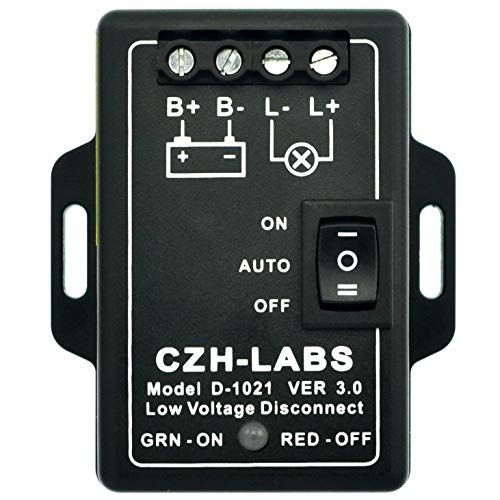
Best for: electronics-heavy setups where precise voltage cutoffs matter. It accepts DC 10 to 32V and provides adjustable disconnect/reconnect with an AUTO rocker switch setting. It includes an emergency ON/OFF function for immediate control.
- Auto disconnect below user-set voltage; auto reconnect when power returns
- Programmable disconnect and reconnect voltages
- Emergency ON/OFF for quick manual override
Why selected: The adjustable voltage settings and emergency override make this module well-suited for sensitive electronics and critical loads where precise protection is required.
Caution: Ensure the voltage range compatibility with your battery chemistry and system design to avoid unintended shutdowns.
Zuomeng 12V 30A LVD With Display
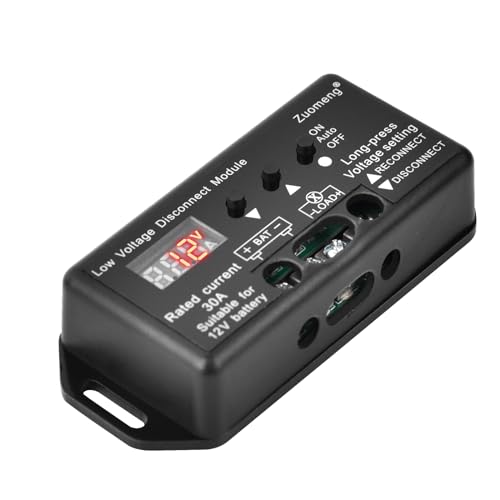
Best for: users needing precise 0.1V-adjustable thresholds and dual protection between the battery and load. It supports 12V systems up to 30A and provides both auto and manual modes with a multi-information display for real-time monitoring.
- Dual protection for battery and load; prevents deep discharge
- Precise 0.1V threshold adjustment
- Automatic reconnection after a short delay once voltage recovers
Why selected: Its fine-grained voltage control enables tailoring for critical systems where exact cut-off values matter, such as sensitive electronics or high-value batteries.
Buying Guide: Key Considerations For Choosing A Programmable Low Voltage Disconnect
What voltage range do you need? Most modules cover 10–32V or 12–36V. Match the range to your battery bank (lead-acid vs lithium) and project (solar, RV, marine, or remote sensor networks).
How precise must the cutoffs be? If your load is sensitive or you want to optimize battery life, choose a model with 0.1V precision (like Zuomeng) over broader thresholds.
Do you need an LCD display? A display helps monitor real-time voltage and thresholds, reducing guesswork during setup and maintenance (as seen in MgcSTEM and Zuomeng).
Is a memory feature important? Memory ensures settings survive power loss, saving configuration time and preventing accidental changes during outages (present in several models).
Mode options: automatic vs manual. Automatic mode protects runs without intervention, while manual mode gives explicit control when you need to override protections.
Physical protection and wiring: Look for durable housings and clear wiring diagrams. Some units are waterproof or encased for harsh environments and easier mounting (as noted in UTKFHT’s description).
FAQ
- What is a low voltage disconnect module used for?
It automatically disconnects a load when the battery voltage falls to a preset threshold to prevent deep discharge and extend battery life.
- Can these modules work with solar batteries?
Yes, many support lead-acid, lithium-ion, and solar panel batteries. Always verify the voltage range and current rating before pairing with solar storage.
- Do these modules include batteries?
No. They are protective switches that control the load; batteries must be supplied separately.
- What is the difference between auto and manual modes?
Auto mode disconnects automatically at the cutoff voltage; manual mode requires a user action to disconnect or reconnect, useful for controlled testing or specific operation scenarios.
- Is a memory function important?
Yes, memory preserves user settings after power loss, enabling a quick resume of protection thresholds without reconfiguration.
- How precise should the voltage thresholds be?
For critical equipment or long-term battery health, aim for modules offering 0.1V precision, which allows tight control over the discharge and reconnect points.