Best Programmable High Voltage DC Power Supplies for Lab Bench Use
Selecting a programmable high voltage DC power supply is essential for precise testing, electronics prototyping, and lab automation. This guide highlights five top options, detailing how they control voltage and current, offer memory storage, and integrate with PC software. Each product is evaluated for accuracy, protection, and ease of use to help you compare features and choose the right unit for your bench experiments.
| Product | Voltage Range | Current Range | Key Features |
|---|---|---|---|
| NICE-POWER DC Power Supply Variable, 200V 1A | 0–200 V | 0–1 A | RS232/USB control, encoder knob, memory storage, output switch, Windows software |
| Kiprim Programmable DC Power Supply 0–30 V 0–10 A | 0–30 V | 0–10 A | Multi-protection, 2.8″ LCD, memory presets, waveform outputs |
| NICE-POWER DC Power Supply Variable, 300V 1A | 0–300 V | 0–1 A | RS232/USB, encoder knob, memory, output switch, Windows software |
| Kiprim Programmable 400W DC Power Supply 0–60 V 0–20 A | 0–60 V | 0–20 A | Overvoltage/overcurrent/overheat protections, memory, waveform editor |
| Jesverty SPS-3010 0–30 V 0–10 A | 0–30 V | 0–10 A | 4-digit display, CV/CC auto-switch, USB interface |
Product 1: NICE-POWER DC Power Supply Variable, 200V 1A

The NICE-POWER 200V 1A programmable power supply provides adjustable output with computer control via RS232/USB after installing Windows software. It supports quick and accurate voltage/current adjustments, multiple memory values, data export, and programmable outputs. The encoder knob enables precise regulation, while the output switch protects the load. Four memory storage buttons enable fast recall of preset values, and a lock button helps prevent accidental changes. This unit is well-suited for experiments requiring repeatable high-voltage tests with simple PC integration.
Product 2: Kiprim Programmable DC Power Supply 0–30 V 0–10 A

This Kiprim model offers a compact 0–30 V and 0–10 A programmable supply with a 2.8-inch color LCD display. It includes overvoltage, overcurrent, and overheat protections, plus intelligent fan cooling. The device allows saving four channel parameter sets (M1–M4) and supports waveform output settings with 10 editable points. The combination of robust protections, memory presets, and waveform capabilities makes it versatile for lab bench testing and development work requiring precise control and monitoring.
Product 3: NICE-POWER DC Power Supply Variable, 300V 1A
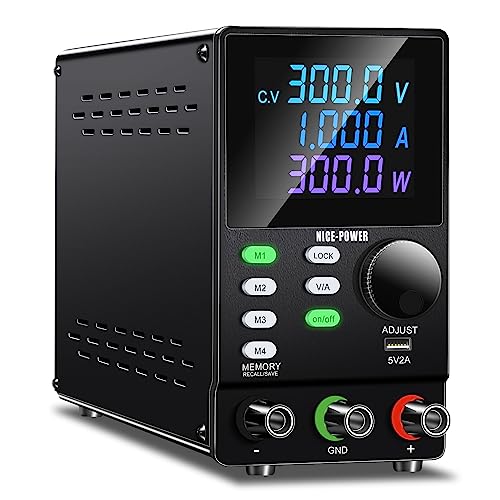
The 300V variant from NICE-POWER expands high-voltage capabilities while maintaining PC connectivity via RS232/USB. It offers encoder knob control, a four-button memory system, and a protective output switch. The Windows-based software enables data export and programmable outputs, supporting repeatable lab tests that require higher voltage levels. This model is suitable for precision high-voltage applications in electronics and instrumentation research where stability and software control matter.
Product 4: Kiprim Programmable 400W DC Power Supply 0–60 V 0–20 A
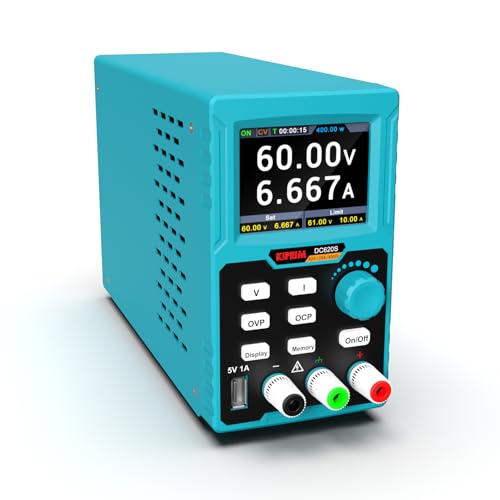
This high-power Kiprim unit covers 0–60 V and up to 20 A with a 4-digit display and comprehensive protections, including overvoltage, overcurrent, and overheat. The device supports Windows software, memory saving (M1–M4), and editable waveform outputs with 10 points per waveform. Note that the power limit may restrict simultaneous 60 V and 20 A operation. It is appropriate for demanding bench setups that require substantial current at higher voltage ranges, with programmable sequencing for automated testing.
Product 5: Jesverty SPS-3010 0–30 V 0–10 A

The Jesverty SPS-3010 offers a 0–30 V, 0–10 A output with a four-digit LED display showing voltage, current, and power in real time. It supports automatic CV/CC mode switching, ensuring stable operation as load conditions change. The unit includes a 5 V/2 A USB port for charging and auxiliary power for connected microcontrollers or measurement gear. Its straightforward interface, reliable regulation, and USB compatibility make it a practical option for general-purpose bench power needs with programmable potential.
Buying Guide: Key Purchase Considerations
- Voltage and current range: Match the supply to your typical test loads, ensuring headroom for safety and peak requirements.
- Programmable control: Evaluate whether RS232/USB interfaces or Windows-only software meet your automation needs; consider Modbus or other protocols if integration is required.
- Memory and sequencing: Look for multiple memory banks (M1–M4 or similar) and waveform editing capabilities for repeatable test setups and complex output profiles.
- Protection features: Prioritize overvoltage, overcurrent, and overheat protections, plus short-circuit and auto-cooling mechanisms to safeguard devices under test.
- Display and interface: A clear 4-digit or larger display helps monitor real-time values; encoder knobs aid precise adjustments during experiments.
- Connectivity and software: Windows-based software often allows data export and graphing; ensure compatibility with your lab PC and operating system version.
- Physical form and cooling: Higher power units may need robust ventilation or active cooling; plan placement on a bench with adequate air flow.
- Safety considerations: Proper isolation, grounding, and adherence to lab safety standards are essential when handling high voltage.
- Future needs: Consider potential upgrades or expansions, such as higher voltage ranges, additional channels, or more advanced waveform capabilities.