Best Programmable Bench Power Supplies for Precise Lab Testing
Answering the need for accurate, programmable bench power supplies, this guide highlights five models well-suited for electronics work, battery charging, and lab experiments. Each product section explains who benefits most, why it stands out, and a practical limitation to watch. Whether you’re building test rigs, repairing boards, or delivering reliable CV/CC power, these options help you manage voltage, current, and safety with clear control interfaces.
Summary table of chosen products:
| Product | Brand | Key Strength | Best For |
|---|---|---|---|
| DC Power Supply Variable, Bench Power Supply with Encoder Adjustment Knob | NANKADF | Precise encoder knob with voltage/current digits | Fine-grained control for calibrations |
| Jesverty SPS-3010 | Jesverty | 4-digit display with real-time CV/CC auto-switch | Auto CV/CC transitions during varying loads |
| UNI-T UDP3305S-E | UNI-T | Four channels with high resolution | Complex multi-channel testing |
| FNIRSI IPS3608 | FNIRSI | Low ripple, dual ports, PC programmability | Stable power for sensitive electronics |
| WANPTEK POWER DC Power Supply | WANPTEK POWER | Coarse & fine encoder, USB-C quick-charge | Rapid charging plus precise setting |
DC Power Supply With Encoder Knob and OCP

The NANKADF DC Power Supply emphasizes a high-precision encoder knob, enabling precise digit-by-digit adjustments for voltage and current (0–9 digits per step). It includes an Output Enable/Disable button to prevent accidental energizing of a load, and an overcurrent protection feature that can alert with a buzzer when a short occurs. It is best for technicians who need meticulous control during calibration tasks or sensitive testing where slight voltage drift matters.
Best for: electronics technicians performing delicate calibrations or lab bench work requiring exact digit selection. This model supports a straightforward on/off control and protective feedback to minimize risk during experiments.
Caution: OCP is available as a mode, but verify how the buzzer alert integrates with your test environment to avoid audible distractions in quiet labs.
Jesverty 0-30V 0-10A Adjustable Power Supply

The Jesverty SPS-3010 stands out with a 4-digit LED display showing voltage, current, and power in real time, with high resolution (0.01V, 0.001A, 0.1W). It automatically switches between constant voltage (CV) and constant current (CC) modes as the load changes, simplifying operation for variable-load projects. A USB 5V/2A port adds convenient charging or signaling capabilities for test rigs that require computer or peripheral power.
Best for: experimenters who need clear, continuous readouts and automatic cv/cc transitions when testing with fluctuating loads.
Caution: Data shows that the user-set voltage/current crossover governs mode switching; ensure your test scenario accounts for where the switch occurs to avoid unexpected mode changes during critical measurements.
UNI-T UDP3305S-E 4-Channel Programmable DC Power Supply

This multi-channel unit provides four independent channels with impressive setting accuracy: CH1/CH2 0–30V/0–5A, CH3 0–6V/0–3A, CH4 5V/2A. It supports fine resolution (10mV/1mA) and a total of 328W. USB, RS232, and LAN interfaces enable computer control and data logging, while a high-definition display shows set and actual values alongside protection statuses. It’s ideal for labs requiring synchronized or varied voltages across several loads.
Best for: researchers and instructors running parallel experiments or testing multiple devices in one bench setup.
Caution: The main channels are powerful; ensure proper wiring and load balancing to prevent accidental overcurrent on one channel while others are idle.
FNIRSI IPS3608 DC Power Supply
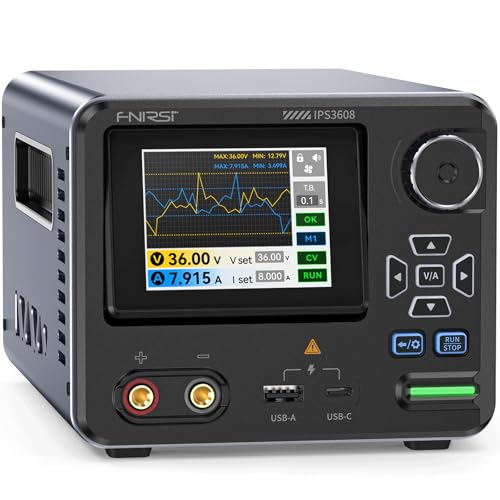
FNIRSI IPS3608 offers 36 V, 8 A, and an ultra-low ripple (<10 mV) output for sensitive electronics. It provides a dual USB port setup (USB-A and USB-C) to support PD, QC, and other fast-charging protocols, expanding its utility beyond bench power to quick device charging. It supports PC programmability with real-time display, curve recording, and preset management, aided by eight safeguards for safe operation. The aluminum shell improves cooling and shielding, contributing to reliable long-term use.
Best for: engineers who need a clean, stable output for precision electronics and a PC-software workflow for testing or data collection.
Caution: While USB-C PD is supported, verify compatibility with hardware that requires strictly controlled current limits to avoid unexpected voltage changes during charging.
WANPTEK POWER DC Power Supply With Encoder

The WANPTEK POWER unit features coarse and fine encoder knobs for rapid, precise voltage and current setting adjustments. It adds a 5V/3.6A USB Type-C fast-charging port to support quick device charging, making it a good fit for test benches that also need to recharge test devices. A notable benefit is its OCP and short-circuit alarms that help prevent damage to loads during fault conditions. It’s compact and portable, suitable for smaller workstations or field labs.
Best for: teams that value quick, precise setup with USB-C fast charging for auxiliary devices and a focus on protection during testing.
Caution: The Type-C port is fast-charging oriented; if your project requires high-precision CC control, test behavior under different loads to confirm it meets your CV/CC needs.
OWON SPE6103 Programmable Lab Power Supply

OWON SPE6103 delivers 0–60 V and 0–10 A on a single channel with a 2.8-inch LCD that displays voltage, current, and protection states. It includes an output enable/disable button for quick control and a suite of protections—limit current, thermal, voltage overload, short circuit, and over power—designed to protect both the unit and the test load. The USB port supports charging and firmware updates, enabling seamless integration into computer-controlled test setups.
Best for: laboratories needing robust protections and a straightforward interface for single-channel, programmable power delivery.
Caution: The device focuses on reliability and protection; for high-precision multi-channel tasks, consider models with multi-channel capability.
Buying Guide: Key Considerations for Programmable Bench Power Supplies
- Voltage and current range: Choose a unit that covers your typical test voltages and currents, with tight regulation and low ripple for sensitive electronics.
- Control interface: Encoders, coarse/fine knobs, and digital displays help accuracy. Consider how easily you can set and read values during workflows.
- Protection features: OVP, OCP, short-circuit protection, thermal protection, and alarms protect both the supply and load. Decide which protections matter most for your projects.
- Multi-channel vs single-channel: Multi-channel units simplify testing multiple loads in parallel; single-channel models are often more compact and affordable.
- Connectivity and data logging: USB, RS-232, or LAN interfaces enable computer control, remote operation, and logging for experiments and documentation.
- Portability and form factor: For compact benches or fieldwork, consider dimensions, weight, and heat dissipation (aluminum shells help cooling).
- USB-C and fast charging: If you need device charging in addition to bench power, ensure the USB-C port provides the required current and compatibility with PD protocols.
- Safety and user workflow: An Output Enable/Disable button or similar quick-control features improve safety and workflow efficiency during testing.
Frequently Asked Questions
- What is CV/CC mode and when is it used?
– Constant Voltage (CV) mode maintains a set voltage; Constant Current (CC) mode limits current and automatically switches when a load draws more current, preventing damage to load or supply during tests. - Why would I want multiple channels in a power supply?
– Multiple channels let you simulate several different loads simultaneously, or run parallel tests without swapping cables, improving testing efficiency and organization. - What does adjustable ramp or encoder control improve?
– Precise dial-based control reduces overshoot and helps set exact voltages or currents quickly, which is valuable in calibration and sensitive experiments. - Is there a risk using USB-C fast charging on a bench supply?
– USB-C fast charging is typically independent of bench voltage settings, but verify your load’s current needs and ensure the supply’s USB-C port is within safe operating limits for your device. - Can I program these supplies via a computer?
– Many models offer USB, RS-232, or LAN interfaces for real-time control, data logging, and automated testing—check the exact model specifications for compatibility. - What should I consider when choosing a power supply for a lab class?
– Prioritize safety protections, a readable display, reliable CV/CC switching, and clear documentation or software support for instructors and students.