Best Pressure Gauge With Switch for Reliable Monitoring
When selecting a pressure gauge with a switch, you want durability, accurate readings, and dependable on/off control for air compressors or water pumps. This guide highlights five top picks that pair a pressure gauge with a switch, offering clear monitoring and reliable operation in workshops, gardens, and DIY projects. Each option includes a robust interface, adjustable settings, and practical gauges to help prevent overloads and ensure smooth start-stop cycles.
The following summary table provides quick guidance on the five featured products, including brand and key specs captured from their listed features.
| Product | Brand | Pressure Range / Ports | Key Feature |
|---|---|---|---|
| QWORK Air Compressor Pressure Switch Control Valve | QWORK | 90-120 PSI; G1/4 | High-accuracy gauge; durable brass valve assembly |
| Solarhome Pressure Switch Gauge 05703110 | Solarhome | 0-75 PSI; 20P-75; 3N2780 | Compatibility with Murphy models |
| I.E.E Air Compressor Pressure Control Switch | I.E.E | 95-125 PSI; 4 ports | Unloader, on/off switch, robust construction |
| Secbolt Pressure Switch Manifold | Secbolt | 90-120 PSI; 1/4″ NPT; 4 ports | Adjustable out; dual pressure gauges |
| Dreyoo Air Compressor Pressure Switch | Dreyoo | 135-175 PSI; 4 ports; 1/4″ NPT | 0-200 PSI gauge; safety valve |
QWORK Air Compressor Pressure Switch

QWORK combines an ABS shell with an iron galvanized connector and brass control valve for durability and anti-corrosion performance. The assembly supports a G1/4 thread and covers a 90-120 PSI range, suitable for mid-range compressors. It includes a high-accuracy pressure gauge accessory to provide immediate, clear readings for monitoring. The unit runs on up to 240V and supports up to 20A maximum MAP current, aligning with common workshop requirements. This product emphasizes robust materials and precise monitoring for reliable operation.
Solarhome 05703110 Pressure Switch Gauge

Solarhome’s 05703110 gauge is designed for compatibility with Murphy 0-75 PSI models, offering a compact pressure switch gauge combination. The “20P-75, 3N2780” labeling indicates a tailored fit for certain pressure ranges and system configurations. This option is useful when replacing an aging or orphaned switch gauge in Murphy-style setups, delivering straightforward monitoring in a compact footprint.
I.E.E Air Compressor Pressure Control Switch

I.E.E’s pressure switch is a four-port control valve designed for 95-125 PSI operation. It features an integrated On/Off switch and an unloader option, making it versatile for standalone 2-stage or single-stage air compressors. The product notes indicate compatibility with various compressor frameworks and a straightforward installation path, enabling reliable cut-in and cut-out control while accommodating unloader preferences.
Secbolt 90-120 PSI Pressure Switch
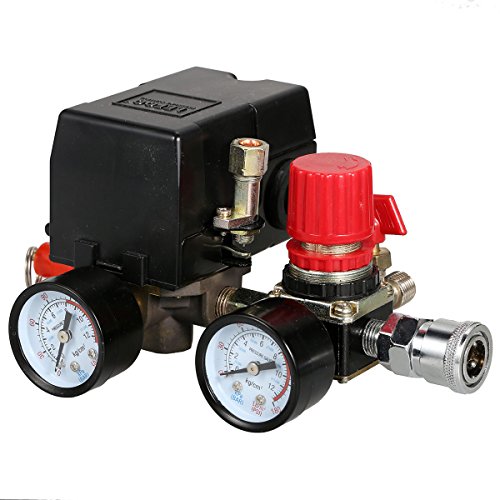
Secbolt’s manifold regulator gauges switch features a 90-120 PSI range with 1/4″ NPT ports and four female ports. It includes an adjustable air outlet, enabling customization of pressure delivery to gauges or tools. The assembly emphasizes heavy-duty construction and integrated gauges for monitoring, suitable for users who want adjustable control alongside reliable readings in a compact, multi-port format.
Dreyoo 135-175 PSI Pressure Switch
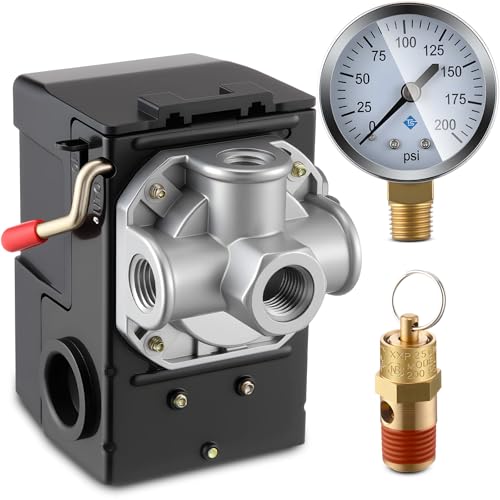
Dreyoo offers a 135-175 PSI pressure switch with four ports and a 0-200 PSI gauge, paired with a 200 PSI brass safety valve. The switch operates on 110-120V and includes a precise factory preset with a red-lever adjustment for cut-in and cut-out pressures. A universal 1/4″ NPT interface supports diverse pneumatic components, making it a flexible option for both two-stage and single-stage compressors and DIY systems. Real-time monitoring is aided by a gauge with tight tolerance.
Buying Guide: Key Considerations and Comparisons
When choosing a pressure gauge with a switch, consider these factors to ensure compatibility with your equipment and reliability over time.
- Pressure range and port size: Match the switch’s PSI range to your equipment’s operating window and verify the port size (commonly 1/4″ NPT) for proper connections.
- Gauge accuracy and readability: Look for clear, easy-to-read gauges and a return-to-zero mechanism to minimize drift and misreads during operation.
- Material quality and corrosion resistance: ABS shells, brass valves, and galvanized connectors improve durability in workshop or outdoor environments.
- Unloader and safety features: An unloader valve can reduce starter load, while safety valves prevent over-pressurization. Consider models with these features if your system is prone to rapid pressure changes.
- Number of ports and adaptability: Four-port designs offer flexibility for multiple gauges, regulators, or valves; ensure the ports match your existing components.
- Electrical specifications: Check voltage and current ratings to ensure compatibility with your power supply and to avoid overloads.
- Installation and maintenance: Look for straightforward wiring, easy access to gauges, and components that are widely available for replacements.
Across the selections, the emphasis is on reliable pressure monitoring combined with switch control, enabling safer operation, steady start/stop cycles, and simpler maintenance in DIY projects, home workshops, or field setups. The five products chosen provide a mix of universal interfaces, gauges, and safety features to accommodate a range of pneumatic and water-pump applications.