Best Pressure Gauge for Water: Accurate Readings for Home, Garden, and RV Applications
When maintaining water systems—from home plumbing to irrigation and RV hookups—an accurate pressure gauge is essential. The right gauge helps you monitor supply pressure, detect spikes, and prevent damage to fixtures. Below you’ll find five reliable water pressure gauges selected for accuracy, durability, and ease of use. Each section includes a quick look at features and how it suits different needs, followed by a practical buying guide to help you choose confidently.
| Product | Dial Size | Thread | Key Benefit |
|---|---|---|---|
| CARBO Instruments 2-1/2″ Water Pressure Test Gauge | 2.5″ | 3/4″ Female Hose Thread | Peak memory with corrosion-resistant case |
| MEASUREMAN 0-200 PSI Water Pressure Gauge | 2-1/2″ | 3/4″ Hose Thread | Wide 0-200 PSI range with reliable brass fittings |
| SENCTRL 0-200 Psi Water Pressure Gauge Test | 2.5″ | 3/4″ Female Garden Hose Thread | Lead-free, stainless steel case; anti-fog design |
| MEASUREMAN 2-1/2″ Water Pressure Test Gauge | 2.5″ | 3/4″ Female Hose Thread | Maximum pressure memory and durable build |
| Watts 2-1/2″ Hose Connection Water Pressure Test Gauge | 4″ (Overall) / 2.5″ dial | 3/4″ HT Hose Connection | Copper alloy sensing with clear window and red indicator |
CARBO Instruments 2-1/2″ Water Pressure Test Gauge

The CARBO Instruments gauge covers 0-200 PSI (0-14 Bar) with ±2.5% accuracy and a peak memory feature that records the highest pressure. A rust-free, corrosion-resistant case houses a brass connector and copper internals, delivering durability in outdoor or indoor environments. The 3/4″ standard hose thread ensures easy connection to spigots, faucets, or irrigation lines without tools. Its compact 2.5″ dial is well-suited to residential plumbing tasks, RV camping setups, and garden testing.
MEASUREMAN 0-200 PSI Water Pressure Gauge

MEASUREMAN’s 2-1/2″ dial and 3/4″ hose thread offer broad compatibility for home testing, garden hoses, and irrigation lines. The 0-200 PSI range supports typical residential water systems, delivering precise readings essential for diagnosing pressure problems, calibrating fixtures, or verifying supply levels. The brass fittings and robust construction emphasize reliability for frequent use in testing and monitoring water lines, with a focus on straightforward installation and durable performance under varying conditions.
SENCTRL 0-200 Psi Water Pressure Gauge Test

This SENCTRL model emphasizes durability and moisture resistance with a 304 stainless steel case and lead-free wetted parts. Its IP67 waterproof rating and vent design help prevent fogging and moisture damage, making it suitable for outdoor installations or damp environments. The device measures 0-200 PSI with a clear dual-scale readout and corrosion-resistant components, including brass and stainless steel wetted parts. It’s a strong option for potable water testing, RV water systems, and irrigation setups where moisture exposure is a concern.
MEASUREMAN 2-1/2″ Water Pressure Test Gauge
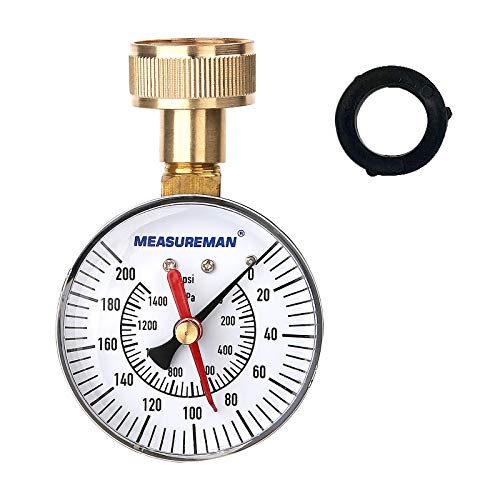
This MEASUREMAN gauge features a large 2.5″ dial, 3/4″ hose thread, and a 0-200 psi/kPa range with a maximum pressure memory. The combination of a clear, legible display and sturdy brass fittings supports reliable monitoring in irrigation lines, home water tests, and seasonal maintenance. The design prioritizes straightforward installation and durable performance, making it a practical choice for both new installations and routine checks.
Watts 2-1/2″ Hose Connection Water Pressure Gauge

The Watts gauge uses a copper alloy Bourdon tube for dependable sensing, housed in a black enamel steel case with a Kostil polymer window and a red indicator hand that marks the highest reading. With a 3/4″ hose connection and ASME Type B accuracy, this model is well-suited for testing water distribution systems, residential lines, and garden hose connections. The durable build and clear display help users quickly identify pressure deviations and take corrective action.
Buying Guide: Key Considerations For Choosing A Water Pressure Gauge
- Pressure range: Most residential systems fall within 0-200 PSI, but verify your setup before buying. A gauge with a broader range can accommodate spikes in irrigation or pump startups, while a narrower range can provide more precise readings in typical conditions.
- Dial size and readability: Larger dials (2.5″ or 4″) offer easier reading from a distance. Consider the environment where the gauge will be used—outdoors or tight spaces—and choose a size accordingly.
- Thread type and installation: Common options include 3/4″ female hose thread and 1/4″ NPT. Ensure compatibility with your faucets, spigots, or irrigation components. Some models offer quick-connect fittings for tool-free setup.
- Materials and durability: Look for brass wetted parts and stainless steel or corrosion-resistant housings for longevity in damp or outdoor locations. Glycerin-filled options can dampen pointer flutter in vibrating systems.
- Accuracy and memory features: ASME accuracy standards (e.g., Type B) and peak memory (maximum pressure memory) help track spikes. Decide whether you need real-time readings or peak monitoring for fault detection.
- Moisture resistance: If the gauge will be exposed to rain or splashes, IP ratings and rubber seals matter. Some models have anti-fog windows to maintain legibility in humid conditions.
- Application compatibility: Consider whether the gauge will test potable water, irrigation lines, RV tanks, or well pumps. Lead-free options are preferable for drinking water systems.
- Installation location: Indoor installations may not require waterproof features, but outdoor or soil-exposed setups benefit from weatherproof casings and sealed connections.
In summary, select a gauge with the right pressure range, compatible thread size, durable materials, and readability for your specific water system. If you often monitor peak events or pressure spikes, prioritize gauges with maximum memory and clear indication features. For damp environments, stainless steel or lead-free options with waterproof designs offer added assurance against corrosion and moisture damage.