Best Portable Outlet UPS Battery Solutions for Home and Office
If you need reliable short‑term power for a computer, modem, or router during outages, a portable UPS with built‑in outlets is the right choice. These units provide battery backup and surge protection to keep essential devices running and allow safe shutdowns. The top picks below target different needs: compact setups for low‑power devices, mid‑range capacity for a small office, and more robust options for home entertainment and networking gear. The following table highlights the chosen products and who they suit best.
| Product | Best For | Key Strength |
|---|---|---|
| APC UPS Battery Backup BE600M1 | Home office with router and computer | Six outlets with mixed battery backup and surge protection |
| CyberPower CP1500PFCLCD | Small business or home office with multiple devices | 12 outlets, PFC sinewave for active power supplies |
| CyberPower ST425 Standby UPS | Compact setups needing essential protection | Eight outlets, compact design |
| APC Back-UPS BE425M | Router, modem, and light office gear | Six outlets, small footprint |
| CyberPower SL700U | Slim, space‑conscious setups | Slim profile with eight outlets |
APC UPS Battery Backup BE600M1 (600VA/330W)
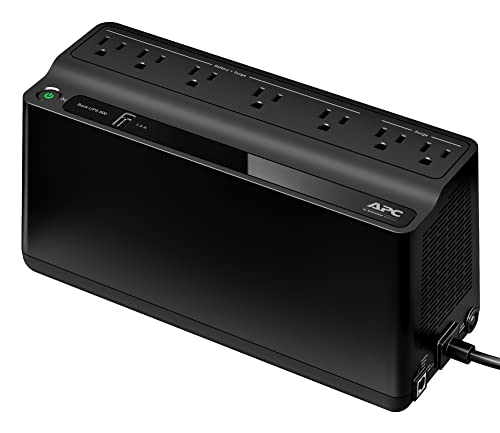
Best for: Home offices needing reliable short‑term power for a computer, router, and modem. The BE600M1 provides 5 battery backup outlets and 2 surge‑only outlets, offering protection during outages and everyday power events. It delivers about 23 minutes of runtime at a 100W load, which helps with safe shutdowns and continued internet access during short outages.
Why selected: It combines essential battery backup with scalable surge protection in a compact footprint. The unit is well‑suited for desks with multiple devices that rely on steady connectivity.
Caution: Runtime varies with load; devices drawing more than 100W will reduce battery time. Use the surge‑only outlets for less critical gear to maximize battery life.
CyberPower CP1500PFCLCD PFC Sinewave UPS (1500VA/1000W)
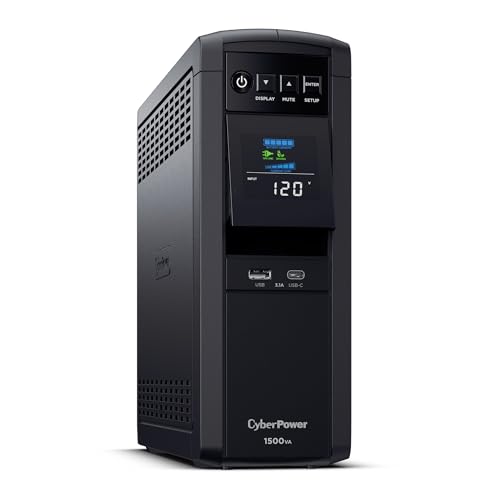
Best for: Offices with active PFC power supplies and multiple networked devices. This model offers 12 outlets with six backed by battery and surge protection and six surge‑protected outlets, plus USB ports for charging mobile devices. A color LCD panel shows battery and power conditions in real time.
Why selected: Its high capacity and sinewave output help protect sensitive equipment during outages and power fluctuations, making it a strong choice for workstations and networking gear.
Caution: Heavier and larger than smaller units; consider space and cable management in compact desks or wall setups.
CyberPower ST425 Standby UPS (425VA/260W)

Best for: Small home offices and home entertainment setups with modest power needs. The ST425 provides 8 outlets with a mix of battery backup and surge protection, ideal for protecting a router, modem, and a compact PC or streaming device.
Why selected: Its standby design keeps costs and space down while still delivering reliable backup for essential devices. The LED indicator helps monitor status and potential wiring faults.
Caution: The unit uses a simulated sine wave output, which is fine for most devices but not optimal for high‑end audio or sensitive lab equipment.
EnginStar Portable Power Station 300W (296Wh)

Best for: Outdoor use, emergency prep, and travel where you need multiple outputs in a compact form. It provides 296Wh capacity, two 110V pure sine wave AC outlets, USB ports, and DC outputs for versatility.
Why selected: It combines portability with a multi‑port approach, allowing charging for phones, laptops, CPAP machines, and small appliances during outages or outdoor activities.
Caution: The device is a portable power station and not a traditional UPS; it switches to battery power but may require planning for longer outages and recharging needs.
APC Back-UPS BE425M (425VA/255W)

Best for: Home routers, modems, and light office gear requiring dependable backup in a compact form. The BE425M provides six outlets with a mix of battery backup and surge protection, suitable for essential devices.
Why selected: It offers a small footprint with reliable power for critical network equipment, ensuring connectivity during brief outages.
Caution: Runtime is limited at higher loads; pair with surge‑only outlets for nonessential devices to maximize battery time.
LIBRIDS Portable Power Station C600 (640Wh)

Best for: Camping, home backup, and outages where you need multiple AC outlets and USB ports without a fixed UPS form factor. The C600 provides 600W continuous output with a 640Wh capacity and 8 ports (4 AC) for flexible charging and powering needs.
Why selected: It combines a high‑capacity LiFePO4 battery with versatile charging and multiple output ports for off‑grid or emergency use. Its fast recharge helps when plans change quickly.
Caution: This is a portable generator rather than a wall‑mounted UPS; startup surges for high‑draw appliances may require careful management.
Buying Guide: What To Consider When Choosing A Portable Outlet UPS Battery
- Power needs: Assess total wattage of devices you want to run during an outage. Choose a unit with a higher VA/W rating than your combined load for headroom.
- Battery backup vs. surge protection: Decide if you need batteries for a graceful shutdown or just surge protection for device longevity in daily power fluctuations.
- Runtime expectations: Budget for runtimes that cover the typical outage duration you face. Short outages require quick recharge cycles; longer outages benefit higher capacity.
- Number and arrangement of outlets: Ensure enough battery‑backed outlets are available for critical gear. Consider transformer‑spaced outlets for bulky adapters.
- Form factor and portability: Slim or compact models fit small desks, while larger units suit a home office or media setup.
- Display and monitoring: A color LCD or clear indicators help track battery status and potential faults before downtime occurs.
- Compatibility: If your equipment uses active PFC or nonstandard plugs, a sinewave output or more outlets may matter for stable operation.
Frequently Asked Questions
- What does VA mean on a UPS and why does it matter?
– VA (volt‑amps) indicates apparent power capacity; matching it to your wattage needs helps ensure the UPS can handle startup surges and running loads. - Should I choose a sinewave or simulated sinewave UPS?
– Sinewave (true or simulated) is better for sensitive electronics. For basic modems and routers, either type can suffice, but higher‑end devices benefit from sinewave output. - How long will a UPS power my devices during a outage?
– Runtime depends on load and battery size. Lighter loads extend runtime; heavy devices shorten it. Refer to each product’s documented runtime at typical loads for planning. - Can a portable UPS back up my Wi‑Fi network during a storm?
– Yes, many models include surge protection and dedicated outlets for routers and modems to keep connectivity during outages. - Is a portable power station a UPS?
– Portable power stations provide battery power for many devices but are not always designed as UPS backs for rapid switching. They excel in off‑grid or outdoor scenarios but may differ in transition time and charging methods.