Best Portable Monocrystalline Solar Panels for Off-Grid Power on the Go
When shopping for portable monocrystalline solar panels, the best choice depends on your intended use, power needs, and climate. This guide highlights five top, foldable options that balance high efficiency with travel-friendly design. Ideal buyers include RV travelers, campers, outdoor enthusiasts, and emergency backup planners seeking reliable solar charging for power stations and 12V systems.
Summary of selected products
| Product | Best For | Key Benefit | Notable Limitation |
|---|---|---|---|
| GRECELL 200W Portable Solar Panel | RVers and blackout prepper | High efficiency 23.5% with ETFE; IP65 waterproof | Requires controller and wiring for full setup |
| Renogy 200W Portable Solar Panel | Compact campers | 25% efficiency; light and compact with magnetic closure | Requires compatible ports for full power station use |
| DOKIO 200W Portable Foldable Solar Panel Kit | Emergency kits and travelers | Separate controller for safe charging; long 3m cable | Includes controller but may need mounting considerations |
| VEVOR 200W Foldable Solar Panel | Multi-device charging | 24% efficiency; multiple ports including Type-C | Heavier than some compact rivals |
| ZOUPW 450W Portable Solar Panel | High-demand power stations | High power in a portable foldable unit; 45V input design | Heavier; not for ultra-light travel |
Below you will find detailed product sections to help you compare features, compatibility, and practicality for your outdoor power setup.
GRECELL 200W Portable Solar Panel Review

The GRECELL 200W panel uses 6-layer ETFE lamination and built-in monocrystalline cells to deliver up to 23.5% conversion efficiency. It is designed as a ready-to-go off-grid solution with a robust IP65 waterproof rating and a weather-resistant 840D Oxford cloth exterior. Best for outdoor enthusiasts who plan to rely on solar power in variable weather and want durability in a compact foldable format. The kit is widely compatible with most power stations via a separate 4-in-1 cable; a charging controller and 12V battery compatibility are supported, though these parts are not included in the base panel. Caution: Do not leave the panel soaking in water or directly under heavy rainfall for extended periods.
Who it’s best for: Outdoor adventurers, campers, and emergency planners seeking a rugged, weather-resistant panel that can pair with a wide range of power stations.
Renogy 200W Portable Solar Panel Overview

Renogy advertises industry-leading 25% efficiency with 16BB N-Type cells for higher output in less space. The panel weighs about 13.89 lbs and folds to a compact size with a magnetic closure for quick setup, making it ideal for SUVs, campers, and compact power stations. It supports charging multiple devices at once (USB-C PD, USB-A ports) and includes MC4 output for direct power station charging. Best for users who need faster energy generation in constrained spaces and straightforward battery or generator charging. Limitation: The magnetic closure is a feature choice—ensure secure packing if traveling rough terrain.
Who it’s best for: Small-space campers and tech users who value high efficiency and easy transport.
DOKIO 200W Portable Foldable Solar Panel Kit

The DOKIO 200W kit includes a standalone PWM controller, offering safe charging for 12V batteries and power stations. A 9.7 lb foldable panel with a 3 m long cable enables flexible setup, letting you place the panel in direct sun while keeping the controller shaded. This setup is best for travelers who want safe, replaceable controller hardware and easy mounting options. Limitation: The included controller may require future upgrades as power needs grow.
Who it’s best for: RV travelers and emergency kits that prioritize safe charging and upgrade flexibility.
VEVOR 200W Foldable Solar Panel for Multi-Device Charging
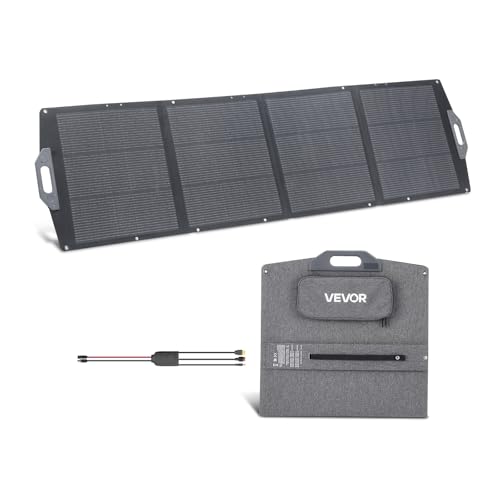
VEVOR combines 24% high-efficiency monocrystalline cells with a foldable design and multiple output ports: USB-A, USB-C, and DC. The panel includes a built-in MC4 cable and a 3-in-1 connector that supports XT60, Anderson, and DC5521. It’s well-suited for charging several devices or power stations simultaneously, and the IP67 rating further protects against moisture. Best for users who want flexible charging options and multi-device compatibility. Caution: Heavier panels can be tougher to carry for hikers with limited payload capacity.
Who it’s best for: Campers and preppers who prioritize charging multiple devices at once and versatile connector options.
ZOUPW 450W Portable Solar Panel For High-Demand Power

The ZOUPW 450W panel uses next-gen N-Type 16BB technology and maintains up to 25% efficiency under varying light, with a 45.9V open-circuit voltage designed for large power stations. It weighs about 29.5 lbs and includes four adjustable kickstands for optimal sun angles. This model is best for users who need substantial power and have room to handle a heavier, high-output unit. Limitation: Not ideal for ultra-light backpacking or very tight travel scenarios due to weight.
Who it’s best for: Serious off-grid setups and large power stations requiring substantial daily output.
Buying Guide: How To Choose The Right Portable Monocrystalline Panel
What should you consider first?
- Power needs: Estimate daily energy usage and match panel wattage to your power station or 12V system.
- Portability: Decide between compact, lightweight panels and higher-output, heavier models based on travel style.
- Efficiency: Higher efficiency panels produce more power in limited sun; consider monocrystalline over polycrystalline for better performance in shaded or cool conditions.
- Durability and weather rating: Look for IP ratings and protective lamination (ETFE preferred) for outdoor use.
- Compatibility: Check if the panel includes MC4 outputs and whether it supports your power station’s input connectors (XT60, Anderson, DC, etc.).
- Setup and safety: Consider whether a separate controller is included or if you’ll use an external charge controller with your battery system.
What configuration should you choose for an RV setup?
RV users often benefit from a balance of weight, foldability, and multi-port charging. A 200W panel with IP65 protection and MC4 output is a strong general choice, paired with a compatible power station and a reliable charge controller. For larger energy needs, consider higher-wattage panels like 450W, provided you can manage the weight and space.
Is it better to pick a panel with built-in ports or to rely on external adapters?
Panels with multiple ports (USB-C, USB-A, DC) reduce dongles and adapters, enabling direct device charging. However, ensure your power station or battery system can handle the power input. If you already own a diverse set of devices, a panel with universal connectors (XT60, Anderson, DC) can improve compatibility and future-proofing.
How important is durability for off-grid use?
Durability matters more than looks. ETFE lamination offers better light transmission and chemical resistance than PET, along with waterproofing advantages. A rugged outer shell and padded carrying options help when you move between campsites, boats, and vehicles.
FAQ
- What is the most efficient portable solar panel size for camping? Answer: A 200W foldable panel offers a good balance of weight, portability, and power for most camping setups, though a higher-watt option may be needed for larger power stations.
- Do all portable panels require a separate charge controller? Answer: Not always. Some panels include a stand-alone controller; others require external controllers compatible with your battery system.
- Is IP65 waterproof enough for outdoor use? Answer: IP65 protects against water jets and dust; it is suitable for outdoor use but should not be submerged or left in heavy rain.
- Can a 450W panel be used with small power stations? Answer: Yes, but ensure the station’s input voltage and current are compatible with the panel’s open-circuit voltage and amperage.
- Are monocrystalline panels better in low light? Answer: Yes, monocrystalline cells generally perform better in low light and high-temperature conditions than polycrystalline cells.
- What should I look for in a travel-friendly solar panel kit? Answer: Portability, efficiency, durability, multiple output options, and compatibility with your power station or battery system.