Best Portable and Static Generators for Every Situation
If you’re choosing between portable and static generators, the best option depends on your power needs, mobility, and environment. This guide highlights five solid picks across portable inverter generators, power stations, and solar-powered models. It’s ideal for campers, homeowners seeking backup power, and emergency prep supplies. Each product section explains who it’s best for, plus practical pros and limits to help you compare quickly.
Reference Table: Selected Products
| Product | Brand | Type | Best For | Key Benefit |
|---|---|---|---|---|
| Oxseryn Power Equipment 4400 Watts Inverter Generator | Oxseryn | Gas Portable Inverter | RV owners and home backup | High output with long runtime |
| EnginStar Portable Power Station, 300W | EnginStar | Solar/AC Portable Power Station | Off-grid trips and camping | Lightweight yet capable power bank |
| MARBERO 237Wh Solar Generator | MARBERO | Portable Solar Generator | Outdoor adventures | Solar panel included for off-grid charging |
| Champion Power Equipment 4000-Watt RV Ready | Champion Power Equipment | Gas Portable Inverter | Camping and backup | Quiet operation and lightweight for its class |
| Westinghouse 2550 Peak Watt Inverter Generator | Westinghouse | Gas Portable Inverter | Home backup and travel | Quiet, fuel-efficient, parallel capable |
Oxseryn 4400 Watts Inverter Generator

- Best For: RVs, outdoor events, and home backup needs with moderate runtime.
- Why Selected: High continuous output (3400 running watts) with 14-hour runtime at 25% load and ECO mode keeps fuel use reasonable during longer camping trips.
- What To Expect: Open-frame design suited for portability; includes multiple outlets for versatility.
- Caution: Real-world runtime depends on load; high draw reduces runtime as with any inverter model.
EnginStar Portable Power Station, 300W
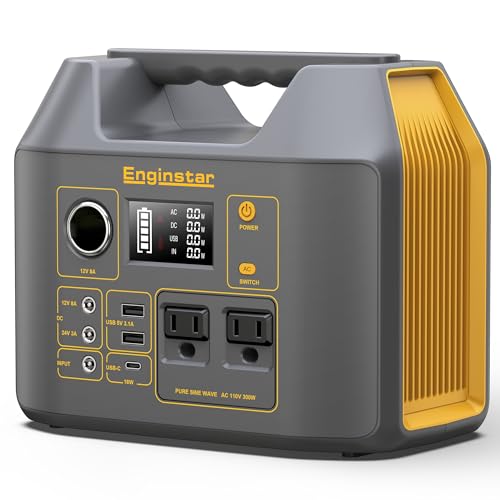
- Best For: Weekend camping trips, CPAP users, and off-grid travelers who need a compact power source.
- Why Selected: Pure sine wave AC outlets plus USB-C and USB-A ports provide clean, safe power for electronics and small appliances.
- What To Expect: 296Wh capacity with multiple charging options and a bright LCD display for easy monitoring.
- Caution: Not designed for high-wattage appliances; best for small devices and essential electronics.
MARBERO 237Wh Solar Generator With Panel

- Best For: Off-grid excursions where solar charging is a priority and small devices need running power.
- Why Selected: Solar panel included, multiple outputs (AC, USB, DC) for flexible device charging; LED flashlight adds utility in emergencies.
- What To Expect: 237Wh battery and 300W peak rating suitable for charging phones, small laptops,lights, and small fans.
- Caution: Can’t handle high-wattage appliances; plan usage around low-to-moderate power needs.
Champion Power Equipment 4000-Watt RV Ready

- Best For: Home backup and RV setups needing reliable power with quiet operation.
- Why Selected: Inverter technology with quiet performance under 64 dBA at 23 feet and up to 10 hours runtime, plus CO Shield safety feature.
- What To Expect: Lightweight for its class, with optional parallel kit to double output when needed.
- Caution: Noise and emissions vary with load; parallel operation requires compatibility checks with other units.
Westinghouse 2550 Peak Watt Inverter Generator

- Best For: Home backup and travel where quiet operation and fuel efficiency matter.
- Why Selected: Parallel capable and light enough at around 42 pounds, with 12-hour run times on modest loads and 3% THD.
- What To Expect: Two USB outlets and versatile AC options; economy mode helps stretch fuel usage for extended outages.
- Caution: Peak watts accommodate short surges; extended high-load use may require larger models.
Buying Guide: How To Choose A Generator
What will you power and where will you use it? Start with watts needed. For lights, phones, and small appliances, a 300–600W power station or inverter can be sufficient. For camping, RVs, or home backup where more power is required, consider 2000–4000W inverter generators or portable power stations with higher capacity and multiple ports.
- Power Type: Inverter generators deliver clean, stable output ideal for electronics. Solar generators rely on built-in batteries and panels for off-grid charging but may limit continuous high-wattage use.
- Fuel And Run Time: Gas models require refueling; look for ECO or economy modes to maximize efficiency. Battery-powered units depend on charge and charging methods (wall, solar, car).
- Portability: Weight and size matter for frequent transport. Parallel capability lets you boost output when needed.
- Outlets And Compatibility: Check for AC outlets, USB ports, DC outputs, and RV-specific plugs if you have an RV or camping setup.
- Noise And Emissions: Quieter units are preferable for camping and indoor use. Consider dBA ratings and auto shutoff safety features.
What To Consider By Buyer Intent
- Emergency home backup: prioritize higher wattage, fuel efficiency, and parallel capability.
- RV or camping: look for portability, low noise, and multiple ports for devices on the go.
- Off-grid solar charging: solar generator kits with included panels provide independence and quiet operation.
Quick Comparison At A Glance
- Best Overall For Home Backup: Champion 4000-Watt RV Ready (quiet, scalable with parallel kit).
- Best For RV/Travel: Westinghouse 2550 Peak Watt (quiet, compact, versatile).
- Best For Off-Grid Charging: MARBERO 237Wh Solar Generator (panel included, versatile ports).
- Best Light and Portable Power: EnginStar 300W Power Station (compact, multiple outputs).
- Best Value For Power On The Go: Oxseryn 4400 Watts Inverter Generator (high output with ECO mode).
FAQ
- What size generator do I need for essential home backup? A: Determine your essential wattage—things like lights, fridge, and modem—and select a model that can handle that load, ideally with some headroom.
- Should I choose a solar generator or a gas inverter? A: Solar generators are quiet and emission-free but may limit continuous high-wattage use. Gas inverters handle heavier loads and longer runtimes with refueling.
- Can I run a generator indoors? A: No. Always use generators outdoors and away from doors and windows due to carbon monoxide risk.
- Is parallel operation worth it? A: Yes for expandable power. It allows pairing two units to double available wattage when needed.
- What maintenance is required? A: For gas units, check oil levels, air filters, and spark plugs. For solar/battery units, follow battery care and storage guidelines to maximize life.
- Do all models come with a flashlight or USB ports? A: Many do; check each product’s outlet configuration to ensure it matches your device charging needs.