Best Portable a/C With Water Cooling for Hot Rooms and Dorms
Answering the search for portable air conditioners that use water to cool, this guide highlights five compact units designed for bedrooms, offices, dorms, and small living spaces. Each option emphasizes energy efficiency, simple setup, and evaporative cooling without window installation. The top picks are best for renters, budget-conscious buyers, and those seeking easy maintenance. Below, compare who each model is best for, how they cool, and practical limitations to consider before buying.
Product Comparison Snapshot
| Product | Best For | Key Strength | Limitation |
|---|---|---|---|
| MELOPHY Portable Air Conditioner | Bedrooms and small apartments | Large 2.5 gal tank; faster cooling | Ice packs required for peak cooling |
| ZEUDRJK Portable Air Conditioner | Home offices and studios | High airflow up to 2000 CFM; tall tank | Requires ice packs for extra chill |
| COOLECH 4-in-1 Windowless A/C | Dry climates and dry rooms | Smart water alerts; four modes | Relies on evaporative cooling; effectiveness varies with humidity |
| PUUXUMIC Portable Ice Fan | Desks, deskside cooling | Ultra-compact; multiple modes | Small capacity; cooling range limited by size |
| LIFECREEK 3-in-1 Evaporative A/C | Bedrooms and home offices | Top-fill 3.2 gal tank; remote | Water tank and ice packs needed for best effect |
MELOPHY 60W Evaporative Portable AC With 2.5 Gal Tank

Best for: small bedrooms or dorm rooms where quick cooling and low energy use matter. This unit emphasizes a high-torque motor and larger air outlet to boost wind speed, while its 2.5 gal tank extends cooling beyond a full day with ice packs. It’s a plug-and-play option, suitable for renters who want no installation. The two-tank refill approach simplifies maintenance for seniors or busy households. A limitation is that adding ice packs in both tanks can significantly boost cooling, but you’ll still see stronger effects with higher humidity.
ZEUDRJK Evaporative AC With 2.5 Gal Tank

Best for: larger rooms or small studios requiring extended cooling. This model claims up to 59°F reduction through efficient water evaporation, with a large 2.5 gal tank and 24-hour run time. It uses no window hose, making it ideal for apartments and spaces without easy venting. A potential drawback is that evaporative cooling effectiveness drops as humidity rises, so performance may vary in damp climates.
COOLECH 4-in-1 Windowless Evaporative Cooler
Best for: dry climates in the Southwest or Texas. This windowless cooler functions as a fan, humidifier, and air cooler with smart water alerts to prevent dry-out. It offers four modes and four speeds for customized cooling, plus a waterless alert system. Limitations include the reliance on evaporative cooling—performance declines with higher humidity and in larger, enclosed spaces.
PUUXUMIC Portable Ice Fan With 1500ml Tank

Best for: personal desk cooling or small office nooks. This compact device combines a portable AC, humidifier, fan, and night light. It features three speeds and two mist modes with a 1500 ml tank for several hours of misting. It’s ideal for close-proximity cooling, but the small water capacity means more frequent refills if used at maximum mist settings.
LIFECREEK 3-in-1 Evaporative A/C

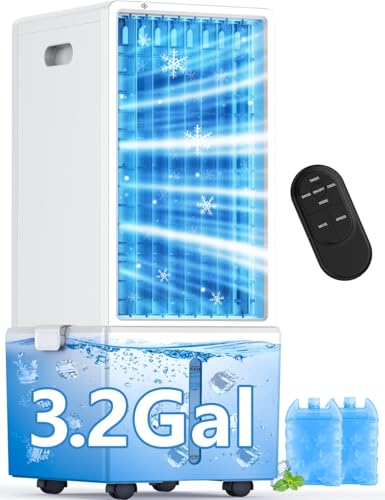
Best for: bedrooms and small home offices needing a 3-in-1 setup. This unit combines cooling, humidifying, and a fan with a 3.2 gallon tank and remote control. An advantage is the top-fill design for easier refills, with ice packs included to boost chill. The caveat is that performance depends on ambient humidity and air circulation; in very humid rooms, evaporative cooling is less effective.
Buying Guide: Key Considerations For Water-Based Portable A/Cs
What should you check before choosing a water-based portable air conditioner? Consider room size, climate, and how you plan to use the unit. Evaporative coolers work best in dry environments with good air movement and are typically cheaper to run than traditional ACs.
What room size is appropriate?
Most portable evaporative units cover up to 200–300 square feet with strategic placement. If your space is larger, consider models with higher airflow ratings or plan for multi-room cooling strategies.
How does climate affect performance?
In dry climates, evaporative cooling lowers air temperature effectively. In high humidity, cooling benefits diminish, so pairing with a dehumidifier or selecting a model with higher airflow may help.
Tank capacity and refill needs
Look for larger tanks (2.5–3.2 gallons) and dual-refill options to minimize interruptions. A top-fill design reduces spills during refills and is convenient for daily use.
Energy usage and noise
Most of these units use around 60W, which reduces electricity costs. Noise levels vary; models with bladeless designs or optimized fans tend to be quieter, suitable for bedrooms and workspaces.
Flavor of features to expect
- Ice packs or ice cubes for peak cooling
- Multiple modes (Normal, Natural, Sleep, Cool)
- Remote control and timers for convenience
- Water level indicators and smart alerts
Maintenance considerations
Remove and clean water tanks regularly, replace ice packs when needed, and monitor water levels to avoid mold or mineral buildup. Removable tanks simplify cleaning and refilling.
Frequently Asked Questions
- Do water-based portable ACs actually cool like traditional ACs? They cool primarily through evaporation and are most effective in dry environments; expect noticeable cooling rather than instant air conditioning.
- Is it safe to use around kids and pets? Many units have bladeless designs and are designed for safe operation, but supervision is advisable, and a water-based unit should be kept clean to avoid mold.
- Do I need installation? No. These units are designed to be plug-and-play and windowless, requiring only a power source and water refills.
- How often should I refill water? It depends on usage and tank size; larger tanks extend runtime between refills, especially with ice packs for stronger cooling.
- Can these cool multiple rooms? They are best suited for single rooms or small office spaces; for multiple rooms, consider a higher-capacity model or dedicated units per space.
- Do they require a window or vent? No. These windowless models are designed to cool without external venting, which is ideal for renters.