Best Portable Battery-Powered Air Conditioners for on-the-Go Cooling
If you’re shopping for portable, battery-powered cooling, you want compact units that run on USB or built-in batteries without needing a wall outlet. This guide highlights five top options ideal for desks, dorm rooms, bedrooms, and travel. Each product is evaluated for battery life, noise level, cooling reach, and portability to help you choose the best fit if you move between home, office, and outdoor settings.
Summary of selected products:
| Product | Best For | Key Benefit | Limitations |
|---|---|---|---|
| TOOKEBEEGO Portable Air Conditioner | Personal desk cooling | 5200mAh battery for wireless use | Lower cooling for large rooms |
| Evapolar evaCHILL | Travel desk or car cooling | Very low power use (10W) | Designed to cool a personal space |
| Humuge Mini AC Unit | Compact dorm or office | 3 speed settings, large water tank | Best for small spaces |
| Temrix Portable AC | Camping or bedside use | 4 speeds, mist modes | Requires regular water refills for extended use |
| CUXPOXTU 4-in-1 Portable AC | Travel or multi-room use | 1600ml tank, dual mist | Bulkier than ultra-compact models |
TOOKEBEEGO Portable Air Conditioner with 5200mAh Battery

Best for: Individuals who need wireless use and desk-level cooling. This unit’s built-in 5200mAh battery enables cordless operation, making it ideal for workspaces, dorm rooms, and travel. It offers three wind speeds for customizable comfort and operates with low noise to support quiet work or sleep.
Why selected: The model emphasizes portability with a rechargeable battery and compact form factor, making it easier to move between rooms or to remote work setups.
Limitation: It is primarily a personal cooler and may not efficiently cool larger rooms or multiple people at once.
Evapolar evaCHILL Portable AC

Best for: Personal cooling on the go, especially in cars, offices, or tents. It uses evaporative technology to provide a breeze within 3–5 feet with a compact, handle-equipped design.
Why selected: It is energy-efficient (about 10W) and can work with or without an ambient air conditioner, making it a good companion device for dry climates.
Limitation: It cools a small personal area, not a room, and effectiveness depends on ambient humidity levels (best under 70% relative humidity).
Humuge Mini Air Conditioner

Best for: Bedrooms, desks, or small offices where a compact, quiet cooling unit is needed. It functions as a portable AC, humidifier, desk fan, and LED night light in one.
Why selected: Combines multiple features in a single unit, allowing flexible use with a 1500ml water tank for longer cooling periods.
Limitation: The cooling capacity suits personal spaces; larger rooms may require more robust solutions.
Temrix Portable AC with 37 oz Tank

Best for: Campers and bedside cooling where a larger reservoir and mist features are helpful. It offers 3 in 1 functionality with dual mist modes and two cooling modes to adjust precision cooling.
Why selected: A larger water capacity supports extended cooling, with multiple modes to adapt to different environments.
Limitation: May require more space than ultra-compact models and needs regular refilling for continuous misting.
CUXPOXTU 4-in-1 Portable AC
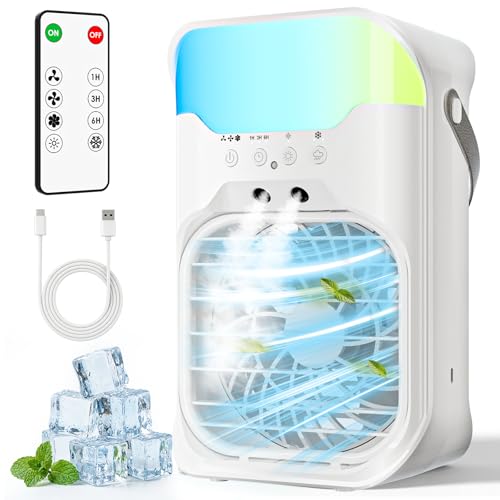
Best for: Users who want a versatile, all-in-one cooling device for rooms, cars, and offices. This unit features a 1600ml water tank, two mist outlets, and a wide cap for easy refills.
Why selected: Its 4-in-1 design delivers multiple modes of cooling and humidity, making it adaptable to various environments. It’s a strong option for multi-room or mobile use.
Limitation: Bulkier than the smallest portable models, which may affect target portability for ultra-tight spaces.
Buying Guide
- What is your primary use case? Personal desk cooling, travel, or room cooling? Personal-use devices are typically lighter and quieter but may not cool larger spaces.
- Power source and battery life: Do you need cordless operation or can you plug in? Look for battery capacity (mAh) and runtime under different speeds.
- Fluid reservoir and mist features: Larger tanks mean longer cooling between refills. Consider whether you prefer misting modes and how often you expect to refill.
- Noise level: If you’ll sleep or work near the unit, choose models emphasizing quiet operation (often labeled as “quiet” or “ultra-quiet”).
- Portability and size: For travel or small desks, compact units with handles are advantageous; for bedrooms or small offices, slightly larger tanks may be acceptable for longer use.
FAQ
- Can these devices cool an entire room? Most battery-powered or evaporative mini cooling units are designed for personal or small-space cooling, not entire rooms. Use multiple devices or a larger unit for bigger areas.
- Do they require ice to work effectively? Some models use ice or cold water to boost cooling, while others rely on evaporative cooling and humidity control. Check the product’s mist and water tank specs.
- Are they noisy? Many models advertise quiet operation, but noise levels vary by speed setting and design. Look for low-noise ratings if you’re sensitive to sound.
- How do I maximize battery life? Use the lowest speed that meets your comfort needs, and only use cooling features like mist when necessary. Fully charging between uses helps preserve battery health.
- Can you use them in a car or outdoor setting? Some units are designed for car or tent use, but always verify the manufacturer’s guidance for outdoor weather exposure and power options.
- What maintenance is required? Regularly empty and clean the water tank, check for leaks, and wipe down grilles to maintain airflow and efficiency.