Best 8-Port PoE Injector Solutions for Expanding Power Over Ethernet
Yes, an 8-port PoE injector can simplify powering multiple PoE devices without upgrading your entire switch. This guide compares top 8-port PoE injectors to help you choose the right model for IP cameras, VoIP phones, Wi‑Fi access points, or other low-voltage devices. It highlights passive and active options, power budgets, and compatibility so you can pick confidently for small offices, home networks, or enterprise-style deployments.
| Product | Best For | Key Benefit |
|---|---|---|
| PoE Texas 8 Port Injector (Passive 48V) | Budget-friendly, simple deployments | 8 PoE outputs, 8 LAN inputs, 48V passive power |
| PoE Texas 8 Port PoE Injector – 56V/120W | Power-hungry devices, scalable layouts | Active Mode B, 56V/120W supply, smart protection |
| IPCamPower 8 Port 802.3bt PoE++ | High-power devices, future-proofing | Up to 90W per port, 250W total, 10G data paths |
| PoE Texas GPOE-8B | Ubiquiti/Mikrotik ecosystems | 8 passive PoE outputs, 24V/48V/56V options |
| DSLRKIT 8-Port Passive PoE | Low-cost wall-mounts or embedded setups | 8 ports, passive, 12–48V DC input |
Buyer note: This article focuses on 8-port PoE injectors that add PoE capability to non-PoE or mixed networks. Each product section includes who it’s best for, why it was selected, and a practical limitation to watch for during planning.
PoE Texas 8 Port Injector — Passive Power Over Ethernet

This 8-port midspan injector provides 8 Data In (LAN) ports and 8 Data + Power Out (PoE) ports with a 48V, 60W UL power supply. It supports passive 802.3af/802.3at devices and is compatible with Mode B negotiation on pins 4,5 (+) and 7,8 (−). Best for budget-conscious setups that add PoE to non-PoE switches for VoIP phones, IP cameras, and APs. Use caution with devices that require dynamic power negotiation, as passive injectors deliver constant voltage and may not suit all equipment.
Who it’s best for: Small offices or home networks needing multiple PoE ports without advanced management.
Why selected: The model offers straightforward, plug-and-play expansion with a clear 8-port PoE output set, making it a practical starting point for non-PoE switches.
Limitation to consider: Passive power means no device-level negotiation; ensure your devices tolerate a constant 48V supply and confirm compatibility from manufacturers.
PoE Texas 8 Port PoE Injector — Active Mode A

This 8-port PoE injector uses active Mode A negotiation (pins 1,2 and 3,6) with a 56V 120W power supply. It enables safe, on-demand power delivery to PoE-capable devices while protecting non-PoE equipment from improper power. Best for networks that include PoE-capable devices like Wi‑Fi APs, IP cameras, and VoIP phones where power delivery should be contingent on device presence. A limitation is that it requires compatible devices to negotiate power, so non-PoE devices won’t draw current.
Who it’s best for: Enterprises integrating PoE devices into non-PoE networks that need controlled power delivery.
Why selected: The active negotiation helps prevent unintended power draw and supports a safer upgrade path in mixed environments.
Limitation to consider: This injector relies on device negotiation; verify compatibility with all connected devices before deployment.
IPCamPower 8 Port 802.3bt PoE++ Injector
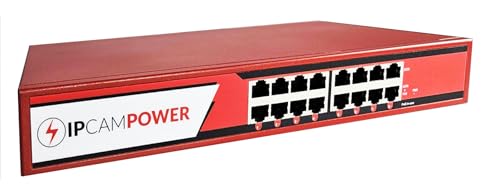
This 8-port injector delivers up to 90W per port with a total 250W budget, supporting 802.3bt PoE++ devices. It uses a dual-row injector design that combines data from a non-PoE switch with high-power PoE on the lower row. Best for power-hungry devices such as high-end PTZ cameras, lighting, or AV systems. Limitations include higher power demand and potentially larger footprint due to dual-row design.
Who it’s best for: Networks needing maximum per-port power and a future-ready PoE solution for demanding devices.
Why selected: The PoE++ capability expands potential device types beyond standard PoE, enabling more robust deployments.
Limitation to consider: Ensure your power budget and cabling support the higher wattage per port to avoid overloading.
PoE Texas GPOE-8B — Passive Mode B Injector

GPOE-8B provides 8 passive PoE outputs for non-PoE switches, with compatibility for Ubiquiti and MikroTik ecosystems. It supports 24V, 48V, or 56V power supplies sold separately, enabling flexible deployments in office or residential spaces. Best for integrators looking to match voltage to specific devices. A limitation is the reliance on separate power supplies and passive power distribution, which may not suit all devices or long-distance runs.
Who it’s best for: Installers aiming to extend PoE to devices such as cameras or access points in environments with Ubiquiti/MikroTik equipment.
Why selected: It offers versatility in powering multiple devices with selectable voltage options, making it adaptable to various device requirements.
Limitation to consider: Separate power supply purchase is needed, and ensure devices support the chosen voltage.
PoE Texas 8 Port Injector — 8 Port PoE Adapter
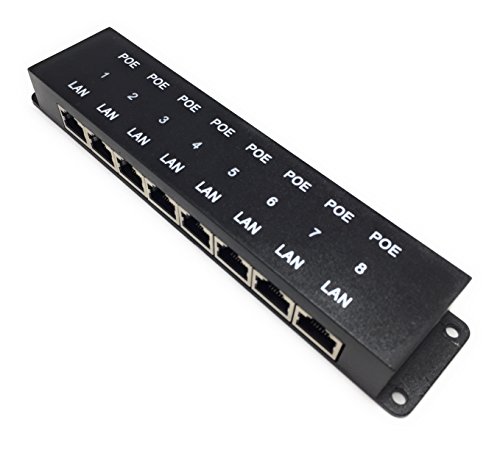
The 8-port PoE injector adds PoE for passive devices with 8 Data In and 8 Data + Power Out ports. It includes wall-mount installation tabs and supports 802.3af/802.3at devices with a passive 48V supply. Best for upgrades to small networks seeking a neat, wall-mountable solution. Limitation: If your devices require dynamic power negotiation, verify compatibility with a passive injector before purchasing.
Who it’s best for: Small offices or home setups needing a compact, wall-mountable solution to add PoE to multiple devices.
Why selected: It is a straightforward, economical option for expanding PoE without changing existing switch hardware.
Buying Guide: Key Considerations For Choosing An 8-Port PoE Injector
- Passive injectors deliver constant voltage, while active injectors negotiate power with devices. Choose based on device compatibility and safety considerations.
- For cameras or APs, ensure per-port wattage meets or exceeds device requirements without exceeding total budget.
- Confirm the cumulative wattage available across all ports and ensure the wiring and switch can support it without overheating.
- Some injectors support multiple voltages (24V/48V/56V). Match voltage to device requirements to avoid damage or under-powering.
- Plug-and-play injectors are quicker to deploy; advanced models with auto-recovery or management features help in larger or growing networks.
- Check device compatibility with IEEE standards (802.3af/at/bt) and with any ecosystems (e.g., Ubiquiti, MikroTik) you use.
- Consider cable length and signal integrity for POE power delivery, especially for longer runs or extended distances.
FAQ
- What is an 8-port PoE injector used for? It adds PoE capability to multiple connected devices when your switch lacks PoE outputs, powering IP cameras, APs, and VoIP phones.
- Passive vs active PoE injectors—which to choose? Passive injectors provide constant voltage and are cheaper but risk compatibility issues. Active injectors negotiate power and are safer for varied devices.
- Can I mix PoE injectors with PoE switches? Yes, but ensure the total power budget and device requirements align to avoid power distribution problems.
- Do I need a separate power supply for each injector? Most injectors include a power supply option; some require separate supplies or user-supplied power inputs depending on the model.
- What should I consider before buying? Assess required wattage per device, total budget, voltage compatibility, and whether you need features like auto-recovery or management interfaces.
- Are 8-port injectors suitable for outdoor use? Some are designed for indoor use; outdoor deployments require models with weather-rated enclosures and appropriate IP ratings.