Best 4-Port PoE Injectors for Expanding Your Network
Finding a reliable 4-port PoE injector is essential for powering multiple PoE-enabled devices without upgrading to a full PoE switch. This guide highlights five solid options, detailing who each device is best for, their power capabilities, and practical trade-offs. Use this to decide which injector fits your VoIP phones, wireless access points, IP cameras, and other PoE devices. The buyer’s persona each product suits will help you pick the right balance of price, power, and ease of use.
| Product | Key Benefit | Ideal For |
|---|---|---|
| 65W total budget with four PoE-out ports | Small offices needing NDAA/TAA compliant options | |
| Compact, straightforward midspan solution | VoIP phones and APs on mixed non-PoE switches | |
| Gigabit performance with clear power negotiation | PDs requiring robust PoE+ up to 30W per port | |
| High-power distribution for multiple devices | Higher-demand APs or cameras that need PoE+ | |
| Passive/Active mode options with flexible mounting | 4-device deployments needing steady 48V support |
TRENDnet 65W 4-Port Gigabit PoE+ Injector

The TRENDnet TPE-147GI provides four PoE-enabled ports plus four data ports, delivering a total 65W of power. It is NDAA and TAA compliant, a key consideration for government or regulated environments. The device is backed by TRENDnet’s manufacturer protection and includes a multi-port PoE+ injector solution for up to 328 feet (100 meters) deployments. Best for small offices or government-adjacent setups that require compliance and a straightforward, all-in-one injector path.
Best for: Small offices needing compliant, ready-to-deploy PoE expansion without upgrading existing PoE switches. Better for environments prioritizing compliance and vendor support.
Caution: Ensure your PDs stay within a combined PoE budget to avoid overloading the injector, and verify compatibility with non-PoE devices on your network.
PoE Texas 4 Port PoE Injector – 48V 48W
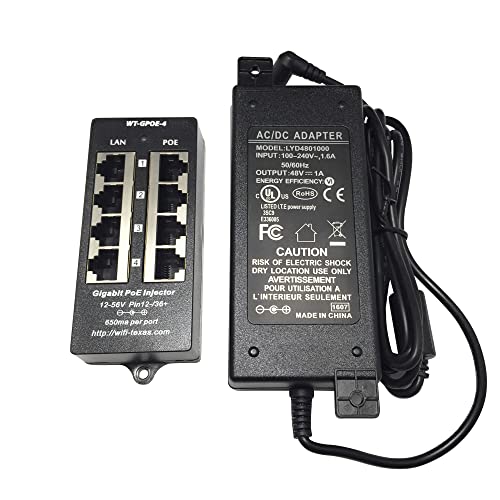
This 4-port PoE injector combines four Data In ports with four Data + Power Out ports, delivering up to 48W total for compatible 802.3af devices. It includes a 48V, 48W power supply and is suitable for VoIP phones, APs, and IP cameras. It’s a solid choice when a compact, dedicated PoE midspan is preferred over a full PoE switch.
Best for: Users needing a compact, cost-effective midspan for VoIP and AP deployments. Choose this if you want a straightforward install with a dedicated power supply bundled.
Caution: Always confirm device compatibility and pins/negotiation mode to ensure your PDs receive the correct power levels.
StarTech.com 4 Port Gigabit Midspan PoE+ Injector

StarTech’s midspan injector supports 802.3at and 802.3af, delivering up to 30.8W per port for PoE+. It negotiates data and power automatically, enabling up to four PDs with reliable performance. It accommodates a wide range of deployments and can be desktop- or wall-mounted for flexible setups. Best for users needing reliable power negotiation and per-port power distribution in a compact enclosure.
Best for: Environments that require reliable PoE negotiation with full Gigabit data paths to PDs. Choose this if you value predictable per-port power delivery and flexible mounting.
Caution: Ensure the total power budget aligns with your PD requirements, especially if installing multiple 802.3at devices on a single injector.
PoE Texas 4 Port PoE/PoE+ Injector With 56V 120W Power Supply

This high-power PoE injector distributes four PoE ports with a 56V 120W supply, enabling PoE and PoE+ on all ports simultaneously. It is IEEE 802.3af/at compliant and supports Mode A negotiation. It’s well suited for IP cameras and high-demand APs that need reliable power across all ports in a single unit. Best for: Deployments requiring strong power distribution across multiple devices, especially with higher-wattage PDs.
Limitation: The higher power output may require careful heat management in compact enclosures and may exceed budgets where many low-power PDs are used.
WiFi-Texas 4 Port PoE Injector (Passive/Active Options)

This 4-port injector supports both data and power for up to four devices, with options for active PoE delivery to ensure consistent voltage across ports. It suits installations where steady 48V PoE power is needed for multiple PDs, such as wireless APs or cameras, without upgrading to a PoE switch. Best for: multi-device projects with reliable, uniform power delivery across all four ports.
Caution: Passive modes or inconsistent negotiation can lead to variable performance; verify device compatibility and ensure proper mode selection for your PDs.
Buying Guide
- Power budget and device needs: Match per-port power (15.4W for PoE, 30W for PoE+) with the total budget of the injector. Higher-wattage PDs require more capable injectors.
- Negotiation and compatibility: Look for devices that support 802.3af/at and automatic voltage negotiation. This ensures safe operation across a mix of PDs.
- Compliance and use case: NDAA/TAA compliance is important for certain customers. For government or regulated environments, pick injectors with these certifications.
- Physical deployment: Consider whether you need desktop, wall-mount, or tabletop mounting. Some models include mounting options or compact enclosures for space-constrained setups.
- Distance and cabling: PoE performance remains reliable over standard Cat5e/6 cables up to 100 meters. Plan for longer runs with appropriate cabling and enclosure placement.
- Expansion strategy: If future-proofing is important, evaluate higher-wattage options and whether you’ll need more than four PD ports in a single unit or prefer a switch in the future.
FAQ
- What is a 4-port PoE injector best used for?
It powers up to four PoE-enabled devices such as IP cameras, VoIP phones, and wireless access points without needing a PoE-capable switch.
- What should I consider about PoE budget?
Sum the per-port wattage of each PD and compare it to the injector’s total budget. Exceeding the budget can cause devices to reset or fail to power.
- Is 802.3af compatible with 802.3at devices?
Generally yes, but ensure the injector supports both standards (or check mode negotiation) to avoid underpowered devices.
- Do I need NDAA/TAA compliance?
Only if you must meet government procurement or specific regulatory requirements. It can influence vendor selection and deployment.
- Can I mix PoE injectors with PoE switches?
Yes, but keep an eye on total network design and ensure your non-PoE ports don’t attempt to power PDs unexpectedly.