Best Commercial Grade Paper Shredders for High-Volume Offices
Answering a common buyer need, these commercial-grade shredders are designed for high-volume, hands-free operation with strong security levels. They’re best for busy offices, legal or financial teams, and facilities that require continuous shredding without frequent downtime. The top picks here emphasize long run times, large-capacity baskets, and reliable auto-feed capabilities to keep workflows uninterrupted. Below, find five highly relevant models with clear pros, who they’re best for, and practical trade-offs.
| Product | Security Level | Auto Feed Capacity | Run Time |
|---|---|---|---|
| Aurora Commercial Grade 200-Sheet Auto Feed High Security Micro-Cut | P-5 | 200 sheets auto / 10 manual | 60 minutes |
| BONSEN 300-Sheet Auto Feed Paper Shredder | P-4 | 300 sheets auto / 12 manual | 60 minutes auto / 30 manual |
| Amazon Basics 200-Sheet Auto Feed Cross-Cut | P-4 | 200 sheets auto / 10 manual | 60 auto / 10 manual |
| Bonsaii 200-Sheet Auto Feed Paper Shredder | P-4 | 200 sheets auto / 12 manual | 60 minutes auto / 30 manual |
| BONSEN 150-Sheet Autofeed Paper Shredder | P-4 | 150 sheets auto / 12 manual | 60 auto / 60 cooldown |
Aurora Commercial Grade Auto Feed Micro-Cut Shredder
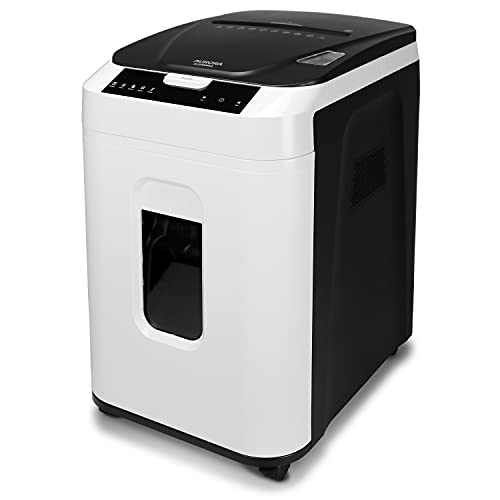
The Aurora model uses an automatic shredding feature with a 200-sheet auto feed and 10-sheet manual capacity. It yields micro-cut particles measuring 5/64 by 15/32 inches (2 by 12 mm), meeting security level P-5. This unit is designed for nonstop 60-minute operation and includes an anti-jam auto-reverse to clear paper jams. Best for large teams that require extremely high-security shredding with minimal downtime. Better for environments prioritizing top-tier data protection and long continuous use; avoid if you only need occasional shredding or smaller office tasks.
BONSEN 300-Sheet Auto Feed Shredder

With a 300-sheet auto feed and continuous 60-minute auto mode (30 minutes manual), this shredder is designed for heavy daily use. It features a 12-sheet manual feed option for mixed tasks and a relatively quiet operation (58dB). It’s best for large offices needing bulk destruction with hands-free operation. Choose this if you frequently process bulk documents; consider manual needs if you regularly shred staples or cards in addition to regular documents, and avoid if your workspace requires compact equipment or lower noise is critical.
Amazon Basics 200-Sheet Auto Feed Cross-Cut

This model shreds into cross-cut particles measuring 4 x 20 mm (5/32 x 25/32 inches). It holds 200 sheets auto feed with a 10-sheet manual capacity and offers a 60-minute auto run time (and 10-minute manual session) before a 45-minute cooldown. It’s best for users needing reliable, straightforward operation with solid security and a medium-duty footprint. Prefer this if you want a familiar interface and fewer bells and whistles; avoid if you require P-5 security (it’s P-4).
Bonsaii 200-Sheet Auto Feed Shredder

Designed for continuous 60-minute auto operation with a 60-minute cooldown window, this Bonsaii model shreds up to 200 sheets auto plus 12 sheets manually. It features a large 8.1-gallon bin with wheels for mobility and a four-wheel design for easy repositioning. Best for mid-to-large offices needing mobility and steady auto shredding, with a practical 12-sheet manual capacity for irregular jobs. Consider manual-only shredding if you rarely use auto feed to avoid occasional jams in continuous modes.
BONSEN 24-Sheet Heavy Duty Cross-Cut Shredder
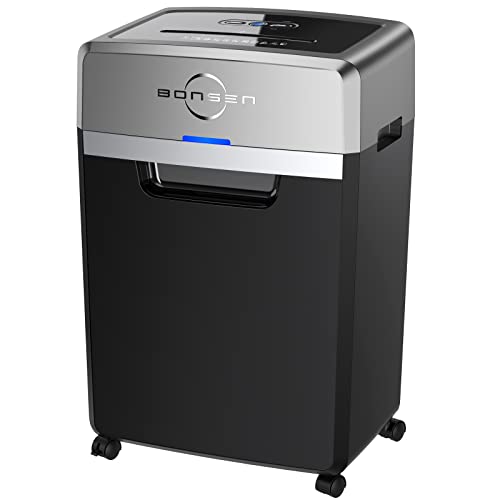
Although included for comparison, its 24-sheet capacity is smaller than the institute-grade peers, and it uses cross-cut rather than micro-cut shredding. It remains suitable for lower-volume needs or multi-purpose shredding. Best for smaller teams or budget-conscious departments; avoid this if you require micro-cut security or 60-minute continuous operation for very large jobs.
BONSEN 150-Sheet Autofeed Paper Shredder

With 150 sheets auto feed and 12-sheet manual capacity, this model is balanced for mid-sized offices. It offers 60 minutes of continuous auto shredding with a cooldown and micro-cut particles in the 5/32″ x 15/32″ range, meeting P-4 security. Best for teams needing reliable auto shredding without investing in the largest units. Use this when auto feed volume is moderate; avoid if you need maximum security (P-5) or the largest document throughput.
Buying Guide
What should you look for in a commercial-grade shredder?
- Security level: Choose P-4 or P-5 based on document sensitivity. P-5 offers finer micro-cut protection; P-4 provides solid cross-cut security for most business records.
- Auto feed capacity: Higher sheet counts reduce manual handling. Consider your typical daily volume to avoid frequent emptying.
- Run time and cooldown: Longer auto run times reduce downtime. Check cooldown requirements for continuous operation to plan workflow scheduling.
- Bin capacity and mobility: Larger bins cut down on emptying, and wheels aid in repositioning a heavy unit in a busy office.
- Noise level: For shared spaces, quieter units help maintain a productive environment.
- Maintenance and reliability: Anti-jam features and auto-reverse help prevent downtime, while simpler designs minimize service needs.
Frequently Asked Questions
- What is the difference between P-4 and P-5 security levels?
P-5 produces much smaller shred particles, offering higher data protection than P-4, which is sufficient for many general business records but less resistant to forensic reconstruction. - Is auto feed always better for an office?
Auto feed saves time on bulk shredding but may require more frequent bin emptying and jam management in high-volume settings. - How long should a commercial shredder run before cooldown?
Most high-capacity models provide 30–60 minutes of continuous auto shredding, followed by cooldown periods to prevent motor overheating. - Which features help prevent jams?
Auto-reverse, jam-clearing modes, and properly maintaining staples and paper clips can reduce jams. - What size bin is ideal for a busy office?
Larger bins (8–9 gallons or more) reduce the frequency of emptying during peak shredding periods.