Best RV Solar Panels for Your Travel Trailer and Off-Grid Needs
Finding reliable solar panels for an RV helps extend freedom on the road without chasing hookups. This guide highlights five high-utility RV solar panel kits, each with built-in charge controllers and corrosion-resistant frames designed for rugged outdoor use. Read on to compare efficiency, durability, and compatibility to pick a system that fits your 12V or 24V battery setup and daily power goals.
| Product | Brand | Approx. Output | Controller Type | |
|---|---|---|---|---|
| ECO-WORTHY 200W Kit | ECO-WORTHY | 200W | PWM | High efficiency mono panels, durable frame |
| Renogy 200W Kit | Renogy | 200W | PWM | Adventurer-Li 30A PWM controller, durable build |
| ECO-WORTHY 400W Kit | ECO-WORTHY | 400W | — | Four 100W panels, IP65 junction box |
| Callsun 400W Kit | Callsun | 400W | — | Four 100W panels, true 100W output |
| Mndstek 600W Kit | Mndstek | 600W | MPPT (via kit) | High efficiency 18BB cells, pre-drilled holes |
The selections cover a range of budgets and power needs, from compact 200W setups ideal for cozy RVs to larger 400–600W systems designed for extended off-grid stays. All options are suitable for 12V or 24V battery banks, with robust frames and weather resistance to handle road tripping and seasonal climates. Consider your daily watt-hour target, available roof space, and whether you prefer PWM or MPPT charging for optimal performance in varying sunlight.
ECO-WORTHY 200W Solar Kit For RVs

Overview: This 200W kit targets RV, camper, and off-grid needs with a high-efficiency monocrystalline panel array and a 30A PWM charge controller. The 21.5% efficiency claim supports solid daily output under good sun, making it a practical fit for compact roof installations. The corrosion-resistant aluminum frame and IP65-rated junction box emphasize long-term durability against wind and moisture. The system is designed for RVs and caravans, with broad daily output expectations around 800Wh under four peak sun hours.
Key strengths: High-efficiency mono cells, sturdy frame, and weather-resistant junction box. Consider extra space on the roof and a plan for mounting hardware if not included. Suitable for customers who want a straightforward, proven 12V/24V charging solution with reliable performance in mid-range solar projects.
Renogy 200W RV Solar Kit With Adventurer Controller
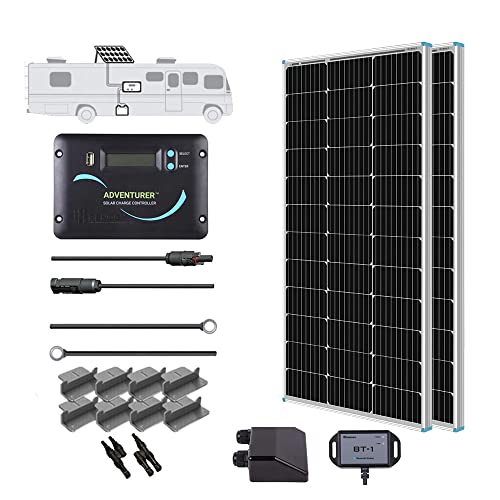
Overview: Renogy’s 200W kit pairs a high-efficiency mono panel array with the Adventurer-Li 30A PWM controller and mounting hardware. The kit emphasizes a compact footprint ideal for RV roofs without sacrificing output. With a corrosion-resistant aluminum frame, this setup is built to endure outdoor use in varying climates. It’s well-suited for RVs, boats, or small off-grid cabins where space is at a premium and a clean, expandable system is desirable.
Key strengths: Clean flush mounting, integrated protection features against overcharge and short circuits, and a track record of dependable performance. Consider roof space and whether you want to upgrade later to an MPPT solution for higher efficiency in partial shade or cooler days.
ECO-WORTHY 400W Four-P Panel Kit

Overview: This four-panel, 400W kit is designed for higher daily energy needs, including RVs with better roof space or those who want extra headroom for extended camping or larger battery banks. The 23% class efficiency with PERC technology, plus IP65-rated junctions, supports better performance across varied lighting. It’s described as a practical DIY partner for 12V/24V systems, enabling easy expansion of existing off-grid setups or new off-grid builds for home, garden, or vehicle applications.
Key strengths: Higher total output in a smaller footprint, low-light resilience via pre-installed bypass diodes, and compatibility with 12V/24V systems. Consider whether you’ll pair this kit with a more advanced MPPT controller for maximum daily production in fluctuating weather.
Callsun 400W Solar Panel Kit

Overview: Callsun’s four 100W panels are designed to deliver a true 100W output per panel and are pitched as efficient and cost-effective for RVs, homes, and off-grid cabins. The kit emphasizes expanding power with ease and supports 12V/24V/48V configurations, which makes it a versatile choice for growing solar systems. The modules are described as efficient and capable of exceeding typical 100W expectations under optimal conditions.
Key strengths: True-watt performance assurance and multi-voltage compatibility. Consider potential gains from additional panels or higher-wattage kits if your battery bank size grows or if you frequently run high-draw appliances on the road.
Mndstek 600W RV Solar Kit With 2 Panels

Overview: This kit combines two high-output 300W panels with a 30A MPPT charge controller option, designed for 12V systems and RV use. The upgraded 18BB cells provide a claimed 24.6% efficiency, with a smaller footprint per watt and robust mounting options. Pre-drilled holes and MC4 connectors simplify installation on roofs or brackets, making it a strong contender for users seeking higher energy production in a mid-size system.
Key strengths: Higher efficiency cells and ready-to-mount design for RV roofs. If future expansion is on your plan, this kit pairs well with larger battery banks and top-tier storage solutions, provided you have sufficient roof space for the panels.
Buying Guide: Key Purchase Considerations And Comparisons
- System compatibility: Check your RV’s battery voltage (12V vs 24V) and whether the included controller is PWM or MPPT. MPPT controllers generally deliver more usable energy, especially in partial shade or cooler days, but can be pricier.
- Power needs and roof space: Estimate daily watt-hours needed for lighting, fans, water pumps, and electronics. Larger rigs with higher energy demands may justify 400W–600W kits, while smaller setups can work well with 200W kits.
- Panel efficiency and technology: Mono-crystalline panels (common in the examples) offer better efficiency and aging performance than polycrystalline panels. PERC technology can improve low-light performance. Consider this when evaluating output expectations.
- Durability and weather resistance: Look for corrosion-resistant frames, IP-rated junction boxes (IP65 or higher), and panels designed to withstand wind, snow, and rain to minimize maintenance.
- Expandability: If you anticipate higher power needs later, choose modular kits with potential to add more panels or upgrade controllers. Some kits explicitly support expansion to higher wattage while maintaining 12V/24V compatibility.
- Ease of installation: Pre-drilled mounting holes, MC4 connectors, and included mounting hardware simplify roof installation. Consider whether you will install yourself or hire a professional.
- Warranty and service: Check manufacturer warranties for panels and controllers. A longer warranty can provide confidence in performance over time and in varying climates.
- Cost vs. value: While higher-w wattage kits cost more upfront, they may or may not deliver proportional gains depending on sun exposure and usage patterns. Balance upfront investment with expected daily energy needs and roof space.
Choosing the right RV solar kit involves balancing daily energy goals, roof space, and future plans for expansion. For portable power with straightforward installation, the 200W ECO-WORTHY or Renogy kits offer reliable performance with proven components. For larger vacations or longer off-grid stays, the 400W Callsun or ECO-WORTHY bundles provide greater headroom, while the 600W Mndstek kit targets users who want serious daily production and plan to run more appliances or upgrade storage. Review your typical sun hours in your area and align the kit’s output expectations with real-world conditions to maximize solar benefits on the road.