Best Outdoor Pipe Heating Cables for Winter Protection
The best outdoor pipe heating cables keep water flowing and protect exposed pipes from freezing in cold weather. This guide highlights five reliable options, with buyers’ needs in mind—whether you need long runs, built-in thermostats, or rugged outdoor use. Each section explains who should buy the product, why it’s a strong choice, and a practical caveat. A quick summary table follows to help with side-by-side comparisons.
| Product | Best For | Key Point |
|---|---|---|
| HEATIT 40ft Self-Regulating | Mid-to-long pipe runs | ETL listed, keeps water flowing to -40°F |
| JDZKOMKE 50FT | Industrial-style, metal/plastic pipes | Full cable certification, 5W/ft |
| VEVOR 18ft | Compact projects, casual use | Built-in thermostat, CE/IP68 |
| SZFY 50FT (3–200FT range) | Multi-scenario outdoor applications | High heating efficiency, 12W/ft |
| Frost King HC3A | Simple, short runs | 3 ft, 7W/ft, basic protection |
Best All-Around: HEATIT 40ft Self-Regulating Heating Cable

Best For: Winter-proofing longer runs on outdoor pipes made of metal or plastic. This self-regulating cable balances heat output with ambient conditions, helping prevent bursts on exposed water lines down to -40°F.
Why selected: It is ETL listed from end to end, with a UL-certified plug for added safety. The 3 W/ft rating delivers efficient heat for energy-conscious protection of pipes, and the product includes a 2 ft power cord with options up to 160 ft. The full cable certification provides confidence in performance and safety.
Important note: Ensure full certification across the entire cable length; plug-only certification is not enough for safe operation.
Best Long Run Choice: JDZKOMKE 50FT Pipe Heating Cable

Best For: Outdoor installations requiring a longer cable run across various pipe materials, including metal and plastic. It supports 5W/ft and provides robust protection against -40°F.
Why selected: The entire heating cable is designed to meet safety standards, not just the plug. It includes an aluminum shield and a TPE jacket for UV, chemical, and moisture resistance, making it suitable for exposed environments. It’s backed by product liability insurance for added security.
Caution: Do not use on fuel lines, gutters, or where water is not present to prevent overheating.
Best Built-In Thermostat: VEVOR Self-Regulating Pipe Heating Cable

Best For: Smaller outdoor projects, hoses, and exterior pipes where a built-in thermostat helps simplify operation.
Why selected: With a 5W/ft rating and rapid heating, this cable quickly protects pipes from freezing. The built-in thermostat turns on at 43°F (6°C) and off at 55°F (13°C), minimizing electricity use while maintaining flow. It is CE-approved with IP68 waterproofing for durability.
Limitation: The thermostat range is fixed; for unusual climates, a separate external controller might offer more flexibility.
Versatile Range: SZFY 3FT~200FT Heat Tape for Water Pipes
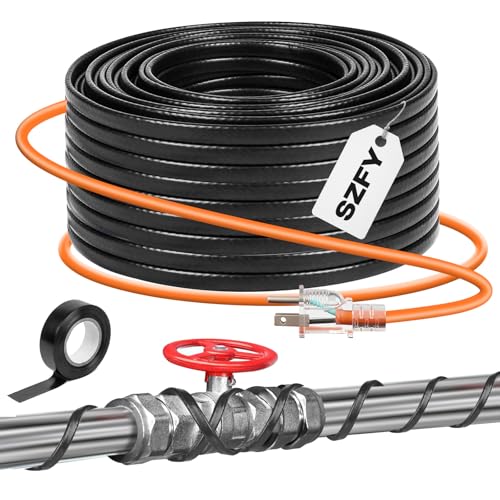
Best For: Scenarios requiring flexible cable length options from short to very long runs, including roofs, gutters, and outdoor water systems.
Why selected: SZFY emphasizes high efficiency with 12W/ft, copper-core construction, and an aluminum shield. The outer jacket is UV- and weather-resistant, and the product is UL-listed with IP67 protection, making it suitable for harsh outdoor conditions.
Tip: Heavy snow or wind exposure may require additional insulation to maximize efficiency and prevent heat loss.
Compact Yet Capable: HEATIT 24ft Heating Cable
Best For: Shorter pipe runs or installations with limited space near exterior taps or valves.
Why selected: This HEATIT option shares the ETL safety emphasis and the same 3 W/ft rating, providing reliable freeze protection for metal or plastic pipes. The full cable is certified, addressing safety comprehensively.
Caution: Shorter length means it’s less flexible for long runs; plan routes carefully to cover the required sections.
Buying Guide: How to Choose Outdoor Pipe Heating Cables
What length do I need? Measure the pipe run to ensure the heating cable covers the exposed area. Longer runs require more cable but can simplify routing and coverage.
Should I get a built-in thermostat? Built-in thermostats simplify operation and save energy by cycling heat on and off automatically. If you prefer manual control, choose a simpler cable without a thermostat.
Are certifications important? Yes. Look for full-length ETL or CSA/ETL certifications across the entire cable, not just the plug. This ensures reliable performance and safety in cold outdoor environments.
What pipe materials are supported? Most modern cables work with metal and plastic pipes, including copper, PVC, and PEX. Confirm compatibility with your pipe material before purchasing.
What about insulation and installation? Adequate insulation reduces heat loss and energy use. Follow manufacturer installation guidelines, especially for outdoor exposure and UV or chemical resistance.
FAQ
- What temperature can these cables protect pipes down to? Most suitable cables protect pipes down to -40°F (-40°C).
- Do these cables require a professional installation? In many cases, DIY installation is feasible if you follow safety and wiring instructions and use proper outdoor-rated components.
- Are all cables fully certified end-to-end? Reputable brands advertise full end-to-end certification; verify this in the product’s safety documentation.
- Can I use these cables on roof or gutter systems? Some cables are designed for roofs and gutters; check product features to confirm suitability for de-icing and gutter protection.
- Will a thermostat save energy? Yes, built-in thermostats help reduce energy use by turning heat on and off based on pipe temperature.
- What maintenance is required? Inspect cables for wear or damage before each winter season and replace any compromised sections to maintain safety and effectiveness.