Best on-Demand Water Heating Systems for Modern Homes
Answering the demand for continuous hot water, these on-demand systems heat water only when needed, helping reduce energy waste. This guide highlights top options across power levels and installation styles, so buyers can choose what best fits their home size and usage. Ideal buyers include apartment dwellers seeking compact solutions, small homes needing point‑of‑use units, and families requiring multiple simultaneous uses. Below is a quick comparison of five strong choices.
Quick comparison table
| Product | Best For | GPM (approx.) | Size/Install |
|---|---|---|---|
| APUS 18kW | Small homes, 2–3 fixtures | Up to 4.4 | Whole-house, 240V |
| Orbek 14kW | 1–2 fixtures, budget-friendly | Up to 3.38 | Indoor, 240V |
| AIYEZIDT 3kW | Under-sink, point-of-use | Up to 3.0–5.0 (varies by flow) | Under-sink, 110V |
| APUS 27kW | Whole home, higher demand | Up to 6.5 | Whole-home, 240V |
| WINTEMP 12kW | 1–2 points of use | Up to 2.8 | Wall-mounted, 240V |
APUS 18kW Electric Tankless Water Heater
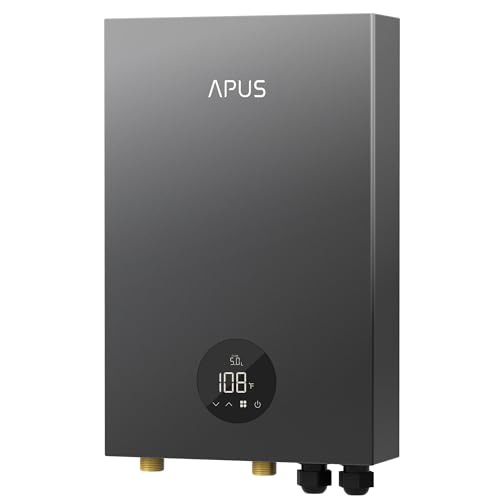
This 18kW unit delivers up to 4.4 GPM, suitable for 2–3 simultaneous uses such as showers and sinks. It features an LED temperature display with 1°F precision and a built-in memory to retain settings after power loss. Self-modulating technology adjusts power by flow to stabilize temperature and reduce energy waste, achieving high efficiency and cutting standby heat loss.
Best for: Small to mid-size homes needing reliable hot water at multiple fixtures with efficient energy use. Limitations: May require multiple units for higher simultaneous demand; check local electrical capacity.
Orbek 14kW Tankless Water Heater

Orbek’s 14kW model provides up to 3.38 GPM for 1–2 fixtures. It requires a robust electrical setup (240V, 60A breaker) and offers advanced separation tech to minimize scale and corrosion. The unit emphasizes cost savings with on-demand heating and rapid hot water delivery.
Best for: Homeowners needing a compact, high-efficiency solution for one or two fixtures. Limitations: Requires a strong circuit and proper wiring; may not support three or more simultaneous uses.
AIYEZIDT 110V 3000W Mini Tankless Heater
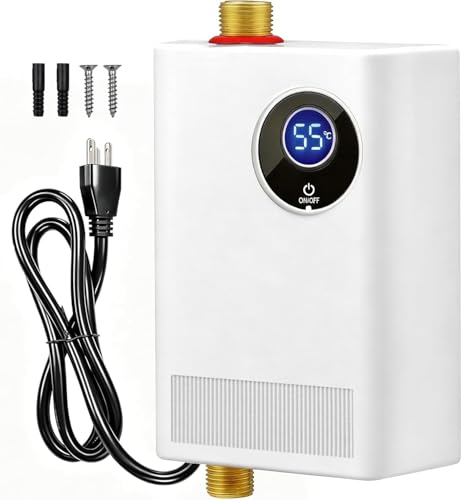
This 110V under-sink option provides instant hot water in 3–5 seconds with 3–5 second response. It’s compact and portable, designed for kitchens, apartments, RVs, or camping. A digital LCD displays status, and multiple safety features support reliable operation.
Best for: Point-of-use needs in small spaces or temporary setups. Limitations: Not suitable for showering or high-flow demands; best for sinks or small appliances.
APUS 27kW Tankless Water Heater
The 27kW model delivers up to 6.5 GPM, suitable for 3–4 simultaneous uses. It features a memory function and LED display with precise 1°F control. Self-modulating technology optimizes energy use, enabling efficient whole-home heating in a compact, space-saving package.
Best for: Larger homes or higher simultaneous demand. Limitations: Higher electrical requirements; ensure panel capacity and wiring meet installation needs.
Wintemp 12kW Tankless Water Heater

The WM12V Plus unit offers up to 2.8 GPM with smart flow control to stabilize temperature. It uses self-modulating technology and a water-electricity separation design to reduce scale buildup and maintenance needs. It’s suitable for 1–2 points of use and can work as a booster heater in some setups.
Best for: Moderate hot-water needs in smaller homes or as a boost for existing systems. Limitations: Lower maximum flow compared with higher-watt models; plan usage accordingly.
Buying Guide
What should you consider when choosing an on-demand water heater?
- Flow rate vs. household needs: Calculate total GPM required when multiple fixtures run simultaneously. Higher wattage generally increases potential GPM.
- Electrical capacity: Verify circuit capacity and panel space. Many units require dedicated breakers and gauge wiring (for example, 40 A or 50 A breakers and appropriate AWG cables).
- Installation space: Tankless units are space-saving, but some models demand wall-mounting or indoor placement with venting considerations for certain fuels.
- Point-of-use vs. whole-home: Point-of-use units are ideal for single fixtures; whole-home models are better for multiple simultaneous uses.
- Temperature control and memory: Look for precise digital controls and memory to maintain preferred settings after outages.
- Energy efficiency: Self-modulating technology minimizes energy use. Consider thermally efficient designs to reduce bills.
- Durability features: Anti-scale interiors and corrosion resistance help long-term performance in hard water areas.
FAQ
- Do on-demand water heaters save energy? Yes. They heat water only when there is demand, reducing standby losses common with storage tanks.
- Can I install a tankless heater myself? Installation often requires electrical and plumbing work; check local codes and consider a licensed technician for safe setup.
- What size unit do I need for a family home? A larger home with multiple simultaneous uses may require 27kW or higher, with ample electrical capacity.
- Is a 110V unit sufficient for most needs? 110V units are best for point-of-use tasks like sinks or small appliances and are not suited for showering or high-flow needs.
- Will these units work in cold climates? Some models perform better at low flow or are designed for colder environments, but higher wattage units are typically needed for consistent performance in cold water.
- What maintenance is required? Look for anti-scale features and periodic flushing recommendations from the manufacturer to maintain efficiency.