Best Onboard 2-Bank Marine Battery Chargers for Boats and RVs
Answering the question buyers ask most: which two-bank onboard charger delivers reliable performance for 12V marine and deep-cycle batteries? This guide highlights five top options, explaining who each is best for, and why they stand out in harsh marine environments. Ideal for boaters, RV owners, and fleet managers who need steady, multi-bank charging with protection features and temperature compensation.
Overview at a glance: the following table summarizes key distinctions to help you compare quickly.
| Product | Banks | Total Output | Best For | Note |
|---|---|---|---|---|
| NOCO Genius GEN5X2 | 2 | 10 A | Harsh marine environments, mixed battery chemistries | Compact, advanced features |
| FirstPower Pro 5X2 | 2 | 10 A | All 12V lead-acid & lithium, IP68 seal | Dry-deep-cycle readiness |
| NOCO Genius GENPRO10X2 | 2 | 20 A | High-demand setups, fast turnaround | More power per bank |
| SOARFLY 2 Bank | 2 | 10 A | Two-battery versatility on boats | Force Mode handy for dead batteries |
| Smart 2 Bank Marine Charger (Zrfmib) | 2 | 10 A | Balanced maintenance and replenishment | Compact and waterproof |
NOCO Genius GEN5X2: 2-Bank, 10A Onboard Battery Charger
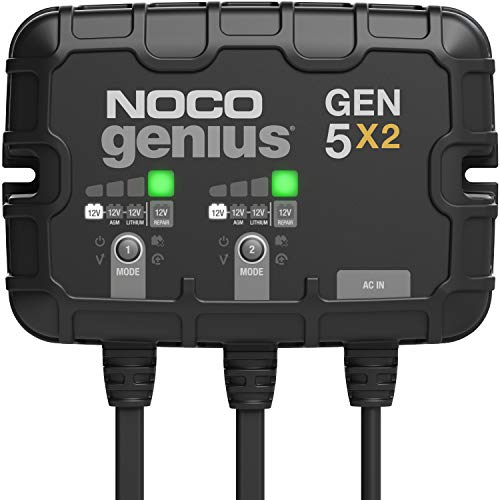
Best for: boat owners with mixed battery chemistries who need compact, multitank charging with precision control. Why selected: this model delivers 5A per bank and supports 12V, AGM, and Lithium modes with a dedicated Repair Mode, all in a smaller footprint than many competitors. The dual installation is suitable for space-constrained consoles or dedicated battery bays. The temperature compensation helps maintain accuracy in fluctuating marine climates.
Key features include 2 independent banks (5 A each), selectable modes per bank, and an overall design optimized for harsh marine environments. Cautions: ensure proper ventilation around the unit to avoid heat buildup in tight compartments. Consider this option if you prioritize size and flexible battery compatibility.
FirstPower Pro 5X2: 2 Bank Marine Battery Charger

Best for: users needing robust IP68 waterproofing and independent dual-channel operation. This charger provides 5A per bank across two banks, compatible with SLA/AGM, Lithium (LiFePO4), and calcium chemistries. Selected for its 24/7 onboard viability and sealed design for wet environments. Caution: the manual mode to force charging may require attention to battery condition to avoid overcharging in some setups.
Why it stands out: independent bank operation and ease of mode selection make it a strong all-around choice for mixed-flavor battery fleets on boats, RVs, or shore power setups where space is not a premium.
NOCO Genius GENPRO10X2: 2-Bank, 20A Onboard Charger

Best for: demanding power needs where faster replenishment is required across two banks. Why selected: it provides 10A per bank (20A total) with the same independent bank design and multi-mode charging as the GEN5X2 family, but higher total output. It’s suitable for larger boats or fleets with faster turnaround between outings. Caution: higher power draw may necessitate adequate electrical capacity on the vessel’s distribution system.
Why it’s a fit: the GENPRO10X2’s higher per-bank rating helps reduce downtime between charging cycles, making it a solid pick for active vessels with heavy electrical needs and multiple battery types requiring careful balancing.
SOARFLY 2 Bank Marine Charger: 10A Total

Best for: boaters who need two independently controlled outputs with easy mode switching for different battery chemistries. Why selected: the unit supports 12V SLA/AGM, Lithium, and Calcium modes and includes a Force Mode to revive dead batteries. This makes it a practical option for vessels where battery health can dip over seasons. Caution: review compatibility if you frequently use Calcium or LiFePO4 in mixed setups, as some boats favor specific mode pairings.
Why it’s a fit: the Force Mode feature provides a practical way to recover long-dormant batteries, which is valuable for seasonal boats and remote marina storage.
Smart 2 Bank Marine Charger (Zrfmib)

Best for: users seeking a balanced maintenance charger with automatic charge-and-maintain transitions. Why selected: it automatically switches from full charging to float charging, supports three modes for different battery chemistries, and includes a dead-battery recovery option. Caution: check the available modes for compatibility with Lithium chemistries if you’re primarily LiFePO4 systems, to ensure mode alignment with battery spec sheets.
Why this stands out: the automatic transition between charging and maintenance helps simplify long-term battery care for boats stored in damp environments or intermittent use conditions.
Guest On-Board Battery Charger 8A / 12V

Best for: users who want a reliable dual-bank solution with strong safety features for marine environments. Why selected: this 2-bank model emphasizes safety with protections against reverse polarity, over-current, over-voltage, over-temperature, and ignition protection, creating a robust option for saltwater or humid docks. Caution: lower total output (8A) relative to some rivals, which may impact charge times on larger battery banks.
2 Bank Marine Battery Charger, 20A (10A/Bank) — IP68 Waterproof
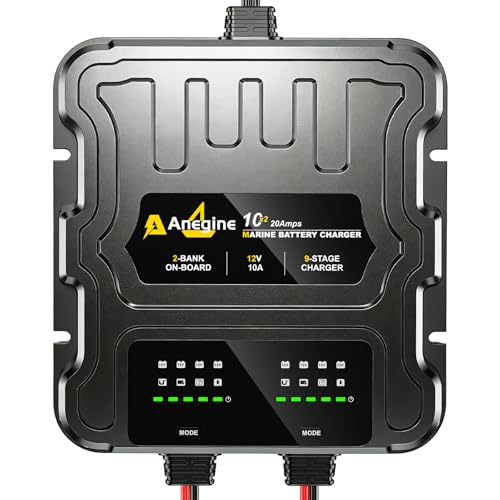
Best for: boats or RVs requiring higher total output with rugged IP68 waterproof protection. Why selected: two independent banks delivering 10A each enable faster cycling for two batteries or a fleet of small 12V systems. Caution: ensure the electrical bus can safely support 20A total continuous draw in your installation to avoid tripping breakers or overheating.
Buying Guide: How To Choose The Right 2-Bank Marine Charger
- Battery types: Match charging modes to your chemistries (SLA/AGM, Lithium LiFePO4, Calcium). Some models offer universal modes; others require mode-specific setup.
- “Per bank” vs total output: If you have two large 12V batteries or need quick recharge, prioritize higher per-bank rating (10A per bank or more).
- Waterproofing: IP68 or IP67 ratings are ideal for exposed compartments; this protects charging electronics from spray, rain, or splashes.
- Mode flexibility: Independent bank control lets you mix battery types or charge cycles without cross-bank interference.
- Dead-battery recovery: Force or Repair modes can revive deeply discharged batteries but should be used with caution and battery health in mind.
- Size and installation: If space is tight, a compact unit can simplify routing to battery bays or dedicated compartments.
- Safety features: Look for protections like reverse polarity, over-current, over-voltage, and temperature compensation to avoid damage in marine environments.
Frequently Asked Questions
- What is a 2-bank marine charger best for?
It’s ideal for boats or RVs with two separate 12V battery setups that require independent charging and maintenance. - Do these chargers work with Lithium batteries?
Yes, many models support 12V Lithium (LiFePO4) in addition to lead-acid chemistries; check each unit’s mode options to confirm compatibility. - What does IP68 mean for a marine charger?
It indicates the unit is highly sealed against dust and can withstand prolonged immersion in water, suitable for wet environments. - Is Force Mode safe for all batteries?
It can revive deeply discharged batteries but should be used sparingly and with attention to battery health and temperature. - Should I choose higher total amperage?
Higher total amperage shortens charging times but requires a stronger boat electrical system; ensure your wiring and alternator setup support it. - How important is temperature compensation?
Temperature compensation improves charging accuracy across varying temperatures, which is key for marine conditions.