Best Oil to Air Cooler Solutions for Your Vehicle or Equipment
When selecting an oil-to-air cooler, aim for models that reliably reduce transmission or engine oil temperatures, fit your line size, and suit your space. This guide highlights five well-rounded choices for American buyers, spanning universal 1/2″ tube-fin coolers to compact air-cooled kits. It’s ideal for vehicle enthusiasts, DIYers, and small- to mid-sized industrial setups looking to prevent overheating, extend component life, and improve efficiency.
The table below summarizes the five highlighted products, focusing on compatibility, cooling style, and best-use scenario.
| Product | Best For | Tube Size / Connection | Key Benefit |
|---|---|---|---|
| TEMSONE 16 Pass Transmission Cooler | Vehicles with -8AN (1/2″) cooler lines | 1/2″ AN | Prevents overheating and leaks |
| WOOTON 16 Pass Universal Transmission Oil Cooler | Most cars with AN8 lines | AN8 | Lowers oil temperature, extends life |
| GDUKOP Upgrade 16 Pass Aluminium Transmission Oil Cooler | Vehicles and air compressors needing durability | 1/2″ AN | Corrosion-resistant aluminum |
| HNeekyr 16 Pass Universal Transmission Oil Cooler Kit | Direct replacement tube-and-fin cores | 1/2″ Tube | Effective heat transfer |
| ULTRA-COOL RF-2G Below Regulator Mounted Oil Cooler Kit | Electronic components and compact setups | Below regulator mounted design | High air-flow cooling |
TEMSONE 16 Pass 1/2″ Transmission Cooler

Best for: Vehicle owners and professionals needing reliable cooling with 1/2″ transmission cooler lines. This TEMSONE cooler uses 16 pass tube-fin technology to dissipate heat effectively, reducing the likelihood of transmission fluid leaks and overheating. It’s suitable for installations with adequate space and clearance for -8AN (1/2″) lines.
- Key benefit: Maintains transmission fluid temperature to cut wear and extend life.
- Limitations: Ensure line size compatibility and available installation space before purchasing.
WOOTON 16 Pass Universal Transmission Oil Cooler

Best for: Car owners seeking a universal 16-pass cooler compatible with AN8 lines. This unit helps keep oil temperature down, boosting lubrication effectiveness and preventing heat-related failures in engines or compressors.
- Key benefit: Improves fuel efficiency by reducing parasitic heat load on the engine/transmission.
- Limitation: Verify space for installation and airflow to ensure optimal performance.
GDUKOP Upgrade 16 Pass Aluminium Transmission Oil Cooler
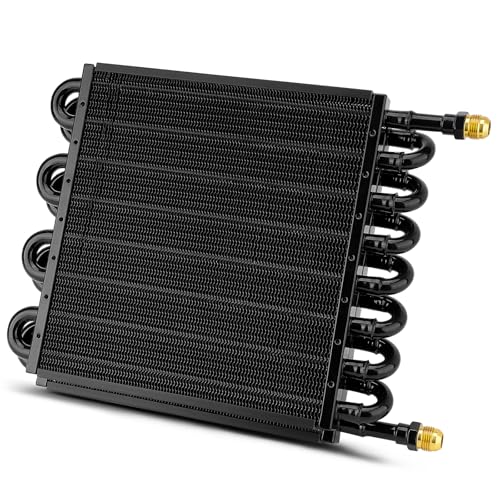
Best for: Users needing a durable, corrosion-resistant aluminum cooler for vehicles or air compressors. The 16-pass design and universal 1/2″ AN connections help maintain stable transmission fluid temperatures and minimize wear.
- Key benefit: Aluminum alloy construction enhances longevity in harsh environments.
- Limitation: Check space and clearance for installation in tight engine bays.
HNeekyr 16 Pass Universal Transmission Oil Cooler Kit

Best for: DIYers seeking a straightforward tube-and-fin cooler core as a direct replacement. Designed for automotive applications, it efficiently transfers heat to help prevent overheating and maintain oil viscosity.
- Key benefit: Direct replacement design simplifies upgrading existing coolers.
- Limitation: Ensure compatibility with your engine’s or transmission’s oil pathway dimensions.
ULTRA-COOL RF-2G Below Regulator Mounted Oil Cooler Kit

Best for: Electronics-focused cooling in compact systems where air flow is critical. The RF-2G kit employs a robust, nylon-coated stainless steel cooler with high air-flow potential, suitable for outdoor or enclosed setups where heat dissipation is paramount.
- Key benefit: High air-flow capacity (up to 220 CFM) supports efficient cooling of sensitive components.
- Limitation: This model emphasizes air cooling; verify it matches your system’s regulator mounting and airflow path.
Buying Guide
What should I consider before choosing an oil-to-air cooler?
- Compatibility: Confirm line size (1/2″ or AN8) and connector type. A mismatch can prevent installation or create leaks.
- Cooling capacity: Higher pass counts (like 16-pass) generally offer better heat dissipation, but require more space and airflow.
- Material: Aluminum coolers resist corrosion and are lightweight; steel or stainless steel parts may offer durability in harsh environments.
- Installation space: Measure available space under the hood or in the equipment bay. Some designs require additional mounting brackets or clearance for airflow.
- Airflow and environment: For electronic components or enclosed spaces, higher airflow ratings improve cooling efficiency; consider ambient temperature and debris exposure.
- Maintenance: Look for hose compatibility, easy-to-access fittings, and clear maintenance paths to prevent clogging or deposits.
Should I pick universal or vehicle-specific coolers?
Universal coolers provide broad compatibility across many makes and models, making them a flexible choice for DIY projects. Vehicle-specific or kit-based options may simplify installation with pre-matched fittings and brackets. Consider your project’s constraints, including existing line sizes, space, and airflow paths.
Which features indicate quality?
- Durable construction: Aluminum alloys or stainless components resist corrosion and wear.
- Secure fittings: High-quality seals and fittings minimize leaks and pressure drops.
- Effective heat transfer: Sufficient pass count and well-designed fins promote steady oil temperature control.
Maintenance and safety tips
- Regularly inspect hoses and fittings for wear or leaks; replace damaged components promptly.
- Ensure adequate airflow around the cooler; remove debris or obstructions in the engine bay or cooling area.
- Follow manufacturer guidelines for installation torque and connection types to prevent leaks or pressure issues.
FAQ
- What is an oil-to-air cooler and why is it used?
The cooler transfers heat from oil to ambient air, reducing oil temperature to protect transmission, engine, or hydraulic systems from overheating. - Can I install a universal cooler on any vehicle?
Universal coolers fit many setups but require verifying line size, space, and airflow for proper installation. - What does “16-pass” mean in a cooler?
It describes the number of times oil flows through the cooler core, increasing heat exchange and cooling efficiency. - Are aluminum coolers safe in high-heat environments?
Yes, aluminum offers good heat transfer and corrosion resistance when properly designed for the application. - Is maintenance heavy with these coolers?
Typically low maintenance, but periodic checks for leaks, debris, and hose integrity are recommended. - Which cooler is best for electronics cooling?
Models with high air-flow and compact design, like the ULTRA-COOL RF-2G, suit electronics or compact systems where space is limited.