Best Off Grid Solar Inverter Solutions for Reliable Power
Choosing the right off grid solar inverter is essential for dependable power in cabins, RVs, or remote homes. This guide highlights five leading hybrid and pure sine wave models, covering capacity, MPPT charging, battery compatibility, and expandability. Each section provides objective specs and considerations to help compare performance and compatibility with common battery chemistries.
| Product | Brand | Key Strength | Max Output | MPPT |
|---|---|---|---|---|
| SUMRY Hybrid Solar Inverter | SRGFTS | Glass-top design with LCD | 4000W | 140A |
| Aninerel 12000W Solar Hybrid | Aninerel | High parallel expandability | 12000W | 2 MPPT |
| VEVOR Hybrid Solar Inverter | VEVOR | High efficiency, 94% | 6000W | 120A |
| SUNGOLDPOWER 10000W | SGPWATT | Built-in MPPT, WiFi | 10000W | 2 MPPT |
| Ampinvt 5000W Off Grid | AMPINVT | 4 charging modes | 5000W | 100A MPPT |
Notes: All models support multiple battery chemistries and various charging configurations. When sizing, consider peak loads, battery depth of discharge, and the solar array’s voltage range to ensure reliable operation during low-light periods.
SUMRY Hybrid Solar Inverter With LCD Display

The SUMRY hybrid unit delivers 4000W continuous output with an 8000W peak, aimed at off-grid setups requiring robust AC power for home essentials or workshop tools. It includes a glass top cover with a large 6.25 inch LCD panel and touchable buttons for real-time monitoring. A built-in 140A MPPT charge controller supports PV inputs up to 5600W at up to 350VDC, yielding high charging efficiency and fast energy capture. The pure sine wave output protects sensitive electronics and extends device life. This model is compatible with battery-less operations or AGM/Lithium battery configurations, offering flexible integration with diverse solar arrays.
- Glass cover with prominent LCD and touch controls for easy monitoring
- 4000W continuous, 8000W peak output to handle peak loads
- Pure sine wave for compatibility with sensitive devices
- Built-in 140A MPPT with high PV input capacity
- Battery-less or AGM/Lithium compatible for flexible setups
Aninerel 12000W Solar Hybrid Inverter

The Aninerel unit provides a substantial 12,000W continuous output with parallel expandability up to 72kW (via six units) and 24,000W peak. It features two MPPT controllers and supports high-voltage PV inputs up to 500VDC, enabling efficient harvesting from modern solar arrays. The inverter is designed for 48V battery systems and accepts AGM, GEL, Lead-Acid, Li-ion, and LiFePO4 chemistries, including no-battery operation for solar-to-load direct use. It’s suitable for large off-grid homes, workshops, or cabins that require scalable power and robust surge capacity.
- Dual MPPT with up to 24,000W peak and 72kW parallel expansion
- Supports high-voltage PV arrays up to 500VDC
- Compatible with multiple battery chemistries; no-battery operation option
- Single-unit output: 120V or 240V as needed
- Ideal for scalable off-grid or hybrid solar systems
VEVOR Hybrid Solar Inverter, 6000W

The VEVOR 6000W hybrid offers a compact all-in-one solution with a built-in MPPT controller delivering up to 120A charging current. It supports a wide DC input range (60V–500V) and is compatible with 48V battery banks including Li-ion and lead-acid chemistries. The inverter emphasizes efficiency (claimed up to 94% charging efficiency) and provides flexible output to suit off-grid homes or cabins, including the option to operate with no battery in some configurations. It’s well-suited for users who want reliable solar-to-load power with easy integration into existing PV arrays.
- All-in-one hybrid with a 6000W pure sine wave inverter
- High-efficiency MPPT charging up to 120A
- Wide DC input range supports diverse PV setups
- Compatible with lithium and lead-acid batteries
- Suitable for off-grid homes and small commercial installs
SUNGOLDPOWER 10000W Hybrid Inverter

The SUNGOLDPOWER SPH10048P provides a robust 10,000W continuous output with a 20,000W peak, making it capable of supporting motors and other demanding loads. It includes two MPPT controllers and a built-in WiFi module for remote monitoring via a mobile app. The unit supports four charging/output modes, including Solar Priority and Utility Priority, enabling flexible power management in off-grid and hybrid configurations. It is designed for split-phase or single-phase 120/240V operation, which suits residential off-grid systems and RV setups.
- Two MPPTs for efficient solar harvesting
- WiFi monitoring for real-time status
- Four charging modes to match source priority
- High surge capability for heavy loads
- Split-phase or single-phase 120/240V output
Ampinvt 5000W Off Grid Inverter
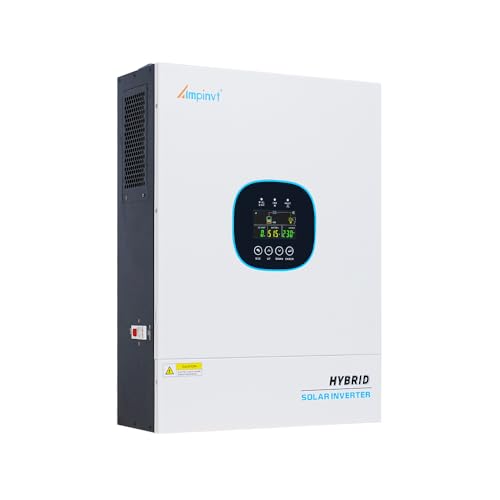
The Ampinvt 5000W unit pairs a pure sine wave inverter with an integrated 100A MPPT controller and supports up to 5500W PV input. It accommodates 48V battery banks (lead-acid and lithium) and offers four charging modes, including PV load priority and solar-first options. The device supports parallel operation for higher capacity and includes multiple output configurations (single-phase, split-phase, or three-phase). This model aims at users seeking a scalable off-grid solution with strong charging efficiency and flexible connection options.
- Pure sine wave with integrated MPPT charger
- Up to 5500W PV input and 100A MPPT charging
- Supports 48V lead-acid and lithium batteries
- Four charging modes and parallel expansion
- Versatile output options for different installations
Buying Guide: Key Purchase Considerations For Off Grid Inverters
-
<liPower needs: Assess peak and continuous power requirements. Choose an inverter with a comfortable headroom above your highest sustained load to avoid tripping or brownouts.
- Expandability: If future needs may grow, consider parallel-ready inverters or modular designs that allow adding more units without reconfiguring the system.
- Efficiency and protection: Favor units with high PV to AC efficiency and robust protections (overload, short-circuit, over-voltage, temperature) to safeguard devices.
<liBattery compatibility: Verify battery type compatibility (lead-acid, LiFePO4, Li-ion) and whether the unit supports battery-less operation if you plan direct solar-to-load usage during sunny periods.
<liMPPT performance: A higher MPPT current and capable voltage range improve energy harvest, especially in varying weather. Look for multiple MPPTs if you have a large or shaded array.
<liRemote monitoring: WiFi or app-based monitoring helps track performance, battery health, and alerts from anywhere.
<liEase of installation: Pay attention to input voltage range, wiring requirements, and whether the unit supports your AC voltages (120V, 240V, or both) for your region.
<liEnvironmental conditions: Consider operating temperature ranges and enclosure ratings if the system will be installed outdoors or in harsh environments.
<liWarranty and service: Check warranty duration and availability of spare parts or technical support when selecting a brand and model.