Best Off-Grid Residential Solar Power Systems for Homes
For homeowners seeking reliable energy independence, off-grid solar systems offer a viable path to uninterrupted power, especially in remote locations or during outages. This guide highlights five ECO-WORTHY solutions designed for residential use, focusing on system capacity, battery storage, scalability, and ease of installation. Each option integrates high-efficiency solar panels, robust inverters, and lithium battery banks to help you understand how these kits can fit different homes and energy needs.
Summary of chosen products
| Product | Solar Panels | Inverter | Storage | |
|---|---|---|---|---|
| ECO-WORTHY 10KW Output Complete Off-Grid System | 12 × 195W | 10KW Inverter (UL) 120V/240V | 2 × 48V 100Ah Li Batteries | ~9.36 kWh under 4 hrs sun |
| ECO-WORTHY Complete Off-Grid Solar Kit: 5000W | 24 × 195W | 5000W Inverter + MPPT | 2 × 48V 100Ah LiFePO4 | Up to 10 kW peak, ~5 kW continuous |
| ECO-WORTHY 5KW Off Grid Solar System Complete Kit | 12 × 195W | 5KW Inverter | 1 × 51.2V 100Ah LiFePO4 | ~4.68 kWh per day |
| ECO-WORTHY 48V Off Grid Solar System Complete Kit | 6 × 195W | 3,500W Inverter | 2 × 48V 50Ah LiFePO4 | ~4.68 kWh per day |
| ECO-WORTHY 7.168KWH RV Off-Grid Kit | 4 × 200W | 3,000W UPS Inverter Charger | 2 × 12.8V 280Ah Li Batteries | ~7.168 kWh storage |
ECO-WORTHY 10KW Off-Grid System Kit For Home

The ECO-WORTHY 10KW Output Complete Off-Grid System provides a substantial energy backbone for residential use. It combines 12 panels of 195W each (2340W total) with a 10KW 120V/240V inverter, enabling robust parallel operation up to six units for higher capacity. A 48V rack-mounted battery bank of two 100Ah lithium cells supports real-time monitoring via CAN/RS485 and mobile apps, offering safety features and remote accessibility. This kit is designed to supply continuous power for essential appliances and can scale to handle higher loads when additional inverters are added.
Key considerations:
– High daily output under optimal sun, suitable for larger homes or energy-intensive loads.
– Parallel capabilities expand power for multi-room or shed setups.
– Inverter safety certifications help ensure reliable operation in North American homes.
– Battery monitoring and wireless connectivity support proactive system management.
ECO-WORTHY Complete Off-Grid Kit: 5000W System
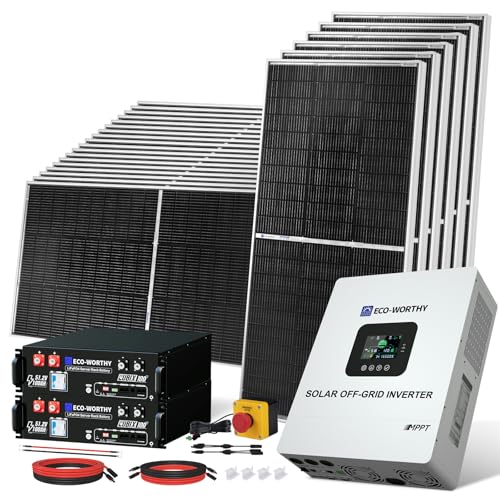
This kit delivers a balanced mix of solar capacity and storage. It includes 24 panels of 195W, a 5,000W off-grid inverter with a 100A MPPT controller, and two 48V 100Ah LiFePO4 batteries. The integrated communication features enable real-time monitoring, and you can parallel up to six inverters for a potential 30 kW output. The system is suitable for homes seeking independence with a flexible upgrade path, especially in regions with inconsistent grid reliability.
Key considerations:
– Scalable architecture with clear upgrade path for growing energy needs.
– Integrated battery communication simplifies setup and monitoring.
– High peak output supports power-hungry devices during cloudier days.
– Compatibility with a broad range of battery chemistries and inverters.
ECO-WORTHY 5KW Off Grid System Complete Kit

Combining 12 × 195W bifacial panels (2340W total) with a 5KW split-phase inverter and a 51.2V 100Ah LiFePO4 battery, this kit presents a compact yet capable off-grid solution. Batteries are designed for rack mounting and full-system safety with UL-listed components. The system supports paralleling to increase output and integrates into a simple, user-friendly installation for single- or multi-room homes. It is ideal for smaller homes, cabins, or spaces requiring reliable backup power without a large upfront footprint.
Key considerations:
– Space-saving rack-mountable battery design.
– Simple wiring and plug-and-play features reduce installation complexity.
– Moderate size with reliable daily output for typical households.
– Safety certifications and robust protection features.
ECO-WORTHY 48V Off Grid Kit

This lean 48V system centers on a 1,200W solar array designed for compact homes or offices seeking steady off-grid capabilities. The included 3,500W inverter handles common appliances with ease, while the two 48V 50Ah LiFePO4 batteries provide essential backup storage. Real-time monitoring is supported via WiFi, ensuring homeowners can track system health and performance. The kit’s compact footprint makes it suitable for RVs, small cabins, or tiny homes needing dependable power without bulk.
Key considerations:
– Compact configuration suited for tight spaces.
– Real-time monitoring helps ensure system reliability.
– Adequate for modest loads and essential household appliances.
– Expandable by adding more batteries or higher-capacity inverters as needed.
ECO-WORTHY 7.168KWH RV Off-Grid Kit

Designed for RVs and mobile setups, this kit delivers 800W of panel capacity with a 3,000W UPS inverter charger. The system ships with four 200W panels and a pair of 12.8V 280Ah Li Batteries, providing 7.168 kWh of stored energy and a reliable, mobile-friendly power source. The Bluetooth-enabled MPPT controller supports easy monitoring, while the UPS functionality ensures quick power transfer when off-grid requires immediate support. Ideal for travel enthusiasts who want dependable energy on the road.
Key considerations:
– Mobility with a practical energy reserve for travel and camping.
– UPS functionality provides seamless transitions during power needs.
– Moderate storage capacity suitable for short trips or tiny homes.
– Bluetooth monitoring for straightforward status checks.
Buying Guide
Energy demand assessment: Determine your daily energy use and peak load. Larger homes or households with electric appliances like air conditioners and water heaters require higher inverter capacity, more panels, and bigger battery banks. Create a realistic daily kWh target and plan for future expansion.
System scalability: Look for modular designs that allow adding more panels, inverters, or batteries. Parallel operation can significantly increase output, but ensure the inverter and battery management system support multi-unit expansion and safe synchronization.
Battery chemistry and safety: Lithium LiFePO4 batteries offer stability, longer lifespans, and safer chemistry than lead-acid. Check BMS protections, temperature monitoring, and UL/CSA certifications. A rack-mountable design helps with space planning and serviceability in a home setting.
Monitoring and connectivity: WiFi or Bluetooth monitoring is helpful for remote status updates. Consider apps that provide real-time metrics such as state of charge, solar production, load, and alerts. RS485/CAN communication improves compatibility with various inverters and solar controllers.
Installation and maintenance: Evaluate the ease of installation, included hardware, and warranty terms. Kits that include mounting brackets, cables, and detailed instructions reduce setup time for homeowners. Regular maintenance typically includes battery health checks, inverter firmware updates, and cleaning solar panels to maintain efficiency.
Weather and climate considerations: Take into account local insolation (sun hours per day) and seasonal variations. In areas with less sun, larger battery banks and more high-efficiency panels help maintain energy reliability through cloudy periods.
Cost and value: While prices aren’t listed here, compare total system capacity, future expansion costs, warranty length, and component certifications. A higher upfront investment can be justified by long-term energy savings, resilience, and system longevity.
Compatibility with grid-tied or hybrid options: If you might rejoin the grid, consider hybrid inverters that can switch between solar and grid power, or devices that allow charging from the grid when solar is insufficient. Parallel-ready configurations offer flexibility for future integration with larger homes or remote properties.
Environmental and safety standards: Prefer products that meet modern safety certifications (UL, CE) and comply with regional building codes. Proper venting, insulation, and fire safety considerations should be part of the installation plan.