Best Non-Invasive DC Current Sensor Guide for Accurate Readings
Non-invasive current sensors provide a practical way to monitor electrical current without breaking the circuit. This guide highlights five reliable options, covering DC and AC current sensing with various output formats. Each option is designed for hobbyist projects, motor control, energy monitoring, and protection applications. Compare features, interfaces, and practical considerations to choose the right sensor for your system.
| Product | Brand | Output / Range |
|---|---|---|
| Current Transformer ZCZQC Blue SCT-013 0-100A Non-invasive AC Current Sensor | ZCZQC | 0-100A AC, 3.5 mm jack |
| MusRock WCS1600 Hall Current Sensor | MusRock | DC 0-100A / AC 0-70A, 22 mV/A |
| JESSINIE WCS1800 Hall Current Sensor | JESSINIE | DC 0-35A, AC 0-25A, 60 mV/A |
| HUABAN SCT013-005 5A 1V Sensor (2-Pack) | HUABAN | Non-invasive split-core, 5A rated, 1V output |
| JANSANE SCT-013-000 100A Sensor | YHDC | AC 0-100A, DIY energy monitor |
Current Transformer ZCZQC SCT-013 0-100A

The ZCZQC SCT-013-0/100A is a ferrite-core, non-invasive current transformer designed for AC current sensing. It supports a 0-100A current range and uses a 3.5 mm jack for flexible interfacing. The device provides two output forms: current output or voltage output when paired with an appropriate load resistance. It is suitable for monitoring lighting equipment, AC motors, and other electrical loads, as well as current measurement and overcurrent protection in basic control systems.
MusRock WCS1600 Hall Current Sensor

The MusRock WCS1600 sensor is designed for bidirectional current detection, offering a DC range up to 100A and a 70A AC range. It provides 22 mV per amp sensitivity and supports a bandwidth of 23 kHz. It operates from 3.0V to 12V DC, drawing 3.5–6.0 mA at 5V, and includes an onboard LDO for stable operation. A built-in LM393 comparator enables adjustable overcurrent protection for real-time fault detection, making it suitable for motor control, battery monitoring, and industrial protection schemes.
JESSINIE WCS1800 Hall Current Sensor

The JESSINIE WCS1800 module supports DC sensing up to 35A and AC up to 25A, with a linear response of about 60 mV per amp. It operates at 5V DC and offers mounting holes for easy installation. The device is designed for analog output, enabling straightforward integration with microcontrollers for motor control, power management, and overcurrent monitoring applications. It provides convenient firmware integration due to its compact form factor and mounting options.
HUABAN SCT013-005 5A 1V Sensor (2-Pack)

This 2-pack comprises non-invasive split-core SCT013-005 sensors rated at 5A with a 1V output. Core material is ferrite, and the rated input RMS is 5A with a maximum input of 30A. The 1V output provides a simple analog signal for monitoring current through microcontrollers or data acquisition systems, enabling easy integration into energy monitoring or protection schemes.
JANSANE SCT-013-000 100A Sensor
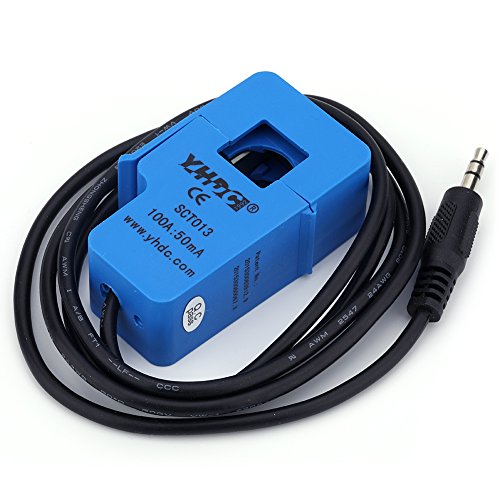
The SCT-013-000 from JANSANE (YHDC) targets whole-building monitoring with a 100A AC sensing capability. It is ideal for DIY energy monitors, Raspberry Pi or Arduino projects, and over-current protection for AC loads. The current transformer is split-core and designed for easy installation around existing conductors, providing a practical, non-invasive sensing approach for energy usage analysis and protection logic.
Buying Guide
Key purchase considerations help ensure you select a non-invasive current sensor that integrates smoothly with your system:
- Current range and type: Decide between AC-only sensors and bi-directional or DC-AC capable sensors. If you need to monitor DC and AC in one project, look for Hall effect-based devices that cover both.
- Output format: Choose voltage output for direct ADC reading or current output for resistor-based load connections. Ensure you have an appropriate load or ADC reference for the chosen output.
- Interface and compatibility: Check voltage supply requirements (common 5V, 3.3V, or wider ranges) and MCU compatibility (Arduino, Raspberry Pi, etc.). Confirm connector types (3.5 mm jack, headers, etc.).
- Accuracy and bandwidth: Higher bandwidth is critical for fast transients and motor control. Evaluate sensitivity (mV/A) and the allowed error for your application.
- Non-invasive practicality: Split-core clamps are easy to install around existing conductors without disconnecting circuits, which is ideal for retrofit and monitoring.
- Protection features: Some sensors include overcurrent detection with adjustable thresholds. Consider whether you need built-in protection for safe operation.
- Physical form factor: Consider size, mounting options, and whether a two-pack is beneficial for your project spacing or channel count.
- Temperature and environmental considerations: If used in industrial settings, confirm temperature ratings and enclosure compatibility.
When selecting among these options, align the sensor’s current range, output type, and interface with your data acquisition plan and microcontroller environment. For multi-channel energy monitoring, a mix of higher-range current transformers and smaller-signal Hall sensors can balance cost and performance. If retrofitting, split-core SCT sensors offer quick installation, while dedicated Hall sensors provide precise DC/AC handling for motor control and protection tasks.