Best Non Contact Amp Meter Picks for Safe, Efficient Electrical Testing
Answering the common buyer question: which non-contact amp meters offer reliable AC current measurement, safe voltage testing, and helpful extras for both professionals and DIYers? This guide highlights five top options, suitable for different needs—from basic NCVT testing to high-accuracy current measurements and data logging. Each product is evaluated for who it’s best for, plus practical caveats. Use the quick-reference table to compare core features at a glance.
| Product | Best For | Key Benefit |
|---|---|---|
| Klein Tools CL120 | General electricians, DIY homeowners | Versatile clamp meter with NCVT and backlit display |
| AstroAI 2000 Counts | Budget-conscious pro and home users | Auto-ranging with NCV; solid all-around features |
| KAIWEETS D-Shaped Clamp Meter | Professionals needing easy clamp access | Distinctive D-shaped jaw for easier clamping |
| AstroAI 4000 Counts | Industrial-or heavy-use environments | Higher counts, multiple measurement functions, NCV |
| FNIRSI DMC-100 | Technicians needing data logging & curve recording | TRMS measurements with real-time curve recording |
Klein Tools CL120 Digital Clamp Meter
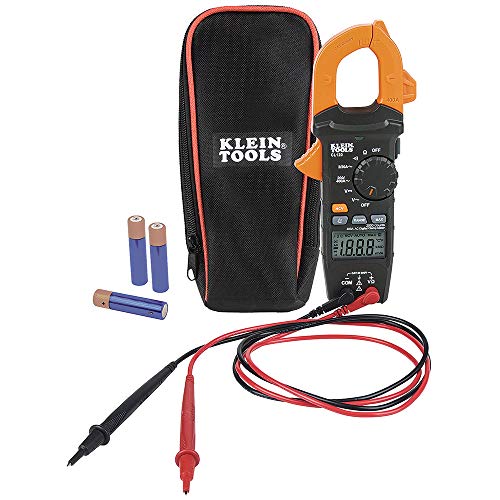
The Klein CL120 is a versatile clamp meter that measures AC current and non-contact voltage testing (NCVT) with the clamp, plus AC/DC voltage, resistance, and continuity via leads. It features a backlit LCD for better visibility in dim environments. This dual-function approach makes it a solid choice for those who want one tool that covers both live testing and circuit diagnosis. Best for: electricians and DIYers who need a single, straightforward tool for VAULE NCVT checks and basic measurements. A potential limitation: the meter may not expose advanced data logging or high-precision counts beyond 400 A ranges.
AstroAI Digital Clamp Meter 2000 Counts

The AstroAI 2000 Counts clamp meter provides automatic measurement of AC/DC voltage, AC current, resistance, capacitance, and continuity, with NCV testing and a live-wire test feature. It includes practical functions like data hold, auto shut-off, and a backlit display. Best for: budget-minded professionals and do-it-yourselfers who need a reliable all-in-one tool without overspending. Limitation to note: this model does not test DC current with the clamp and requires clamping around a single conductor for current readings.
KAIWEETS Digital Clamp Meter With D-Shaped Jaw

The KAIWEETS clamp meter uses a true-RMS measurement system for AC and DC current and voltage, along with NCV detection and a D-shaped jaw that opens up to 1.1 inches. It also measures temperature, capacitance, frequency, resistance, diode, and continuity. Best for: electricians who need a robust, versatile tool and easy clamping on larger cables. Choose this if you frequently work with multi-conductor cables. Caution: ensure the conductor sits in the clamp center for accurate current readings; avoid clamping across multiple wires simultaneously.
AstroAI Digital Clamp Meter 4000 Counts
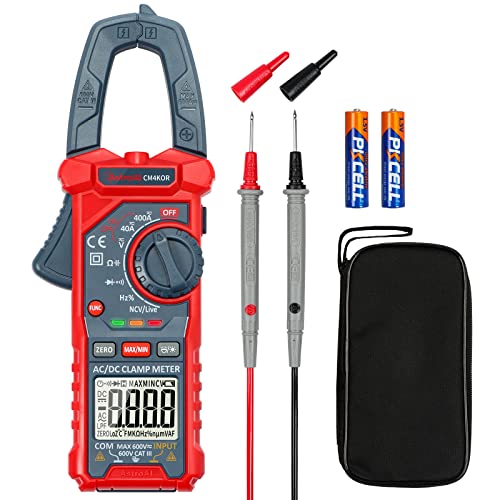
This AstroAI model handles AC/DC current and voltage, resistance, capacitance, frequency, and continuity, with added features like a low-battery indicator and a backlit LCD. The non-contact voltage testing includes sound and light alarms to signal voltage presence. Best for: technicians needing more measurement ranges and a readable display in dim environments. Limitation: higher-count meters can be more complex to learn, so novice users may require a brief familiarization period.
FNIRSI DMC-100 Clamp Meter

The FNIRSI DMC-100 offers a 10000-count TRMS clamp meter with a 600 A AC/DC measurement range, curve recording, and a 2-inch TFT screen. It includes NCV and live-wire testing, with real-time data graphing that stores multiple data sets for troubleshooting. Best for: field technicians and HVAC professionals who require data visualization and record-keeping during diagnostics. Limitation: the feature set is substantial, which may require time to master the user interface and menus.
Buying Guide
Key considerations when choosing a non-contact amp meter:
- Current range and counts: Higher counts (e.g., 4000 or 10000) offer finer resolution and better diagnostics for complex circuits.
- Non-contact voltage testing (NCVT): Look for audible and visual alarms, as well as reliable detection across a range of voltages.
- Display and visibility: Backlit LCDs or color screens improve readability in dim work areas.
- Jaw design: D-shaped jaws or wide-opening clamps simplify clamping on larger cables or bundles.
- Additional functions: Capacitance, resistance, frequency, diode testing, and temperature extend utility for multi-purpose diagnostics.
- Data logging and curve recording: For troubleshooting intermittent faults, models like FNIRSI DMC-100 provide real-time graphs and history.
- Battery life and power features: Auto shut-off helps conserve batteries on long jobs; consider units that use common batteries.
Practical recommendations by scenario
- Best all-around for professionals and DIYers: Klein Tools CL120 or AstroAI 2000 Counts for balance of features and cost.
- Best for easy clamp access on diverse cables: KAIWEETS with D-shaped jaw.
- Best for heavy use and data needs: FNIRSI DMC-100 with curve recording and 10000 counts.
- Best on tighter budgets with essential NCVT: AstroAI 4000 Counts or Klein Tools CL120VP kit for added test leads.
Frequently Asked Questions
- What is a non-contact voltage tester and why use it?
A non-contact voltage tester detects electrical presence without contacting live conductors, enhancing safety when approaching unknown circuits. - Can I measure current with the clamp around multiple wires?
No. For accurate current readings, clamp the meter around a single conductor. - Do these meters test DC current with the clamp?
Some models test DC current via the clamp; others require the conductor’s path to be DC-free. Check each product’s specs. - What does TRMS mean and why does it matter?
True RMS provides accurate readings on non-sinusoidal waveforms, common in modern power systems and equipment. - Is data logging important for HVAC or industrial work?
Yes, curve recording and memory storage help analyze intermittent faults and verify repairs over time.