Best No Battery Solar System Options for Off-Grid Power
Exploring solar setups that minimize or eliminate battery dependence can simplify off-grid living. This guide highlights five no-battery-friendly solar systems from ECO-WORTHY, designed for RVs, cabins, sheds, and remote outposts. Each entry emphasizes compatibility, installation ease, and practical power output to help you compare reliable off-grid solutions.
| Product | Key Power Output | Best For | Link |
|---|---|---|---|
| ECO-WORTHY 200W Panels Kit (12V/24V) with 30A PWM Controller | Up to 800Wh/day (4 sun hours) | RVs, campers, cabins needing lightweight, expandable solar | View Product |
| ECO-WORTHY 7.168KWH 800W Complete Off-Grid Kit | Up to 3.2 kWh/day (4 sun hours) | RV trips, cabins, remote off-grid living with UPS backup | View Product |
| [Ultra] ECO-WORTHY 1200W 24V Off-Grid System | 5.52 kWh/day (4 sun hours) | Full RV or tiny home off-grid power with battery storage | View Product |
| ECO-WORTHY 10000W Complete Off-Grid Kit | Up to 40 kWh/day (4 sun hours) | Homes, sheds, cabins requiring high-capacity off-grid power | View Product |
| ECO-WORTHY 200W Solar Starter Kit (RV Off-Grid) | Up to 800Wh/day (4 sun hours) | Beginner-friendly RV/off-grid starter with included battery and inverter | View Product |
ECO-WORTHY 200 Watts Panel Kit With PWM Controller

The ECO-WORTHY 200W solar kit combines a monocrystalline panel with a 30A PWM charge controller. It targets RVs, campers, and other off-grid needs with an estimated daily output of about 800Wh under four peak hours of sun. The panel features a corrosion-resistant aluminum frame and an IP65-rated junction box, designed to resist wind and snow loads for durability in outdoor settings. This setup is suitable for simple, portable off-grid power where high efficiency and steady charge are priorities, and it can be expanded with additional panels over time.
ECO-WORTHY 7.168KWH 800W Off-Grid Complete System

This complete off-grid kit integrates four 200W monocrystalline panels, a 3000W inverter charger, and a 60A MPPT controller with Bluetooth. It serves as a turnkey solution for RV life or remote cabins, offering the benefit of UPS-like power transfer between solar generation and mains charging. The design emphasizes a user-friendly installation process and a robust all-black appearance, with a stated daily yield of about 3.2 kWh under ideal four-hour sun exposure. It supports powering common RV appliances and provides hybrid charging options for continuous operation off-grid.
[Ultra] ECO-WORTHY 1200W 24V System With Batteries
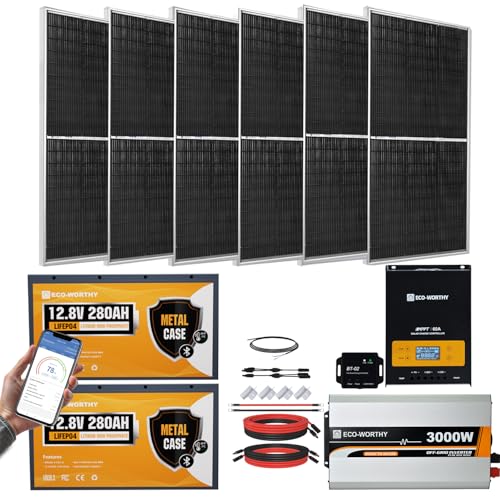
The Ultra 1200W system targets larger off-grid sites with six 195W panels, a 24V battery bank, and a 60A MPPT controller. It claims a daily production of 5.52 kWh under four hours of sun, aided by a dual-axis tracker that boosts efficiency by over 40%. The battery pack uses Li-ion cells for higher cycle life compared with lead-acid options. This kit is designed for RVs, cabins, or small homes needing substantial daytime generation and a compact storage solution, all in a scalable platform.
ECO-WORTHY 10000W Complete Off-Grid Kit

This high-capacity off-grid package pairs a 9.84 kW solar array with two 5,000W inverters and a 7,168Wh Li-ion battery bank. It is marketed for homes, sheds, cabins, or farm setups needing substantial daytime generation and robust backup. With an emphasis on remote monitoring via an app, the system supports 110V appliances and can operate independently from the grid, while enabling grid charging when sun is insufficient. It suits users seeking a scalable, high-output solar backbone for extended off-grid living.
ECO-WORTHY 200W Starter Kit For RVs
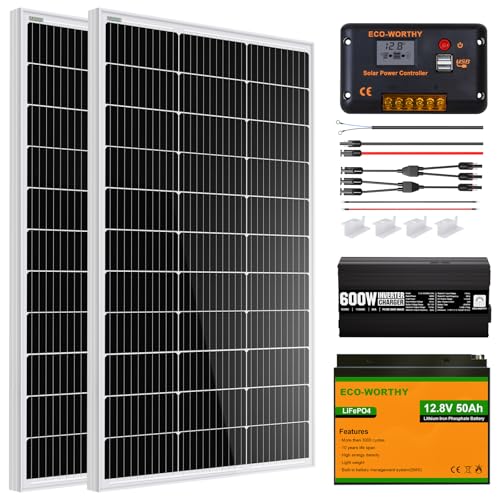
This beginner-friendly kit is designed for RVs and off-grid use, featuring a 200W panel with a 30A charge controller, a 50Ah Li battery, and a 600W inverter. It emphasizes ease of setup and a balanced power footprint suitable for travelers and campers who want a straightforward solar upgrade. The system highlights durable panel construction, weather sealing, and the potential to scale with additional panels as needs grow.
Buying Guide
Power goals and site conditions drive the best no-battery or minimal-battery solar setups. Consider these factors when comparing systems:
- Power needs: List essential appliances and estimate daily watt-hour consumption. Match kit output to sustain these loads during typical sun hours.
- Panel efficiency: Higher efficiency panels perform better in limited space, important for RVs or small outbuildings.
- Controller type: PWM is affordable and simple; MPPT controllers optimize charging, especially in variable light. For larger systems, MPPT is often worth the extra cost.
- Durability: Look for corrosion-resistant frames, IP ratings, and snow/wind load specs to ensure longevity in outdoor environments.
- Scalability: If you plan future expansion, select kits designed for easy add-ons or with modular components.
- Battery consideration: Some kits incorporate LiFePO4 packs for longevity; others are intended to work with external batteries or mains charging.
- Monitoring: Apps or built-in displays can help you track production, consumption, and system health, aiding operational efficiency.
- Installation complexity: Beginner-friendly kits offer guided assembly and included connectors; more advanced kits may require professional wiring.
- Warranty and support: Check coverage on panels, controllers, and battery banks; long-term support reduces risk in remote deployments.
Across these options, you’ll find a balance between portability, power capacity, and complexity. If you prioritize easy setup for RV travel, a 200W–800W panel kit with PWM to MPPT upgrades may be ideal. For stationary cabins or tiny homes, larger systems with lithium storage and robust inverters offer stronger reliability. Always verify compatibility with local sun hours and any grid-tied charging capabilities to maximize your off-grid performance.