Best Nickel Strip Spot Welder Solutions for Battery Packs and DIY Projects
Answering the common buyer question: which nickel strip and spot welder options best fit battery pack builds and repairs? This guide profiles five relevant products—skimming from pure nickel strips ideal for high-current packs to versatile spot welders that work with nickel sheets and battery tabs. Ideal buyers include hobbyists assembling 18650 battery packs, small workshop technicians, and DIY makers seeking reliable, corrosion-resistant connections.
Summary table of selected products
| Product | Why Selected | Best For |
|---|---|---|
| SHONAN Pure Nickel Strip 99.6% (2 in, 0.15x6x50mm) | High-purity nickel for corrosion resistance and reliable spot welds; versatile for Li-ion cell wiring | High-capacity battery packs; long-term corrosion resistance |
| SHONAN Pure Nickel Strip 99.6% (0.1x8mm, 32 ft) | Excellent welding hardness and current handling; suitable for nickel plating options | Custom pack builds requiring precise current paths |
| Nickel Strips for Battery Welding, 0.15mm x 7mm, 10m Roll | Durable, conductive, strong connections with standard sizing | Mass fabrication or long-run pack assembly |
| AWithZ 9000W Battery Spot Welder | Rotary knob power control and dual pulse output; adaptable for delicate to robust tasks | DIY battery packs; 0.1–0.3mm nickel sheets |
| 8000W Spot Welder, Docreate | High power with foot pedal option; adjustable output for precise welding | High-volume spot welding and flexible workflows |
SHONAN Pure Nickel Strip 99.6% (2 Inches, 0.15x6x50mm)
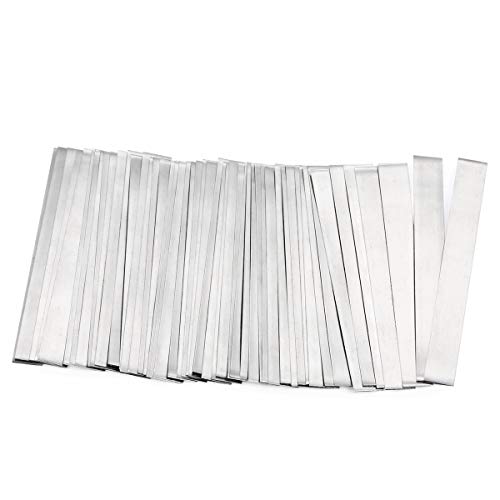
Key features: 99.6% purity; corrosion-resistant; suitable for spot welding and soldering; magnetic near room temperature. This strip is ideal for high-capacity 18650 packs and various battery configurations. Best for builders needing durable nickel strips that resist corrosion over time.
Who this is best for: hobbyists and professionals assembling large lithium battery packs who require a reliable nickel path with solid current carrying capacity.
Limitations: the strips are designed for spot welding and soldering, so exact current handling depends on your parallel/series configuration and welding technique. Use appropriate heat settings to avoid deformation.
AWithZ 9000W Battery Spot Welder

Key features: dual pulse output; rotary power control; safety with built-in temperature monitoring; sleep/shutdown after inactivity. This model supports 0.1–0.3mm nickel sheets and offers both foot pedal and hand operation for flexible workflows.
Who this is best for: users needing strong control over welding current and multiple operation modes for precise battery pack construction.
Limitations: high output requires careful handling; ensure compatible nickel sheet thickness and proper safety measures when welding heavy gauge packs.
Nickel Strips for Battery Welding, 0.15mm x 7mm, 10m Roll

Key features: 0.15mm thickness; 7mm width; high-conductivity and corrosion resistance; designed for reliable spot welding in battery packs.
Who this is best for: projects needing standard nickel strip dimensions for consistent welding results; suitable for 18650/21700 pack builds.
Limitations: design assumes typical current paths; unusual pack layouts may require alternative widths or thicknesses for optimal welds.
8000W Spot Welder, Docreate

Key features: 8000W output; dual pulse; 9-level adjustable power; foot pedal control; supports welding 0.1–0.3mm nickel sheets and assorted battery tabs.
Who this is best for: makers performing frequent, high-volume welding tasks who benefit from continuous operation and an adjustable power range. Better for robust pack builds and repairs.
Limitations: larger power requires appropriate safety precautions; ensure your workpiece thickness stays within the recommended range to avoid weld failure or damage.
Buying Guide: Nickel Strip Spot Welder Essentials
What to consider when selecting nickel strips and a spot welder for battery packs:
- Material purity and corrosion resistance: Higher nickel purity (around 99.6%) improves long-term reliability in battery connections.
- Thickness and width: Thinner strips (0.1–0.15 mm) suit delicate packs; wider strips distribute current more evenly in high-current builds.
- Current rating and welding capability: Match current handling with pack size and parallel/series configuration; use multiple strips if needed to increase current paths.
- Welding method and control: Spot welder models offer pulse, temperature monitoring, and adjustable power for different sheet thicknesses.
- Operation mode and safety: Foot pedal, hand control, and automatic modes provide flexibility; ensure proper ventilation and eye protection during welding.
- Portability and power source: Cordless devices enable mobility but depend on battery life; mains-powered units are often more robust for continuous work.
- Ease of use and setup: Visual displays, gear adjustments, and clear instructions help reduce setup time for beginners.
Frequently Asked Questions
- What thickness nickel strip is best for 18650 battery packs? For general 18650 packs, 0.15 mm (0.006 in) is common, but 0.1 mm can be used for very thin packs or delicate cells, while 0.2 mm offers higher current capacity.
- Can nickel strips be used for nickel plating? Yes. Pure nickel strips can be used for nickel electroplating to achieve a bright, corrosion-resistant surface.
- Is a higher wattage welder always better? Not necessarily. Higher wattage provides more welding power, but you must match it to the material thickness and current requirements to avoid damage.
- Do I need a spot welder with a foot pedal? A foot pedal offers hands-free operation and can improve precision for batch welds or tight spaces.
- How do I choose between different nickel strip widths? Consider current path length, contact area, and the number of parallel connections; wider strips reduce resistance but may fit poorly in tight spaces.
- Are these nickel strips suitable for NiMH or LiPo packs? Yes, the strips are designed for a range of battery chemistries including Li-ion, NiMH, and NiCd, depending on current and configuration.