Best Natural Gas Pressure Transducers for Accurate Monitoring
Choosing the right natural gas pressure transducer is essential for safe and reliable monitoring in gas systems, appliances, and industrial equipment. The following five products represent a range of common, durable options designed to handle natural gas, fuel oils, and related fluids with robust sensing technology. Each option supports varying pressure ranges and output signals to fit different installation needs and control systems.
| Product | Brand | Pressure Range | Output | Thread |
|---|---|---|---|---|
| FASTROHY 0.5-4.5V 60 Psi Universal Transducer | FASTROHY | 0–60 psi | 0.5–4.5 V | 1/8″ NPT |
| Hilitand 4-20mA Transmitter (0-1.6MPa) | Hilitand | 0–1.6 MPa | 4–20 mA | G1/4″ |
| Ronybuy 0-100 Psi Sensor (1/8″ NPT) | Ronybuy | 0–100 psi | 0.5–4.5 V | 1/8″ NPT |
| DriSentri 0-100 Psi Sensor (1/8″ NPT) | DriSentri | 0–100 psi | 0.5–4.5 V | 1/8″ NPT |
| LEFOO T2000 0-100 PSI Transmitter | LEFOO | 0–100 psi | 4–20 mA | G1/4″ |
Overview: The selection below highlights five products with robust materials, corrosion resistance, and compatibility with natural gas and related media. These transducers offer varying electrical outputs and fastening threads to fit common gas-and-liquid process lines, ensuring safe integration into existing control systems.
FASTROHY 0.5-4.5V Transducer For Gas And Oil

The FASTROHY unit is constructed from stainless steel, delivering durability for long-term use in oil, fuel, diesel, gas, water, and air pressure applications. It features a universal 0.5–4.5 V output that is suitable for low-power sensing modules and legacy control systems. Its 1/8″ NPT thread makes it a convenient drop-in replacement in many fuel and gas lines. This sensor is appropriate for mounting in oil tanks, gas tanks, and various fluid storage applications where compact sensing is valuable.
Hilitand 4-20mA Gas Pressure Transmitter 0-1.6MPa

The Hilitand pressure transducer is designed for stable performance with precision compensation technology. It offers multiple pressure ranges, including 0–1.6 MPa, and a compact, lightweight form factor that simplifies installation. The 4–20 mA output supports long-distance transmission and is compatible with host controllers and PLCs commonly used in gas, water, and oil systems. Its design emphasizes reliability under demanding environmental conditions.
Ronybuy 0-100 Psi Oil/Fuel Transducer

Ronybuy’s 0–100 psi sensor uses a 316 stainless steel body for corrosion resistance and a robust 1/8″ -27 NPT threading. It provides a 0.5–4.5 V linear output and operates across a wide temperature range (-40 to 105°C). The device is designed as a plug-and-play replacement for OE pressure transmitters in fuel, oil, air, and water systems. It is built to endure high-temperature environments and offer reliable readings over extended cycles.
DriSentri 0-100 Psi Sensor With Harness Kit
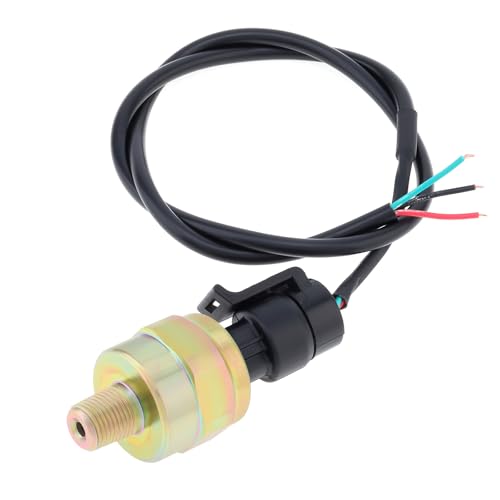
The DriSentri sensor is built from 316 stainless steel, offering high-temperature and chemical resistance with an impressive 500,000-cycle life. It features a 0–100 psi measuring range with a 0.5–4.5 V output, making it suitable for fuel, oil, air, and water measurements. Its IP65 waterproof rating ensures functionality in challenging environments, and the 1/8″ NPT thread guides straightforward installation alongside a harness kit for immediate wiring.
LEFOO T2000 0-100 PSI 4-20mA Transmitter

LEFOO’s T2000 transmitter supports a 0–100 psi range with a 4–20 mA output, using a G1/4″ pressure connection. It is designed for gas, water, and oil media and operates within an 8–36V DC supply. The unit emphasizes quick response time and strong performance under varied temperatures, making it a practical choice for control systems requiring accurate current-loop signals and reliable gas pressure monitoring.
Buying Guide
- Output type: Match sensor output to your control system. Voltage outputs (0.5–4.5 V) suit older or simpler controllers, while 4–20 mA outputs support longer cable runs and noise immunity in industrial environments.
- Pressure range: Select a range that covers normal operating pressure with a safety margin. Common ranges include 0–100 psi, and 0–1.6 MPa, depending on the application scale.
- Thread and mounting: Ensure the sensor’s thread size (1/8″ NPT or G1/4″) matches your fittings. Consider the physical footprint and whether a harness or mounting bracket is needed for installation.
- Media compatibility: For natural gas, ensure material compatibility (stainless steel bodies are common) and any exposure to oil, water, or fuels is accounted for in the design.
- Environmental rating: Look for IP ratings (such as IP65) to gauge dust and water ingress protection. Temperature tolerance is critical for outdoor or harsh environments.
- Durability and life: Stainless steel construction and high cycle life extend service intervals, reducing maintenance downtime in critical systems.
- Installation considerations: Some devices come with harness kits or pre-wired connections, simplifying field wiring and reducing installation errors.
- Calibration and accuracy: Review accuracy specs and any compensation features. Stable performance under temperature changes adds reliability to gas monitoring systems.
- Maintenance and replacement: Prefer units with readily available spare parts, and verify that the sensing element and seals can be replaced when needed.
- Standards and safety: Ensure compliance with local codes and safety standards for gas measurement equipment in your region.