Best MPPT Solar Charge Controller 60 Amp: Top Picks for Efficient Solar Charging
If you’re sizing a 60A MPPT solar charge controller for a 12–48V system, you want reliable power tracking, solid battery compatibility, and clear monitoring. This guide highlights five strong options and explains who each is best for. The focus is on controllers that deliver high tracking efficiency, flexible battery compatibility, and durable construction for RVs, off-grid cabins, boats, and workshops. The following table summarizes the selected models and their ideal applications.
| Product | ||
|---|---|---|
| LiTime 60A MPPT Solar Charge Controller | LiFePO4 and mixed-system setups | LiFePO4, Lead-Acid |
| PowMr 60A MPPT Solar Controller | Large parallel installations | LiFePO4, Lead-Acid |
| Renogy Rover Lite 60A | Versatile, rugged environments | Li, Gel, Flooded, AGM |
| PowMr MPPT Solar Charge Controller (Software Update) | Customizable battery setups | LiFePO4, Li(NiCoMn)O2, Sealed/Gel etc. |
| ECOBOSS 60A MPPT Solar Charge Controller | High-efficiency, multi-peak tracking | Lead-Acid and Lithium varieties |
LiTime 60A MPPT Solar Charge Controller — 12/24/36/48V Auto
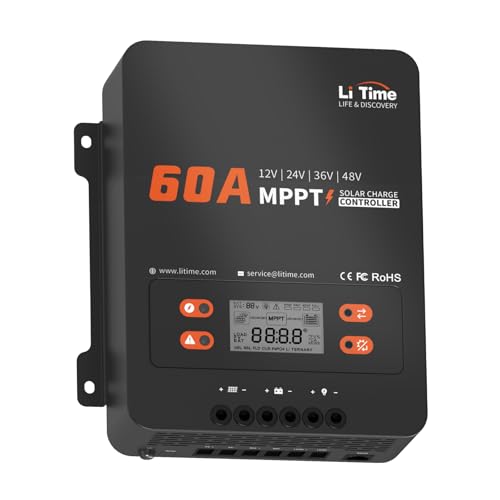
Best for LiFePO4 battery setups and mixed-system needs. The LiTime 60A MPPT controller features up to 200VDC PV input, multiple system voltages, and a clear LCD for system status. It supports LiFePO4 charging modes and auto-detects 12V/24V/48V for LiFePO4 while offering 12/24/36/48V/Auto for lead-acid systems. Its 99% tracking efficiency and up to 96% peak conversion efficiency provide strong power harvesting, especially in arrays with partial shading. The LCD and LED indicators help monitor charging progress and fault conditions. A potential limitation is the absence of built-in Bluetooth, which may require external monitoring solutions for remote access.
Who it’s best for: Home workshops or RV setups using LiFePO4 packs, or mixed-battery systems seeking a high-accuracy MPPT with a straightforward interface. Choose this if you want robust performance without wireless connectivity.
Why selected: High tracking efficiency, broad voltage support, and LiFePO4 compatibility cover common off-grid configurations while keeping the interface simple for quick setup.
PowMr 60A MPPT Solar Controller — 12/24/36/48V, Parallel Ready

Best for larger solar installations that may grow through parallel wiring. This PowMr controller supports up to 12 units in parallel, enabling scalable power for bigger systems. It offers a customizable charging current limit (2–60A) to accommodate different battery chemistries, and a wide PV input range that fits 12–48V systems with defined voltage ranges per configuration. The unit emphasizes dual cooling and heat dissipation via a die-cast aluminum body and a turbofan that activates at higher temperatures. A caveat is the reliance on external sensors for optimum operation in some setups.
Who it’s best for: Large RVs, commercial vehicles, or off-grid installations where modular expansion is anticipated. The ability to parallel multiple controllers is a key advantage for growing systems. Choose this if expansion flexibility matters most.
Why selected: Flexible parallel capability and robust cooling make it strong for higher-power needs, with clear protection and customization options.
Renogy Rover Lite 60A MPPT Charge Controller

Best for versatile systems needing broad battery compatibility and reliable performance in varied conditions. The Renogy Rover Lite 60A supports 12V–48V systems and a wide input range, enabling connection to six 200W panels in series for larger array configurations. It offers wide operating temperature tolerance and self-cooling design for stable performance in harsh environments. This model handles multiple battery types, including lithium, AGM, gel, and flooded lead-acid. A potential limitation is it may be less feature-rich in monitoring compared with some premium models.
Who it’s best for: Off-grid cabins, marine, and RV users who need a rugged, adaptable controller with broad battery compatibility and steady performance under tough conditions.
Why selected: The combination of high input capacity, broad battery support, and rugged design makes it a dependable workhorse for diverse setups.
PowMr MPPT Solar Charge Controller — 60A, Software Update

Best for highly customizable battery configurations and detailed system monitoring. This model emphasizes a software-update MPPT design with high efficiency (≥98.1%) and PV utilization (≥99%). It is suitable for 12/24/36/48V systems and supports a range of battery types (LiFePO4, Li(NiCoMn)O2, flooded, gel, sealed, NiCd). The device includes an LCD for real-time data and a diagnostic function to identify faults. A limitation is the complexity of parameter settings that may require careful configuration for optimal performance in certain chemistries.
Who it’s best for: Technically-minded installers who want fine-grained control over charging profiles and battery chemistry. Choose this if precise parameter tuning is important for longevity and efficiency.
ECOBOSS 60A MPPT Solar Charge Controller
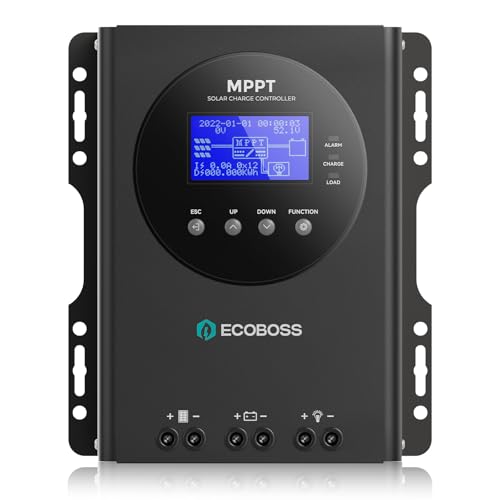
Best for high-efficiency multi-peak tracking and broad battery compatibility. ECOBOSS claims ≥99.5% tracking efficiency and 97.5% conversion efficiency, with auto-detection of 12V/24V/36V/48V battery systems. It supports lead-acid and lithium chemistries and offers real-time monitoring with automatic power reduction at high temperatures. Its multi-peak tracking is advantageous for shaded or partially shaded arrays. A caution is that some setups may require careful configuration to maximize the tracking gains in diverse weather.
Who it’s best for: RV, off-grid cabin, and marine users who value high tracking performance and automatic system protection in varying climates.
Why selected: The high tracking and versatile battery support make it a compelling choice for demanding off-grid or mobile installations.
Buying Guide: Key Considerations When Choosing a 60A MPPT Controller
- Battery chemistry compatibility: Ensure the controller supports the battery types you use (LiFePO4, Li-NiCoMn, flooded, gel, AGM, etc.).
- System voltage and PV input range: Match the controller to your panel array configuration and target system voltage (12–48V, auto-detection helps with mixed setups).
- Tracking and conversion efficiency: Higher tracking efficiency yields more harvest, especially under partial shading.
- Parallel expansion and scalability: If you plan to expand, consider controllers that allow parallel connection to increase total system capacity.
- Thermal management: Active or passive cooling affects performance in hot environments; look for heat dissipation features.
- Monitoring features: LCD/LED indicators and data logging help with on-site troubleshooting and parameter adjustments.
- Protection features: Overload, reverse polarity, short-circuit, and temperature protection extend battery and controller life.
FAQ
- What does 60A MPPT mean for my system? It refers to the maximum charging current the controller can handle, suitable for mid-sized solar setups with 12–48V batteries.
- Can I connect multiple 60A controllers in parallel? Some models allow parallel connections (up to a limit) to increase total capacity, helpful for larger systems.
- Which battery type is easiest to use with MPPT controllers? Lead-acid variants (flooded, gel, AGM) tend to be straightforward, while LiFePO4 requires proper voltage settings and protection features.
- Do MPPT controllers require Bluetooth or Wi-Fi for monitoring? Many models include LCDs for on-device monitoring; wireless options are available on some models but are not required.
- How important is temperature protection? High temperatures impair charging efficiency and battery life; look for controllers with automatic power reduction or cooling features.
- Is a 200V PV input rating necessary? It’s useful for larger panel strings and simplifies wiring, but ensure your array voltage stays within the controller’s spec.