Best Motorized ALR Projector Screens for Bright Rooms
Answering the common buyer question: which motorized ALR projector screens deliver bright, high-contrast images in well-lit spaces? The top picks below are best for living rooms, media rooms, or offices with ambient light. They emphasize Ambient Light Rejecting (ALR) surfaces, floor-rising or long-throw compatibility, and easy remote operation. The buyers most likely to benefit are home theater enthusiasts, apartment dwellers, and conference-room managers seeking sleek, space-saving screens that perform in daylight.
| Product | Screen Size | Throw Type | ALR Benefit | Best For |
|---|---|---|---|---|
| Acmejm 100″ ALR Motorized Floor Rising | 100″ | Long Throw | ALR surface for bright rooms | Living rooms and small theaters |
| AWOL VISION 120″ ALR Floor Rising | 120″ | Long Throw/Standard | High gain, wide viewing, 170° | Large family rooms, bright spaces |
| IN&VI 120″ ALR Floor Rising | 120″ | Long Throw | 85–95% light rejection in bright rooms | Multi-purpose living areas |
| IN&VI 100″ ALR Floor Rising | 100″ | Long Throw | Strong ALR for daylight viewing | Compact home theater setups |
| NothingProjector 100″ ALR Floor Rising | 100″ | Long Throw | ALR with auto-on/off sync | Basements and bright living rooms |
100″ ALR Motorized Floor Rising Screen — Acmejm

Best for living rooms or conference rooms where ambient light is a factor, this Acmejm screen uses professional-grade ALR technology to reject room light while delivering bright, high-contrast images with vivid colors. It is optimized for long-throw projectors, ensuring sharp focus across a large viewing area. The floor-rise design keeps all wiring hidden and the space uncluttered. Caution: check ceiling clearance and ensure the base area is free for full extension.
NothingProjector Motorized ALR Screen — 100″

Designed for basements and bright living spaces, this NothingProjector model features a 100-inch ALR surface with seamless auto-sync between projector and screen. The screen rises and retracts remotely, eliminating manual adjustments. Best for users who want a high-contrast display in daylight and minimal installation effort. Limitation: ensure your projector supports USB-trigger synchronization for the full auto-function.
AWOL VISION 120″ ALR Floor Rising Screen

This model uses premium ALR surface with a wide 170° viewing angle and 0.8 peak gain, tuned for 4K/8K content with active 3D support. A smart control box remembers the desired height and coordinates motor action, delivering a smooth, automatic rise and fall. Best for larger rooms needing robust brightness and a simple, automated setup. Caution: heavier screen and installation may require stronger mounting or floor support.
IN&VI 100″ ALR Floor Rising Screen

Designed for Ultra Short Throw projectors, this IN&VI screen provides bright, immersive visuals with strong ambient light rejection. The floor-rising design saves space and suits living rooms or apartments where a fixed frame is impractical. Best for compact setups requiring a hidden, clean appearance. Limitation: verify your UST projector compatibility and the pre-set rise height for your seating distance.
Acmejm 120″ ALR Motorized Floor Rising

Similar to the 100″ model, this 120″ screen emphasizes ALR performance and long-throw optimization for larger spaces. It is best for home theaters and conference rooms that require a bigger image with ambient-light resistance. Caution: ensure the install footprint allows full screen travel and that room lighting is adjustable for optimal contrast.
Aoxun Motorized Screen — 120″ Indoor/Outdoor
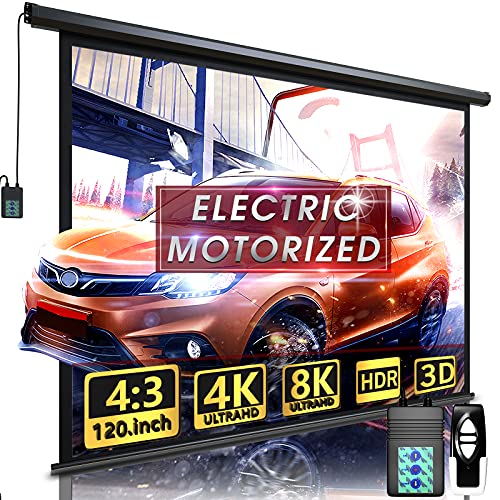
Suitable for both indoor and outdoor use, this model provides a 4:3 aspect and a 4-layer PVC matte screen with a 160° viewing angle and 1.2 gain. It includes a long-distance RF remote and a wall-mounted panel. Best for versatile environments and multi-use spaces. Limitation: 4:3 aspect may require letterboxing for 16:9 content.
Buying Guide
What screen size should I choose? Consider seating distance and room width. Larger rooms benefit from 120″ screens; smaller spaces may prefer 100″ to maintain image sharpness and brightness.
Which ALR technology is best? Look for screens that reject ambient light without washing out colors. A higher viewing angle (170°) helps groups seated off-center maintain image quality.
Floor rising vs. wall-mounted: Floor rising screens save space and hide the mechanism, but ensure enough floor clearance and ceiling height for full travel. Wall-mounted options avoid floor complexity but require confident mounting.
Compatibility notes: Ultra Short Throw (UST) models excel with short-distance projectors, while long-throw screens suit standard throw projectors and larger rooms. Verify projector compatibility with automatic syncing or IR control if you want hands-off operation.
Durability and maintenance: Choose screens with sturdy housings and easy-clean surfaces. Verify remote range and ease of motor operation, especially in shared rooms or multipurpose spaces.
FAQ
- What is ALR technology? Ambient Light Rejecting (ALR) surfaces reduce the impact of ambient light to preserve contrast and color in bright rooms.
- Are motorized screens reliable for daylight viewing? Yes, when paired with ALR surfaces and appropriate projector brightness, motorized screens perform well in well-lit spaces.
- Should I choose floor rising or wall-mounted? Floor rising saves space and hides mechanics; wall-mounted is simpler if you have fixed room constraints and ceiling height is limited.
- Do these screens work with Ultra Short Throw projectors? Some models are designed for UST projectors; verify the product notes for compatibility and recommended throw distance.
- Is auto-synchronization important? Auto-sync reduces manual adjustments by coordinating screen rise with projector power on/off, enhancing convenience in daily use.
- What should I check before buying? Screen size, throw type, ALR performance, viewing angle, remote operation, and room lighting conditions.