Best Motors for Science Projects and How to Pick the Right One
Choosing the right motor for a science project can transform a concept into a working, measurable demonstration. This guide highlights five versatile motor kits ideal for classrooms, makerspaces, and home experiments. Each option covers common voltages, gear options, and accessible wiring to help students explore electricity, magnetism, and motion. The featured products emphasize safety, instructional value, and hands-on learning.
Summary of Selected Products
| Product | Brand | Type | Key Benefits |
|---|---|---|---|
| EUDAX 6 Set DC Motors Kit | EUDAX | DC motors with wheels and accessories | Multiple speeds, complete setup for DIY experiments |
| 4 in 1 Solar Power & Electric Motor STEM Kits | CYOEST | Solar-powered car, fan, wind car, wooden plane | Solar and electric power learning, classroom use |
| Burnur Circuit Electric DC Motor Kit | Burnur | Complete circuit motor kit | All-in-one circuit components, easy science projects |
| Sntieecr Electric Circuit Motor Kit | Sntieecr | Motor kit with switches and bulbs | Hands-on electrical circuits, STEM applications |
| EUDAX 465PCS DC Motor Kit | EUDAX | Large parts kit for motor projects | Extensive accessories, many build options |
EUDAX 6 Set DC Motors Kit

This kit provides a compact assortment of DC motors designed for educational use. Features include a wide voltage range (3V-12V), a no-load speed spectrum of 9000-25000 RPM, and a 2mm propeller shaft. The package includes a 2x AA battery holder and a 9V clip connector, making it suitable for introductory experiments on motor speed, torque, and basic circuit design. Cautionary notes emphasize correct wiring to prevent overheating and short circuits. The varied motor colors and voltages help students observe how different power levels affect speed and performance.
Applied learning ideas for this kit include constructing a simple car, windmill, or propeller-driven device. Students can measure current draw at different voltages, compare no-load speeds, and explore efficiency by comparing added gears or propeller sizes. The multiple motor options encourage experimentation with speed control and load testing, all while reinforcing electrical safety practices.
4 In 1 Solar Power & Electric Motor STEM Kits

The 4-in-1 kit blends solar and electric power concepts in a single package. It includes a solar-powered car, solar fan, wind-powered car, and a wooden plane. Each model is individually packaged, with a magnetized screwdriver and step-by-step instructions. This kit is ideal for group demonstrations and home experiments, enabling learners to compare solar energy directly with battery-powered scenarios. It supports hands-on exploration of energy transfer, circuit completion, and how weather or light intensity influences performance.
Practical activities include timing the solar car under different light levels, comparing the speed of solar versus electric configurations, and examining how weight distribution affects results. The kit supports early STEM education goals by making abstract concepts concrete and visually engaging, while also serving as a national-standards-aligned classroom project option.
Burnur Circuit Electric DC Motor Kit

This comprehensive kit presents a complete circuit system for science projects. It includes a variety of wiring pieces, bulbs, a motor, switch, buzzer, and a battery holder, facilitating a broad range of experiments from simple on/off demonstrations to interactive experiments involving sound and light. The all-in-one design makes it convenient for teachers and parents to guide students through circuit-building steps, reinforcing concepts like series versus parallel connections, current flow, and energy conversion. Suitable for classroom STEM activities and DIY engineering explorations.
Learning objectives with this kit may involve constructing a working circuit with a motor to power a propeller or small fan, investigating how changing the switch or battery type affects performance, and documenting safe operating practices. The kit’s breadth supports varied proficiency levels, from beginners to more advanced students who want to prototype motor-driven devices.
Sntieecr Electric Circuit Motor Kit
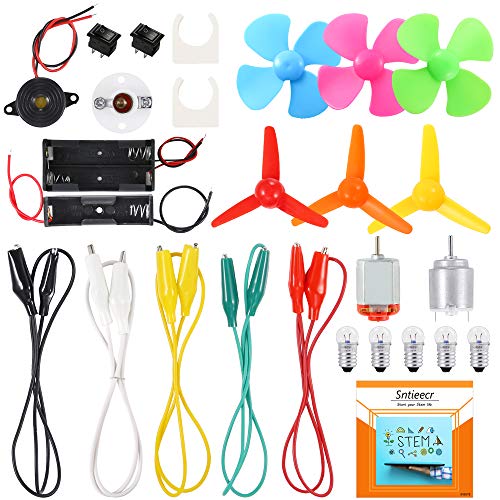
This kit emphasizes a hands-on approach to building electrical circuits around a motor. It includes two motors, switches, bulbs, propellers with multiple vane configurations, and an AA battery holder. The package is designed to support school science projects and Montessori-style learning, helping learners understand how electric energy converts to motion and how different circuit layouts influence outcomes. It’s well-suited for small-group activities or individual exploration, with clear parts lists enabling straightforward assembly and testing.
Potential activities include assembling a motor-driven propeller with different vane configurations to study thrust, or creating a simple motor-driven LED circuit to observe the relationship between current, resistance, and brightness. The kit’s practical components foster critical thinking, problem solving, and collaborative experimentation in STEM contexts.
EUDAX 465PCS DC Motor Kit

This expansive motor kit is designed for deep experimentation and creativity. With about 465 pieces, it supports numerous build options and at least 16 project ideas, according to the description. The kit includes LEDs, gears, and plastic parts to facilitate constructing motion-based demonstrations and more complex mechanisms. It emphasizes hands-on learning, encouraging students to design, assemble, and test their inventions, while fostering perseverance, creativity, and confidence as projects come to life.
Educational applications include lesson units on robotics basics, gear ratios, and motor control. Teachers can guide students through stepwise challenges—from simple on/off mechanisms to more intricate autonomous devices. The breadth of accessories makes this kit particularly suitable for extended projects and science fairs, where iterative design and testing are essential.
Buying Guide: Key Purchase Considerations
- Voltage and compatibility: Ensure the motor kit operates in safe voltage ranges (commonly 3V-12V). Consider whether you need a lower-voltage option for beginners or a broader range for advanced experiments.
- Educational scope: Look for kits that include wiring, switches, gears, and propellers for a complete learning experience, or opt for modular kits if you want to add components gradually.
- Project variety: Choose kits that support multiple projects (robotics, propellers, solar-assisted devices) to maximize learning opportunities and align with different curricula.
- Safety and durability: Prioritize kits with clear safety instructions, durable components, and non-toxic materials to support a classroom environment.
- Instruction quality: Detailed manuals or online resources help learners understand circuit layouts, motor behavior, and measurement methods, reducing setup time.
- Scalability: For groups or classrooms, consider whether a kit can be expanded with additional accessories or compatible parts from other brands.
- Assessment flexibility: Look for kits that enable objective measurements—speed, current draw, torque, and efficiency—to support quizzes, lab reports, and science fairs.
Overall, selecting a motor kit for a science project involves balancing instructional value, safety, and flexibility. The five options highlighted provide a mix of direct electrical motor experiments, solar-assisted demonstrations, and expansive accessory sets suitable for different learning stages. By pairing hands-on tasks with clear measurement goals, students can build tangible understanding of core physics and engineering concepts.