Best Mini Wind Turbine Generator Kit for STEM Learning
Whether you’re teaching a classroom of curious students or exploring renewable energy at home, a mini wind turbine generator kit makes learning hands-on and affordable. The top picks below are chosen for clarity, safety, and plating well with common STEM curricula. They’re best for classroom demonstrations, DIY science projects, or hobbyist experiments that illustrate how wind or small motors convert kinetic energy into electricity. The list focuses on kits suitable for different age ranges and skill levels—from beginner sets for kids to more capable motor kits for teens and adults.
| Product | Brand | Best For | Notes |
|---|---|---|---|
| ONHUMILLION Mini Wind Turbine & Hydroelectric Generator DIY Science Kit | ONHUMILLION | Educators & curious students | Dual power: wind and water; plug-and-play setup |
| Thames & Kosmos Wind Power V5.0 STEM Experiment Kit | Thames & Kosmos | Structured STEM exploration indoors/outdoors | 3 ft tall model; optimized for various settings |
| Small Wind Turbine Generator Micro DC Motor Power (QINIZX) | QINIZX | Older kids and teens with a DIY mindset | Requires external fan/blower for power; not wind-native |
| EUDAX 6 Set Mini Generator Motors 3V-12V | EUDAX | Hands-on electrical experiments | Multi-voltage set; versatile for motors and LEDs |
| Sntieecr 6 Set Mini Generator Motors | Sntieecr | Fundamental energy conversion demos | Similar to EUDAX with varied propellers |
ONHUMILLION Mini Wind Turbine & Hydroelectric Generator DIY Kit

The ONHUMILLION kit demonstrates renewable energy conversion through two power modes: wind and water. It uses a compact motor (about 16.5 mm cube) with a 26 mm fan and yields a low DC voltage range suitable for simple LED experiments. Best for: teachers introducing basic energy conversion concepts to younger students, or home learners seeking a quick, visual demonstration. Advantage: dual-power design encourages discussion about how different renewable sources work. Limitation: intended for small-scale demonstrations; real-world energy output is minimal, so don’t expect significant current for large loads.
Thames & Kosmos Wind Power V5.0 STEM Experiment Kit

The V5.0 kit is designed for more structured STEM exploration. It lets learners build a 3-foot-tall wind turbine and explore clean energy concepts with both indoor and outdoor setups. Best for: classrooms or families seeking a robust, expandable wind power project that aligns with science curricula. This kit emphasizes the technology behind wind power, historical context, and modern-day uses. Caution: outdoor use adds exposure to weather conditions that can affect components over time.
Small Wind Turbine Generator Micro DC Motor Power Kit (QINIZX)

This kit centers on a micro wind turbine driven by a larger fan blade arrangement. Note that it requires a controlled air source rather than relying on natural wind. Best for: older students or DIY enthusiasts who want to explore how blade size, RPM, and motor voltage relate to electricity generation. Limitation: not suitable for outdoor wind experiments without a proper wind source, as real-world wind is unpredictable for consistent results.
EUDAX 6 Set Mini Generator Motors 3V-12V

The EUDAX set provides six mini generator motors with multiple shaft propellers and mounting hardware. Best for: comprehensive classroom labs where students compare how different voltages and RPMs affect LED brightness and energy conversion. Why selected: the kits bundle multiple components, enabling varied experiments within one purchase. Caution: some users report a range in motor speed across units; test each component before large demonstrations.
Sntieecr 6 Set Mini Generator Motors
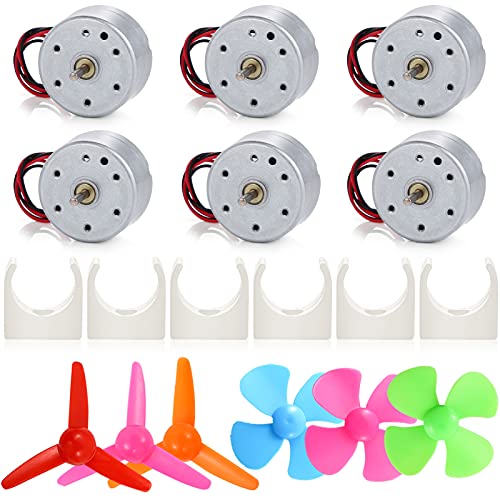
The Sntieecr kit offers six mini DC motors with varied propellers and holders to explore energy conversion in a compact format. Best for: foundational experiments in energy generation and early electronics projects. Why selected: similar in scope to the EUDAX set but with a different propeller mix for comparative learning. Caution: ensure safe handling of small motors during hands-on activities.
Buying Guide: Mini Wind Turbine Generator Kits
- What will you power? Identify target projects. If you mainly want to observe light indicators, a kit with LEDs and a small motor is ideal. For longer experiments or larger demonstrations, choose a kit with higher RPM ranges and flexible power outputs.
- Wind source considerations—natural wind works for outdoor use but is unpredictable. Kits like QINIZX require an external fan or blower to drive the turbine. Indoor-friendly kits often include components optimized for steady, small-scale output.
- Voltage and current ranges—start with low-voltage sets (DC 3V–12V) to avoid safety concerns and to simplify interpretation of results. Higher RPM motors can generate more voltage, but require more careful handling and measuring equipment.
- Education level and scope—beginner kits suit younger students with simple assembly and experiments. Intermediate kits include more components to explore efficiency, gear ratios, and power calculations. Advanced kits may involve multiple energy sources (wind, water) and more complex wiring.
- Durability and outdoor readiness—for outdoor demonstrations, look for weatherproof components or protective housings. Some kits are explicitly designed for indoor use, which can reduce weather-related wear and tear.
- Safety and supervision—small motors have exposed moving parts. Ensure supervision for younger learners and provide guidance on safe handling and power connections.
Frequently Asked Questions
- What is the main learning outcome of these kits? They demonstrate energy conversion principles, showing how wind or mechanical force can generate electricity and how load affects performance.
- Can these kits power real devices? Most are designed for LEDs, small indicators, or educational demonstrations rather than powering home electronics.
- Why use a dual-power kit? A dual-power kit helps learners compare wind and water energy conversion, highlighting how different input sources influence output.
- Are these kits safe for children? Most are designed for school-age learners with adult supervision, featuring low-voltage outputs and small components. Always follow the manufacturer’s safety instructions.
- Which kit is best for beginners? The ONHUMILLION kit offers an approachable, plug-and-play introduction with dual power modes, while the Thames & Kosmos Wind Power V5.0 provides structured activities for growing learners.