Best Medical Desktop Power Supply Solutions for Workstations
Direct answer: when selecting a medical-grade or medically inclined desktop power setup, seek compact, adjustable bench power supplies for precise voltage/current control, high stability, and reliable safety features. The top picks below cater to labs, clinics, and small medical workstations. They balance CV/CC control, clear readouts, and durable construction for sensitive equipment, testing rigs, and Arduino/embedded medical modules. This guide highlights five units and explains who benefits most from each option, plus a practical buying guide and FAQ to aid decision-making.
| Product | Best For | Key Benefit |
|---|---|---|
| Jesverty SPS-3010 | Bench labs and medical prototyping | Wide 0-30V, 0-10A with precise 4-digit display |
| Jesverty SPS-3010V | Low-noise bench power for experiments | 0-32V, 0-10A with encoder adjustments |
| FNIRSI DPS-150 | PC-driven lab setups | CC/CV, <20 mV ripple, multiple connection options |
| Thermaltake 600W PSU | Medical desktops requiring stable PC power | 80 Plus Certified, robust baseline performance |
| StarTech.com Power Cord | Reliable desktop wiring and peripherals | UL listed, 10A capacity for medical workstations |
Jesverty SPS-3010: 0-30V 10A Adjustable Bench Power Supply

The Jesverty SPS-3010 is a compact bench power supply designed for precision work in clinical labs and medical device prototyping. It offers a wide voltage range from 0 to 30 volts and current up to 10 amps, with a high-precision 4-digit display that shows voltage, current, and power in real time. This model is ideal for researchers or technicians who need accurate CV/CC behavior as loads vary, such as testing sensors or powering pilot medical hardware. It includes a 5V/2A USB port for auxiliary devices and rapid setup with coarse and fine adjustments for exact tuning.
Best for: engineering labs and medical prototyping benches where adjustable, clean power supports sensitive instrumentation. Better for: users who value real-time readouts and CV/CC automatic switching. Avoid this if: you require ultra-low ripple specifications beyond typical bench supply performance.
Pros and limitations:
- Pros: Clear 4-digit readout, CV/CC auto-switch, USB charging port, precise coarse/fine control.
- Limitation: Does not advertise ultra-low ripple specs beyond standard bench power levels.
Jesverty SPS-3010V: 0-32V 10A Bench Power Supply with Encoder

The SPS-3010V extends the standard SPS line with an advanced encoder-based coarse and fine adjustment system. This helps technicians dial in exact voltages and currents for delicate medical electronics and diagnostic devices. It provides a switchable CC/CV mode with a straightforward display that helps maintain stability for time-sensitive experiments. The unit includes USB-C and USB-A power options for auxiliary equipment, supporting typical desk setups where multiple devices require power without adding clutter.
Best for: users who need highly precise setting increments and improved workflow efficiency in a medical testing station. Better for: environments where quick, repeatable voltage targets are common, such as calibration rigs. Choose this if: you prioritize encoder-based adjustment over traditional knobs for repetitive tasks.
Caution: Always confirm that the supply’s voltage/current limits align with your device specifications to avoid overloading protected medical modules.
Thermaltake Smart 600W: ATX 12V Power Supply
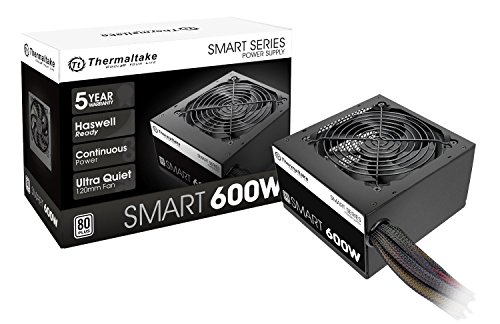
The Thermaltake Smart 600W PSU is a conventional computer power supply suitable for medical desktops that double as patient-monitoring or diagnostic workstations. It delivers a steady 600W continuous output, compliant with ATX 12V and EPS 12V standards, and features 80 Plus efficiency to minimize heat generation in compact work areas. Its active PFC helps maintain stable power delivery under varying loads, which is relevant when medical software or hardware spikes power needs during diagnostics.
Best for: medical desktop rigs that run standard PC components and demand reliable, efficient power. Better for: configurations with two PCIe devices or multiple peripherals that benefit from a stable baseline PSU. Limitations: not a compact bench-style supply; this is a full PC power supply intended for tower or mid-tower builds.
StarTech.com 10ft Computer Power Cord: 3-Prong NEMA to C13

The StarTech.com 10ft power cord provides a robust, UL-listed connection between medical desktops, monitors, and power supplies. It uses 18 AWG conductors and C13 to NEMA 5-15P connectors, rated for 125V and up to 10A. This cord is designed for stable, long cable runs in clinic spaces or lab benches, reducing the risk of loose connections that could interrupt critical equipment. It’s a practical upgrade to ensure dependable power delivery for medical workstations and peripherals.
Best for: medical workstations needing a durable, compliant power cord. Better for: setups where a longer, reliable cable is preferred to reduce strain on outlets. Limitation: does not address internal power supply performance; focuses on cabling reliability.
FNIRSI DPS-150 DC Power Supply: 30V 5A

The FNIRSI DPS-150 is a versatile DC power supply with 30 V, 5 A output and a four-digit IPS display. It is CC/CV switchable and offers <20 mV ripple, suitable for protecting precision medical equipment from voltage fluctuations. The DPS-150 supports PC programming and has multiple connection options, including 4mm banana heads and U-shaped terminals, which makes it adaptable to a range of medical devices and prototyping rigs. This model supports quick preset changes to streamline work in clinical research labs or hospital tech rooms.
Best for: lab and clinical environments needing stable programmable output with low ripple. Better for: projects requiring quick switching between preset voltage/current combinations. Choose this if: you rely on PC-based configuration for automatic test sequences.
Caution: verify that the unit’s preset programming aligns with your device’s max voltage/current to avoid accidental overshoot.
Buying Guide: Key Considerations for Medical Desktop Power Needs
Power quality matters in medical settings. Consider these questions when choosing a desktop power solution:
- What load will you power? Identify whether you need a bench supply, a PC PSU, or a simple power cord upgrade.
- Do you require CV/CC with automatic switching? For sensitive medical electronics, consistent voltage and current control reduces risk of damage.
- How precise must the readout be? Look for four-digit displays, and note voltage/current/power resolution for strict lab requirements.
- Is ripple or noise a concern? Medical instrumentation can be sensitive to fluctuations; check ripple specs when precision is critical.
- What connectivity is needed? USB ports or PC-programmable features can speed calibration and automated tests.
- What about safety and certification? UL-listed components and proper power cords reduce risk in clinical environments.
Practical Comparisons
- Best overall CV/CC performance: Jesverty SPS-3010 and SPS-3010V for precise lab work requiring accurate mode switching.
- Better for programmable workflows: FNIRSI DPS-150 with PC-based preset capabilities.
- Best for PC-based medical desktops: Thermaltake Smart 600W as a solid baseline PSU for standard PCs.
- Best for reliable cabling in clinics: StarTech.com 10ft power cord ensures stable connections to equipment.
FAQ
- What is CV/CC mode in power supplies? CV means constant voltage, CC means constant current. The supply switches between them based on load to protect devices.
- Why is ripple important for medical devices? Lower ripple means steadier voltage, reducing measurement noise and component stress.
- Do I need a PC-programmable power supply for medical testing? If you run automated test sequences, PC programmability can save time and improve repeatability.
- Can a standard ATX PSU power medical equipment? A standard PSU can power PC-based medical workstations, but ensure electrical safety and compatibility with the devices in use.
- Is a longer power cord needed for medical labs? Longer cords can help reach distant outlets, but ensure proper gauge and certification for safety.
- What safety certifications matter? UL, CE, and RoHS compliance reduce risk in clinical environments; always verify the product’s certifications.