Best Marine Shore Power Converters for RVs and Boats
If you need reliable DC power while docked or underway, a marine shore power converter is essential. This guide highlights five top options, explaining who each is best for and why. It’s ideal for boaters and RV owners seeking efficient charging, safe power management, and easy compatibility with common shore power setups.
Product Snapshot (quick reference):
| Product | Best For | Key Benefit |
|---|---|---|
| PD4560CSV Power Converter | RV and marine battery banks requiring 60A | Direct replacement for PD4500 Series with high amperage |
| WF-8955-MBA Power Converter | Lead-acid and lithium batteries needing smart charging | Three-stage smart charge suitable for multiple chemistries |
| Groovely 30A to 15A Extension Cord | Portable shore power conversions | ETL-listed, 125V compatibility, durable cable |
| Kanayu SS2-50P to L5-30R Adapter | 50A to 30A shore power transitions | Locking ring connectors for rugged outdoor use |
| 1ft 30A to 15A Marine & RV Cord | Compact adapters for mixed outlet setups | NEMA 5-15P to L5-30R, 10 AWG cable |
PD4560CSV Power Converter for PD4500 Series

The PD4560CSV is designed as a direct replacement for PD4500 Series Power Center units in RV and marine environments. It delivers up to 60 amps, enabling fast charging and maintenance of deep-cycle batteries when shore power is available. This converter provides steady DC distribution, helping to keep power available for essential systems and appliances. It’s best for boaters or campers who need a plug-and-play upgrade with high output for larger battery banks. A potential limitation is compatibility with non-PD4500 centers; verify fit before purchase.
WF-8955-MBA 55 Amp Smart Converter

The WF-8955-MBA is a three-stage smart charger suitable for both lead-acid and lithium batteries. It adapts charging based on battery type and state, making it a versatile option for mixed fleets. This product is best for buyers who want intelligent charge control to protect battery longevity. Best used in scenarios where battery chemistry varies or where long-term maintenance charging is needed. A limitation is that the exact compatibility with all WF Series units should be verified before integration.
Groovely 30 Amp to 15 Amp Marine Cord

This 1-foot Groovely extension cord converts 30A shore power to a 15A receptacle, enabling compatibility with standard 15A outlets on boats and RVs. It uses STW 10AWG copper conductors and is ETL-listed for safety. It’s best for quick, portable conversions when you need a compact adapter with reliable construction. Choose this for temporary setups or limited space. A caveat is the short length; longer runs may require additional cable or adapters.
Kanayu NEMA SS2-50P to L5-30R Adapter
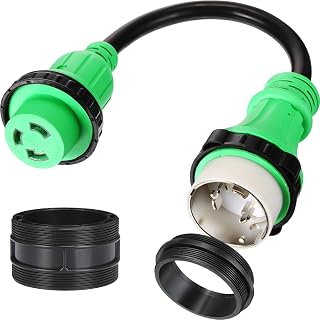
The Kanayu adapter transitions a 50A SS2-50P male plug to a 30A L5-30R female, featuring locking rings for rugged outdoor use. It uses 10AWG copper conductors and a flameproof PVC coating for durability. This option is best for boats or RVs needing a safe, secure way to connect 50A shore power to a 30A inlet. Consider its length and environmental exposure when planning placement; ensure compatibility with your inlet configuration.
1Ft 30A to 15A Marine & RV Cord

This compact 1-foot cord converts a 30A twist-lock inlet to a 15A household outlet, with NEMA L5-30R to NEMA 5-15P configuration. It uses STW 10AWG copper conductors and is ETL-listed. It’s best for quick, space-constrained setups where you need to run a smaller 15A circuit from a 30A shore power source. A limitation is the short length, which may require closer proximity to the power source.
Buying Guide: Key Considerations for Marine Shore Power Converters
What size and type of battery system do you have? Choose a converter that matches your total amperage needs and supports your battery chemistry. For mixed fleets, consider smart chargers that adapt to lead-acid and lithium batteries. Are your connectors standard in your area? Verify inlet and outlet compatibility, including locking-ring connections for outdoor use. How important is portability? Lightweight, shorter cords are convenient, but may limit distance from shore power. Do you need replacement compatibility? Some units are designed to fit existing RV or marine power centers, reducing install time. Look for ETL or equivalent safety listings for additional reliability.
What installation constraints exist? Check space, ventilation, and available DC distribution capacity. How about future expansion? If you plan to add batteries or upgrade systems, choose a converter with headroom and upgrade-friendly features. For outdoor use, pay attention to weatherproofing, cable gauge, and robust insulation. What about monitoring and maintenance? Smart chargers with state-of-charge feedback can extend battery life and reduce boil-off. Finally, consider warranties and service support from the manufacturer to ensure long-term reliability.
Frequently Asked Questions
- What is a marine shore power converter used for? – It converts shore power to suitable DC levels for charging and distributing power to onboard systems.
- Which amperage should I choose for RV or boat batteries? – Choose based on your battery bank size and peak load; larger banks require higher amperage to charge efficiently.
- Do all converters support lithium batteries? – Not all do; look for models advertised as compatible with lithium and lead-acid chemistries.
- Is a smart charger better than a basic converter? – Yes, smart chargers adjust charging profiles to protect battery longevity and performance.
- What safety features are important? – ETL listings, overcurrent protection, and robust weatherproofing are key.
- Can I mix adapters and cords from different brands? – Compatibility varies; use adapters and cords that meet standard NEMA/L5-30 or L5-20 specifications and ensure electrical ratings align.