Best Marine Battery Smart Chargers for Boats and Yachts
When choosing a marine battery smart charger, the goal is reliable, multi-bank charging that protects batteries in harsh conditions. This guide focuses on top-notch onboard chargers that handle lead-acid and lithium chemistries, with features like temperature compensation and overcharge protection. Ideal buyers include boat owners needing dependable maintenance, dockside technicians managing multiple batteries, and anyone upgrading to smarter, safer marine charging. Below is a quick buying table of five strong options, followed by detailed sections for each product.
| Product | Best For | Key Benefit |
|---|---|---|
| NOCO Genius GEN5X2 | Two-bank boat systems | 10A total, 5A per bank with independent modes |
| NOCO GEN5X3 | Three-bank system | 15A total, individual bank control |
| NOCO Genius10 | High-capacity maintenance | 10A per bank, strong cold-weather performance |
| NOCO GENIUS5 | Compact multi-battery setups | 5A per bank, versatile modes |
| Zrfmib Smart 2 Bank | Rugged, budget-friendly dual-bank | Waterproof, independent mode per battery |
NOCO Genius GEN5X2: 2-Bank Marine Charger

Best for two-bank onboard charging in demanding marine environments. This charger provides 10 amps total with 5 amps per bank, enabling independent charging of 12V lead-acid or lithium batteries. Modes include 12V, 12V AGM, 12V Lithium, and a 12V Repair Mode, allowing precise maintenance with temperature compensation for optimal performance. It’s ideal for boats with separate starting and deep-cycle banks. A limitation is that bulk charging capacity is split across two banks, which may slow charging if both banks are near empty.
NOCO Genius GEN5X1: 1-Bank Marine Charger
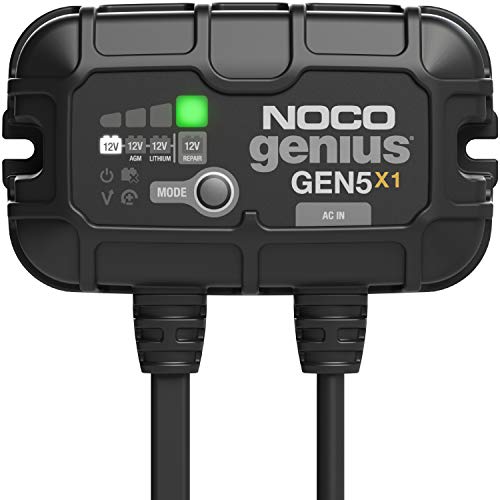
Better for single-battery setups or compact boats. This 5A single-bank charger provides independent charging with modes for 12V, 12V AGM, 12V Lithium, and a 12V Repair Mode. It’s compact and designed for harsh marine environments with overcharge protection and temperature compensation. Choose this if you only need to maintain one battery bank and prioritize space savings.
NOCO Genius10: 10A Dual-Voltage Charger
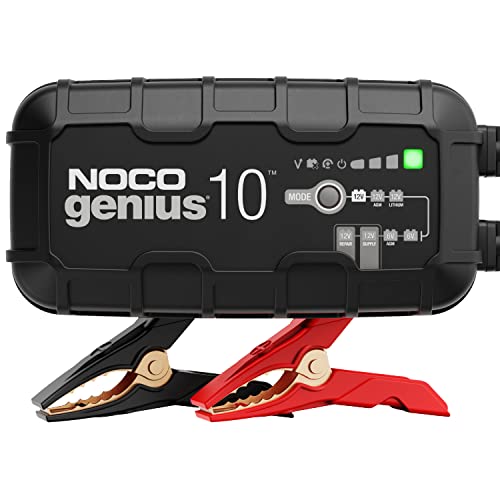
Best for higher charging demand and robust maintenance. The Genius10 supplies 10A with 6V/12V capability and includes a comprehensive set of modes for lead-acid and lithium batteries. It features thermal regulation to adapt charging to ambient conditions, helping prevent overcharging in heat and undercharging in cold weather. A potential limitation is its larger size compared to compact single-bank models.
NOCO GENIUS5: 5A Smart Charger

Designed for versatile, mid-range battery needs. The Genius5 offers 5A per bank with multiple modes for 12V lead-acid and lithium chemistries, including a temperature-compensation feature. It’s suitable for a boat with a couple of batteries or a small fleet of marine powersports. Limitations include moderate charging speed compared to higher-amp multi-bank units.
Smart 2 Bank Marine Battery Charger (Zrfmib)

Best for budget-conscious dual-bank needs. This charger supports 12V 10A total (5A per bank) with 12V SLA/AGM, 12V Lithium, and 12V Calcium modes. It can independently set modes per battery, and claims to rescue dead batteries for revival charging. Consider this option if you want a rugged dual-bank setup at a competitive price, but verify compatibility with your exact battery chemistries and storage conditions.
Buying Guide: Key Considerations for Marine Battery Smart Chargers
Purpose and Bank Configuration: Determine how many batteries you need to charge simultaneously. For small boats, a single-bank unit may suffice; for larger vessels, two- or three-bank chargers streamline maintenance and readiness.
- Compatibility: Check that the unit supports your battery types (lead-acid, AGM, Gel, VRLA, LiFePO4) and voltages (12V, 6V as needed).
- Charging Modes: Look for selectable modes per bank (12V, AGM, Lithium) and a repair or desulfation function for extended battery life.
- Temperature Compensation: Chargers with thermal sensors adjust charging based on ambient temperature to prevent overcharging in heat and undercharging in cold environments.
- Waterproof and Marine Durability: For exposed areas on deck or near bilge, choose a marine-rated IP-rated or rugged enclosure unit.
- Safety Features: Overcharge protection, reverse polarity, and dead-battery recovery modes protect both the charger and batteries.
- Size and Installation: Consider footprint and mounting options. A smaller form factor can fit tighter spaces on smaller boats.
Frequently Asked Questions
What does “multi-bank” mean in marine chargers?
Multi-bank chargers charge multiple batteries independently, allowing each battery to receive appropriate voltage and charging mode without affecting the others.
Why is temperature compensation important?
Temperature compensation adjusts charging based on ambient temperature to prevent overcharge in heat and undercharge in cold conditions, protecting battery health.
Can I use a marine charger with LiFePO4 batteries?
Yes, many marine chargers support LiFePO4 batteries in addition to lead-acid chemistries. Check the specific model’s compatibility in the product features.
Is it better to choose a higher-amp charger?
Higher amps charge faster but may generate more heat. Choose a charger that matches your battery bank size and charging needs to balance speed and safety.
What maintenance mode does a desulfator provide?
A desulfator helps reduce sulfation on lead-acid batteries, potentially improving performance and extending life when used correctly.