Best Marine Battery Options for RVs: Reliable Power on the Go
Choosing the right marine or RV battery ensures you have dependable power for days off-grid, weekends on the water, or extended camping trips. This guide compares five high-quality options, spanning AGM and LiFePO4 chemistries, to help American RV and marine enthusiasts select a battery that suits their load, climate, and charging setup. Each pick is evaluated on capacity, durability, charging behavior, and long-term value to keep your adventures powered.
| Product | Brand | Type | Approx. Capacity | Key Strength |
|---|---|---|---|---|
| Weize 12V 100Ah AGM | WEIZE | AGM | 100 Ah | Low self-discharge, maintenance-free |
| Weize Dual Purpose 24M | WEIZE | AGM | 90 Ah | Dual purpose, fast charging potential |
| Renogy Deep Cycle AGM 12V 100Ah | Renogy | AGM | 100 Ah | Strong safety track record, versatile in series/parallel |
| GRNOE 12V 100Ah LiFePO4 Group 31 (2-Pack) | GRNOE | LiFePO4 | 2 × 100 Ah | Long cycle life, built-in BMS |
| CHITOLI 12V 100Ah LiFePO4 Group 24 | CHITOLI | LiFePO4 | 100 Ah | Excellent cycle life, smart BMS |
Note: All selections are designed to support RV and marine applications, including off-grid cabins, trolling motors, solar charging setups, and weekend adventures. Practical considerations include weight, charging compatibility, and temperature performance, which influence overall reliability and length of service.
Weize 12V 100Ah AGM Battery
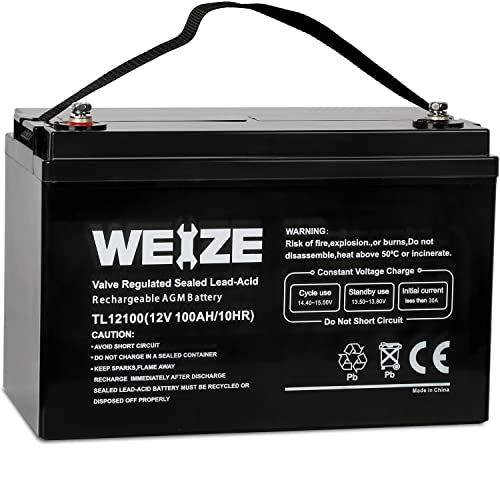
The Weize 12V 100Ah AGM battery is designed for maintenance-free operation in RVs, boats, and off-grid systems. Its AGM construction minimizes acid leakage and eliminates routine checks, while the compact 12.99 x 6.73 x 8.43 inch footprint fits many battery compartments. A notable feature is its low self-discharge rate, helping storage without frequent recharging. Operating temperatures span as low as 14°F to as high as 122°F, with a recommended mid-range environment around 77°F for best performance. With a maximum discharge current around 1100A for short bursts, it handles high-load surges common in RV starter or accessory circuits. Always pair with a compatible charger that respects AGM charging profiles to maximize lifespan.
Ideal use cases include RV house loads, solar storage, trolling motors, and marine accessories where maintenance simplicity matters. The left/right terminals provide straightforward wiring, though installations benefit from a diagram or professional guidance in tight compartments.
Weize BCI Group 24M Dual Purpose AGM Battery

The WEIZE BCI Group 24M is positioned as a dual-purpose option, combining starter and deep-cycle capabilities in a sealed AGM design. It emphasizes a low internal resistance for stable power output and longer cycle life—claimed to be two times that of traditional flooded batteries. Quick charging is promoted, enabling faster replenishment after use; however, users should observe recommended charging voltages (around 14.4V) and avoid extended charging beyond 24 hours. Its configuration supports both starting power and deep cycling, making it a versatile choice for RVs that require reliable ignition alongside living-area power. Temperature tolerance aligns with typical outdoor RV use, ensuring reliability in variable climates.
Practical benefits include easier maintenance, compatibility with 12V systems, and straightforward installation. When using in cold or hot environments, pairing with a BMS-friendly charger improves longevity and performance in daily cycles.
Renogy Deep Cycle AGM 12V 100Ah Battery

Renogy’s 12V 100Ah AGM battery is a globally trusted option for RV and marine setups. The sealed AGM chemistry reduces maintenance needs and lowers the risk of electrolyte spillage, which is beneficial in mobile environments. Renogy emphasizes safety and stability, with good performance in series or parallel configurations to scale capacity. The absence of a direct lithium option is compensated by robust safety profiles and broad compatibility with standard 12V charging systems. This battery excels in quiet, dependable power for living spaces, lighting, refrigeration accessories, and electronics in RVs and boats.
Design considerations include compatibility with solar charging systems and the need for a reliable charger that matches AGM charging requirements. In cold climates, ensure the BMS and battery management plan can support the expected discharge profiles to avoid unexpected power loss.
GRNOE 12V 100Ah LiFePO4 Group 31 (2-Pack)

This two-pack set from GRNOE uses LiFePO4 chemistry, offering high energy density with significantly lighter weight (roughly one-third of traditional lead-acid equivalents). Each 12V 100Ah cell is supported by a built-in BMS that guards against overcharge, deep discharge, overcurrent, short circuits, and thermal events. The kit emphasizes long cycle life, with the promise of thousands of cycles under balanced DoD usage, which translates into reduced replacement frequency and total cost of ownership for RVs and marine vessels. The compact, lighter design helps with weight management in trailers and boats. It’s important to follow the recommended charging profile (14.6V ± 0.2V) for optimal full-charge performance.
Potential drawbacks include higher upfront cost and the need for compatible lithium charging equipment. The BMS adds a layer of protection but requires correct integration with existing solar, alternator, or shore-power systems to maximize lifespan and safety in varying temperatures.
CHITOLI 12V 100Ah LiFePO4 Group 24 Battery

CHITOLI offers a Group 24 LiFePO4 option with a built-in 100A BMS that enables robust protection for RV, trolling motor, and marine energy storage. It emphasizes high cycle life—thousands of cycles under favorable depth of discharge—as well as stable performance across a range of temperatures. The battery claims a lighter weight and significantly higher energy density compared with standard lead-acid, which can improve payload capacity in an RV or boat. The smart BMS helps prevent common LiFePO4 issues like overcharge and deep discharge, contributing to user-friendly operation in mixed charging environments (shore power, solar, generator).
Practical usage notes include ensuring compatibility with your charging system’s voltage window and considering the need for ample headroom when running high-draw appliances. LiFePO4 chemistry shines when long life and weight savings matter, but system balance and proper charging are essential for best results.
Buying Guide: Key Purchase Considerations And Comparisons
- Chemistry choice: AGM batteries offer maintenance-free operation, robust safety, and broad compatibility with standard 12V chargers. LiFePO4 options deliver longer cycle life, far lighter weight, and deeper DoD, but require lithium-compatible charging equipment and possibly higher upfront costs.
- Capacity and DoD: If you routinely run appliances or large loads, aim for 100Ah or more at 12V with 50-80% DoD for lead-acid, or up to 100-100Ah in LiFePO4 with high usable capacity. Consider how you sum capacity across multiple batteries if you plan parallel configurations.
- Weight and space: LiFePO4 cells are significantly lighter per Ah, a critical factor for trailers or marine vessels with weight limits. AGM batteries are heavier but simpler to install in many existing compartments.
- Charging compatibility: Ensure your charger, solar controller, and alternator are compatible with the battery chemistry. AGM requires appropriate voltage control; LiFePO4 typically uses a 14.4-14.6V charging window with a smart BMS managing cell balance and safety.
- Temperature performance: Batteries have optimal operating ranges. Cold temperatures can reduce capacity and charging efficiency. Some LiFePO4 options include low-temperature protection features, while AGM batteries also tolerate a range but may require pre-warming strategies in extreme climates.
- Durability and maintenance: AGM batteries are generally maintenance-free, with strong spill resistance and vibration tolerance—useful for RVs and boats. LiFePO4 models offer superior cycle life and deeper DoD, translating into longer service life, especially when cycles are frequent.
- System integration: Consider your existing power setup—shore power, solar, or generator—and how you’ll balance multiple batteries in series or parallel. BMS complexity, wiring, and fusing requirements are important for safe and reliable operation.
In sum, for RVs and marine use where weight and long-term life matter, LiFePO4 options like the GRNOE and CHITOLI batteries provide significant advantages in cycle life and efficiency, provided charging systems are LiFePO4-compatible. For straightforward, maintenance-free reliability with broad compatibility, AGM options from WEIZE and Renogy remain strong contenders, especially when budget and installation simplicity are primary concerns.