Best 3-Bank Marine Battery Chargers for Boats and Yachts
Answering the need for reliable, multi-bank charging, this guide highlights top 3-bank marine battery chargers suited for boats, yachts, and other watercraft. These options are ideal for boaters who run multiple 12V batteries—such as house, starting, and deep-cycle packs—simultaneously. Whether you operate in saltwater or freshwater, these chargers emphasize compact design, IP68 waterproofing, and selectable charging modes to protect lead-acid, AGM, calcium, and lithium chemistries. The list below focuses on models that balance performance, durability, and ease of use for different boating setups.
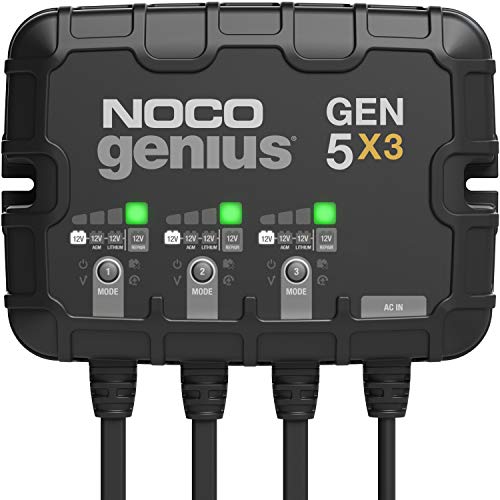
NOCO Genius GEN5X3: Compact 3-Bank, 15A Onboard Charger
The GEN5X3 delivers 15 amps total with 5 amps per bank, making it suitable for boats with three 12V batteries in parallel or separate circuits. It supports multiple charging modes per bank, including 12V, 12V AGM, 12V Lithium, and a Repair Mode. Independent bank operation helps protect each battery type—great for mixed fleets of lead-acid and lithium cells. This unit is designed for harsh marine environments and includes overcharge protection and temperature compensation for safer charging. Best for boaters needing a compact, durable 3-bank solution with versatile mode selection.
Who it’s best for: Small to mid-size boats with three 12V batteries using a mix of lead-acid and lithium chemistries. It’s ideal for offshore or coastal mariners who want reliably balanced charging with per-bank control.
Limitations to note: Lower total amperage means slower charge if all 3 banks are heavily discharged. Ensure your batteries can accept 5A per bank without triggering incompatibility.
NOCO Genius GENPRO10X3: 3-Bank, 30A Marine Charger
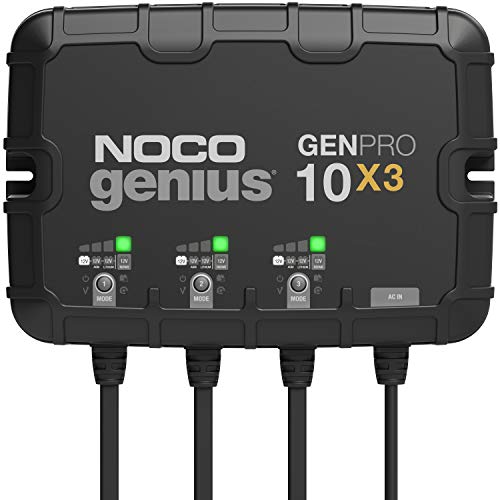
The GENPRO10X3 provides 30 amps across three banks, equating to 10 amps per bank. This makes it a strong option for boats with higher energy needs or larger battery banks. It features selectable modes per bank—12V, 12V AGM, 12V Lithium, and Repair Mode—allowing independent charging for lead-acid and lithium chemistries. The unit is designed to withstand tough marine conditions with waterproofing while offering precision maintenance through its smart circuitry. Best for larger boats or systems needing robust, evenly distributed charging across three batteries.
Who it’s best for: Boat owners with three sizable 12V packs or dual-deep-cycle arrangements requiring consistent 10A per bank and flexible battery chemistry support.
Limitations to note: Higher amperage per bank can generate more heat; ensure adequate ventilation and that installation follows all manufacturer guidelines.
Upgraded 3 Bank Marine Battery Charger 10X3: 30A Total

This model supplies 30A total with 10A per bank and includes IP68 waterproofing for 24/7 onboard charging. It supports three modes—12V SLA/AGM, 12V Lithium, and 12V Calcium—allowing independent mode selection for each bank. The Force Mode revives dead batteries by allowing charging to begin even when a battery is deeply discharged. Best for vessels that require continuous operation across several battery chemistries and need robust water ingress protection.
Who it’s best for: Boats needing reliable 3-bank charging with aggressive compatibility across SLA/AGM, LiFePO4, and calcium batteries, plus a dead-battery revival option.
Limitations to note: The manual mode operations may require a short learning curve to optimize each bank’s mode per battery type.
ProMariner ProSport HD 3-Bank Charger

The ProSport HD 3-Bank Charger manages 20 amps across three banks, using digital control for accurate charging and efficient distribution of available amperage. It emphasizes fast, precise charging and Distributed-On-Demand Technology, which allocates unused charging capacity to any battery as needed. This makes it a strong pick for mixed battery setups on boats that require dynamic power management. Best for mariners wanting smart, software-guided charging with flexible amperage distribution.
Who it’s best for: Boats with fluctuating power needs across multiple batteries who benefit from intelligent amp distribution and fast, controlled charging cycles.
Limitations to note: Slightly higher price point and potential reliance on onboard electronics for optimal performance.
MVMOD 3-Bank 15A Marine Charger: IP68 and Force Mode
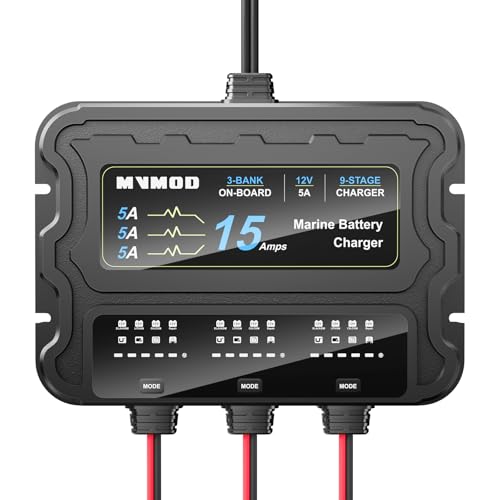
The MVMOD charger offers three independent banks at 5A each, totaling 15A. It supports all common 12V battery types (lead-acid and lithium) and features IP68 waterproofing, ensuring reliable operation in harsh marine environments. Independent bank control helps prevent cross-interference and enables customized charging per battery. Best for boats with smaller to mid-sized battery banks seeking a solid, weatherproof 3-bank solution.
Who it’s best for: Mariners looking for a compact, fully waterproof three-bank charger that handles a range of battery chemistries with a simple mode interface.
SOARFLY 3 Bank Marine Battery Charger, 12V 30A

The SOARFLY charger delivers 30A total, with 10A per bank for three independent channels. It supports 12V SLA/AGM, 12V Li-ion, and 12V Calcium modes, and allows independent control per battery or simultaneous charging. It includes Force Mode to revive dead batteries. Best for boat owners who want strong multi-bank performance with broad battery compatibility and flexible operation.
Who it’s best for: Users seeking a cost-effective, versatile three-bank option that handles multiple chemistries and includes dead-battery recovery.
anegine 3-Bank Marine Battery Charger, 12V 5A/Bank

This model provides 5A per bank across three banks, totaling 15A while allowing independent operation for balanced charging. It features IP68 rating and a Force Mode for reviving deeply discharged batteries. It supports lead-acid and lithium chemistries and is designed for marine use, car, RV, and boat charging needs. Best for compact installations where you need a dependable 3-bank charger with strong water resistance.
Who it’s best for: Smaller vessels or installations prioritizing waterproofing and independent bank control at a moderate total amperage.
Buying Guide
- Battery types supported: Look for chargers that support lead-acid, AGM, calcium, and lithium (LiFePO4). If you have mixed chemistries, choose models with independent bank modes and clear mode labeling.
- Amperage per bank: Decide based on your battery size and how quickly you want to recharge. Higher per-bank amperage reduces overall charging time but may require larger wiring and cooling considerations.
- Waterproofing and durability: IP68 rating or higher is ideal for exposed marine installations. Consider enclosure requirements and heat management in enclosed compartments.
- Charging modes and repair options: Modes like AGM, Lithium, and a dedicated Repair or Force Mode help revive deeply discharged batteries and tailor charging to each battery type.
- Independence of banks: Independent banks prevent cross-charging issues and allow simultaneous, different-mode charging for each battery.
- Installation considerations: Check for mounting space, ventilation, wiring gauge, fusing, and compatibility with your vessel’s electrical system.
- Maintenance and monitoring: Some models offer status indicators, fault alarms, or diagnostic capabilities. Consider how you will monitor charge health on board.
FAQ
- What is a 3-bank marine battery charger? It is a charger with three independent charging circuits that can simultaneously charge three 12V batteries, often with separate modes for each bank.
- Can these chargers work with lithium batteries? Yes, many listed models include 12V Lithium or LiFePO4 modes, but verify compatibility with your exact lithium chemistry.
- Is IP68 waterproofing necessary? For boats exposed to splashing or submersion risk, IP68 helps ensure the charger remains protected in marine conditions.
- Do these chargers maintain batteries during off-season storage? Some models include maintenance or desulfation functions, but always follow manufacturer guidelines for seasonal storage.
- Should I choose more amperage per bank or more banks? More banks provide flexibility for separate batteries; higher amperage per bank speeds charging. Choose based on your battery count, size, and desired charging time.
- What installation considerations matter? Ensure appropriate wiring gauge, proper mounting, ventilation, and protection from water exposure, with correct fusing and secure connections.