Best Marine Battery Charger Inverter Solutions for Reliable Power Onboard
If you need a marine battery charger inverter, you want a setup that can both convert DC to AC and charge from shore power or a generator without interrupting critical loads. The following five products represent solid choices for boaters seeking reliable pure sine wave output, smart charging, and marine-grade durability. This guide explains who benefits most from each option and why it’s a good fit, with practical caveats to consider. A quick buying table at the intro helps you compare key points at a glance.
Product Comparison at a Glance
- Victron Energy MultiPlus-II Pure Sine Wave Inverter Charger (120A/12V, 120V) — Best for advanced PowerControl and seamless shore/generator integration.
- ECO-WORTHY 1000W Pure Sine Wave Inverter Charger — Best value for moderate power needs with UPS-style reliability.
- NOCO Genius GENPRO10X3, 3-Bank 30A — Best for multi-bank, higher-load marine systems with flexible charging modes.
- NOCO Genius GEN5X2, 2-Bank 10A — Best for compact, space-conscious boats needing two-charger flexibility.
- FirstPower Pro 2 Bank 5X2 — Best budget-friendly two-bank option with independent modes for each bank.
Victron Energy MultiPlus-II Pure Sine Wave Inverter Charger

The MultiPlus-II integrates true sine wave inverter power with an advanced charger and PowerControl/PowerAssist options. It supports external current sensing to optimize self-consumption and islanding protection, with built-in compliance for many regions. The standout feature is fast, seamless transfer when grid power drops, keeping critical loads powered within 20 milliseconds. This is ideal for boats that rely on shore power or generators but want reliable islanding protection and smart power sharing.
Best for: Boats that require high reliability, robust power management, and automatic support during generator or shore outages. The unit is well-suited for larger cabin systems that need efficient, automated load support and the ability to optimize AC usage with external sensing.
Caution: Installation and configuration can be more complex. Ensure your battery bank size and AC input source can be properly integrated to maximize PowerAssist benefits.
ECO-WORTHY 1000W Pure Sine Wave Inverter Charger

This 1000W inverter with a 55A charger combines power conversion and charging in one package. It includes a 20ms UPS-style transfer, ensuring uninterrupted power when grid power fails. Pure sine wave output supports delicate electronics, and the unit provides multiple protections for safety. It is a strong choice for mid-size marine setups needing reliable, all-in-one functionality without breaking the budget.
Best for: Small to mid-size boats, RVs, or campers needing a compact, cost-effective UPS-enabled inverter charger with solid protection features. It’s particularly good when you want stable output for everyday appliances and some sensitive devices.
Caution: Peak power is limited; avoid running heavy appliances at full load for extended periods unless you verify compatibility with your specific devices.
NOCO Genius GENPRO10X3, 3-Bank 30A Inverter Charger
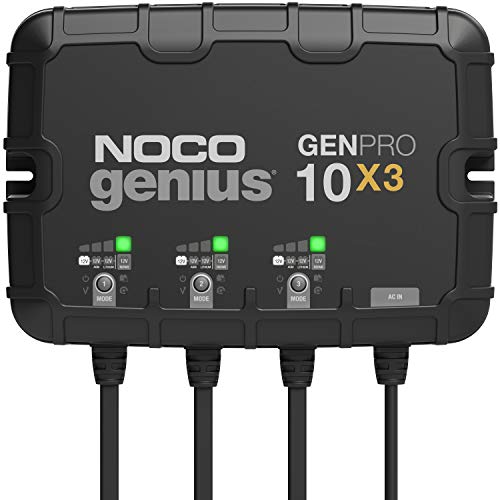
The GENPRO10X3 delivers three banks with a combined 30A charging capacity, offering independent charging for each bank and flexible modes for 12V lead-acid and lithium batteries. It is designed to endure harsh marine environments and provides precise maintenance charging. The unit is a fit for boats with separate battery banks for house, starting, and auxiliary systems, where tailored charging per bank matters.
Best for: Boats with multiple battery banks needing dedicated charging profiles for different battery chemistries. Choose this when you want precise bank-by-bank control and robust protection features for marine use.
Caution: Higher upfront investment and installation complexity; verify wiring space and cooling for three banks in confined areas.
NOCO Genius GEN5X2, 2-Bank 10A Onboard Charger

The GEN5X2 offers two independent banks with 5A per bank, enabling separate charging workflows for two battery strings. It supports 12V SLA/AGM, 12V Lithium, and a repair mode to recover weak batteries. Its compact footprint makes it appealing for smaller vessels or installations where space is at a premium. It’s a reliable, space-efficient choice for dual-bank systems with diverse battery chemistries.
Best for: Smaller boats or tight engine rooms needing a two-bank charger with straightforward setup and flexible mode options. It’s better for lighter duty top-ups and maintenance rather than heavy daily peak loads.
Caution: Lower total charging amperage means slower recovery for large deep-cycle systems; ensure it matches your battery size and usage patterns.
FirstPower Pro 2 Bank 5X2 Marine Charger

The 2-bank charger offers independent 5A-per-bank charging with IP68 waterproof protection, making it well-suited for 24/7 onboard charging. It supports multiple modes and can charge SLA/AGM, lithium, and calcium batteries. This unit emphasizes durability and simplicity for dual-battery systems and is a cost-conscious choice for boats that need dependable daily charging in marine environments.
Best for: Budget-conscious boats with two battery banks needing reliable maintenance charging and robust waterproofing for continuous offshore use. Choose this if you prioritize durability and straightforward operation over high amperage charging.
Caution: Lower total amperage may not meet high-demand scenarios; plan battery capacity accordingly and consider additional charging capacity if needed.
Buying Guide: How to Choose a Marine Inverter Charger
- Power needs: Match inverter wattage to your typical load. If you run microwaves, AC units, or power tools, choose higher continuous wattage and peak ratings to avoid overloads.
- Bank configuration: Determine how many battery banks you have and whether you need independent charging modes per bank. This affects charger choice and wiring complexity.
- Battery chemistry: Ensure the charger supports your batteries (lead-acid, AGM, Gel, LiFePO4). Some models offer multiple modes for different chemistries; this improves longevity and safety.
- Grid interaction: If you rely on shore power or a generator, evaluate features like PowerAssist, PowerControl, and auto-transfer time. Quick transfer minimizes load interruption for sensitive devices.
- Protection and durability: Look for IP ratings, thermal management, overcharge protection, short-circuit protection, and compatibility with harsh marine environments.
- Installation and space: Consider dimensions, mounting options, and wiring space. Higher-bank units require more cabinet space and careful cable routing.
- Future expandability: If you plan to add more batteries or extend loads, choose a model that supports future upgrades or higher input/output ranges.
Buying Guide: Quick Comparison by Scenario
- Best overall for large boats with complex power needs: Victron Energy MultiPlus-II Pure Sine Wave Inverter Charger. Why: advanced power management, fast transfer, and PowerControl/PowerAssist options.
- Best budget all-in-one for mid-size systems: ECO-WORTHY 1000W Pure Sine Wave Inverter Charger. Why: strong UPS behavior and solid protection features at a lower cost.
- Best for multi-bank control: NOCO Genius GENPRO10X3. Why: dedicated three-bank charging with versatile modes for different chemistries.
- Best compact two-bank option: NOCO Genius GEN5X2. Why: space-efficient with flexible mode choices for two banks.
- Best dual-bank value with marine-grade protection: FirstPower Pro 2 Bank 5X2. Why: waterproof design and dependable two-bank charging at a sensible price.
Frequently Asked Questions
- What is a marine inverter charger used for? It combines an inverter to produce AC power from DC and a battery charger to replenish batteries from shore power or a generator, often with smart management to protect loads.
- Do I need pure sine wave output? Yes for most electronics and appliances, especially sensitive devices, to prevent flicker and damage.
- How many amps should my charger provide? Choose based on your total battery bank capacity and expected load. More amps can charge batteries faster but require more space and wiring.
- Can I use multiple chargers on the same battery bank? It depends on the model. Some offer multi-bank setups with independent charging; ensure configuration compatibility and proper synchronization.
- What maintenance is required for marine chargers? Regularly inspect connections, ensure ventilation, check cooling, and monitor battery health and state of charge to optimize performance.
- Is installation difficult? Advanced units may require professional installation, especially when integrating PowerAssist/PowerControl with shore power and grid-tie considerations.