Best Marine Battery and Charger Solutions for Your Boat or Yacht
Answering the question you likely have: which marine battery charger combination offers reliable charging, protects against overcharge, and works with different battery chemistries? This guide highlights top onboard chargers optimized for boats, pontoons, and other watercraft. It’s ideal for anglers, weekend sailors, and captains who want simple maintenance and robust protection. Below, five carefully chosen options are compared by bank count, charging modes, and battery compatibility to match varied setups from small rib boats to larger vessels. A quick buying table follows to help you decide at a glance.
| Product | Banks | |||
|---|---|---|---|---|
| NOCO Genius GEN5X2 | 2 | 10 | Medium boats with mixed battery types | Independent bank charging with multiple modes |
| NOCO Genius GEN5X3 | 3 | 15 | Larger boats needing more capacity | Three independent banks |
| ProMariner ProSport HD 44021 | 3 | 20 | High-amp, multi-bank maintenance | Distributed-On-Demand technology |
| FirstPower Pro 5X2 | 2 | 10 | All 12V lead-acid & Li-ion on the water | IP68 waterproof, flexible modes |
| FirstPower Pro 10X3 | 3 | 30 | Commercial-grade 3-bank charging | Multiple mode options, force mode |
NOCO Genius GEN5X2: 2-Bank Onboard Charger
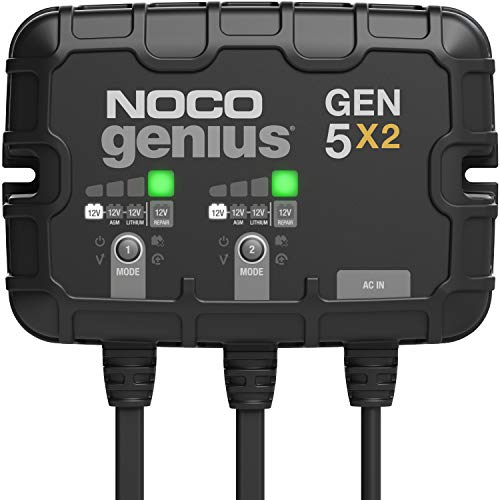
Best for mid-size boats needing reliable dual-bank charging. The GEN5X2 delivers 10 amps total with 5 amps per bank and supports 12V lead-acid and lithium batteries. Modes include 12V, AGM, Lithium, and a Repair mode for maintenance. Its compact design suits tight bilges and crowded compartments while offering temperature compensation for variable marine climates. Best for owners who want precise, independent bank control without sacrificing space. A potential limitation is that higher-demand setups may benefit from a third bank for simultaneous higher-capacity needs.
NOCO Genius GEN5X3: 3-Bank Onboard Charger
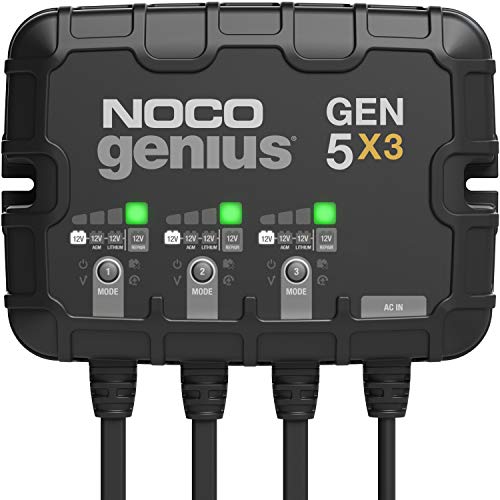
Best for larger vessels with multiple battery banks and varied chemistries. The GEN5X3 provides 15 amps across three banks (5A per bank) with selectable modes for each bank: 12V, AGM, Lithium, and Repair. This setup supports independent charging of marine, starter, deep-cycle, and auxiliary batteries. Choose this if you regularly run several systems or keep many batteries in the boat. A caveat is that three independent banks require compatible space and wiring for optimal installation.
ProMariner ProSport HD 44021, 20A, 3 Bank

Best for boats needing fast multi-bank charging with distributed power. The ProSport HD uses microprocessor-based charging and 100% available amps directed where needed. It supports three batteries and emphasizes precise, fast charging with smart distribution. Suitable for cruisers or fishing boats that rely on multiple electrical circuits. A possible limitation is that higher power may demand robust mounting and sea-rated wiring to accommodate 20A without overheating.
FirstPower Pro 5X2: 2-Bank 10A Charger

Best for 12V systems that require dependable two-bank charging with marine-grade protection. It features IP68 waterproof sealing and three charging modes (SLA/AGM, Lithium, Calcium) with independent bank control. It’s well-suited for smaller to mid-sized boats that operate year-round. A limitation is that two banks may be less ideal for crews running numerous ancillary systems, where a third bank could provide extra capacity.
FirstPower Pro 10X3: Upgraded 3 Bank, 30A

Best for serious multi-battery systems on larger boats. The 10A per bank across three banks totals 30A, with IP68 waterproofing and independent bank modes. It supports 12V SLA/AGM, Lithium, and Calcium chemistries, plus a Force Mode to initiate charging on deeply discharged packs. Choose this if you manage several batteries and need robust, continuous maintenance on a larger vessel. A caveat is that installation complexity increases with more banks and wires.
Buying Guide: Key Purchase Considerations
- Bank count and total amperage: Match the charger to the number of batteries and expected simultaneous charging needs. More banks allow independent charging for separate systems.
- Battery chemistry support: Ensure compatibility with lead-acid, AGM, GEL, and lithium (LiFePO4). Some models include dedicated modes for each chemistry.
- Waterproofing and durability: Look for IP68 or higher for onboard use and saltwater environments. Consider enclosure and mounting requirements.
- Charging modes and repairs: Features like AGM, Lithium, and a Repair/Force mode help maintain and restore battery health, especially after deep discharge.
- Installation space and wiring: More banks require more cable length and circuit protection. Plan routing to minimize heat and interference with engines.
- Maintenance and monitoring: Some units provide smarter diagnostics and temperature compensation to optimize charging in hot or cold climates.
FAQ
- Do marine battery chargers work with lithium batteries? Yes, many models offer dedicated lithium modes and temperature compensation for LiFePO4 cells.
- Is a higher bank count always better? Not necessarily. Choose a bank count that aligns with your number of batteries and how you plan to use them simultaneously.
- What is temperature compensation and why does it matter? It adjusts charging based on ambient temperature to prevent overcharge or undercharge, extending battery life.
- Can I use a 12V charger on dual 6V batteries? Some 12V chargers support series-connected configurations or require a different voltage setting; check the manual for compatibility.
- What maintenance features should I expect? Look for idle/float modes, repair or desulfation features, and automatic mode switching between charging and maintenance.
- Do these chargers require professional installation? Installation can be straightforward but may require a marine electrician for optimal wiring and compliance with local codes.