Best Marine AGM Battery Charger Options for 2026
If you need a reliable marine AGM battery charger, you want options that are rugged, waterproof, and capable of maintaining both lead-acid and lithium batteries. This guide highlights five top selections, explains who each product is best for, and compares charging capabilities to help you pick the right charger for your boat or yacht.
Buyer focus: The top picks here are ideal for seriou s boaters, professional captains, or weekend sailors who require dependable multi-bank charging, temperature compensation, and compatibility with AGM batteries. A quick summary follows, then deep-dive product sections.
| Product | Bank Count | Max Amps | Best For |
|---|---|---|---|
| NOCO Genius GEN5X2 | 2 | 10 A total (5 A per bank) | Small boats needing robust 2-bank charging with AGM/Lithium modes |
| NOCO Genius GEN5X1 | 1 | 5 A | Compact boats or daysailers requiring a single-bank charger |
| NOCO Genius GENPRO10X1 | 1 | 10 A | Single-battery systems with high-output needs |
| NOCO Genius GEN5X3 | 3 | 15 A total (5 A per bank) | Three-bank systems on larger craft needing individual bank control |
| FirstPower Pro 2 Bank 5X2 | 2 | 10 A total (5 A per bank) | IP68-rated, 24/7 charging for diverse battery chemistries |
NOCO Genius GEN5X2: 2-Bank, 10A Marine Charger
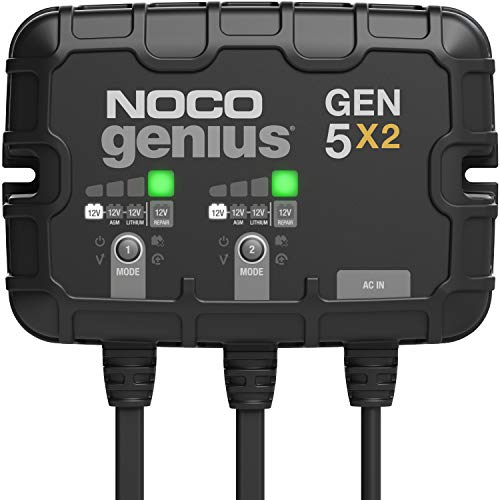
The GEN5X2 provides two independently controlled charging banks, up to 10 amps total (5 per bank). It supports 12V AGM and 12V Lithium modes in addition to standard 12V charging, with temperature compensation for consistent performance in varying climates. Best for boaters who need flexible, dual-bank charging in one compact unit. Caution: ensure proper venting and waterproofing in extreme bilge conditions; verify battery type compatibility for full feature use.
NOCO Genius GEN5X1: 1-Bank, 5A Onboard Charger
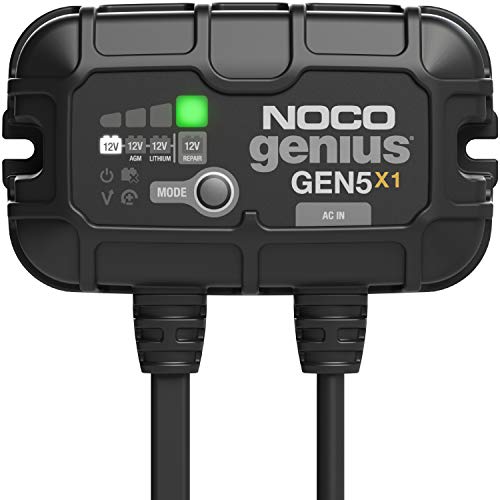
The GEN5X1 delivers a single 5-amp output with flexible charging modes for 12V lead-acid and lithium batteries. It’s ideal for smaller craft or auxiliary power setups where space is at a premium but reliable AGM/Lithium charging remains essential. Choose this if your system runs a primary 12V battery with occasional maintenance charging. Limitation: single-bank design means zero redundancy in charging if the unit fails.
NOCO Genius GENPRO10X1: 1-Bank, 10A Onboard Charger

The GENPRO10X1 features a higher-output 10A single bank, suitable for boats with a single high-demand battery or deep-cycle system. It supports multiple battery chemistries and includes temperature compensation. Best for boats where one battery bank drives most systems, offering robust charging without multi-bank complexity. Caution: not ideal if you need independent maintenance for multiple batteries without additional banks.
NOCO Genius GEN5X3: 3-Bank, 15A Charger
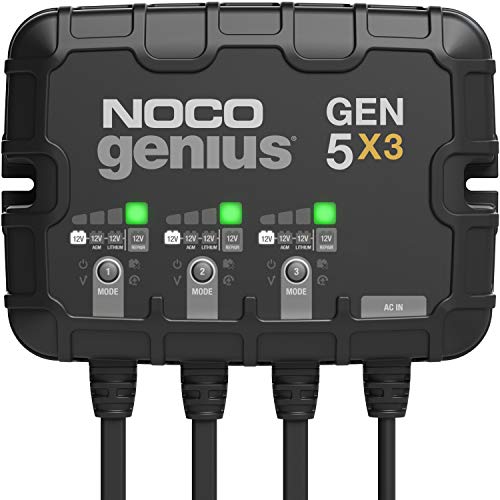
The GEN5X3 offers three independently controllable banks (5 A per bank, 15 A total). It’s well-suited for larger boats with separate battery banks for starting, house, and trolling motors. Best for crews who want precise bank-by-bank charging and maintenance with robust protection features. Limitation: larger footprint than 1- or 2-bank models; ensure mounting space on deck or in the battery compartment.
FirstPower Pro 2 Bank 5X2: 10A Marine Charger

This 2-bank unit delivers 5 A per bank and is designed for 12V SLA/AGM, 12V Lithium, and 12V Calcium batteries. It features IP68 waterproofing for fully sealed operation and allows both banks to charge simultaneously. Best for saltwater berths or open-water boats where a rugged, 24/7 charging option is needed. Caution: check mode options on each bank to ensure proper mode selection for your battery chemistries.
Buying Guide
What to consider when choosing a marine AGM charger
- Bank count and expansion: Determine how many banks you need now and in the future. More banks allow independent charging and maintenance for multiple batteries.
- Maximum charging current: Higher amperage is beneficial for deep-cycle or high-demand systems, but ensure your battery bank can accept the rate.
- Battery chemistry support: Verify compatibility with AGM, lithium (LiFePO4), calcium, and other 12V chemistries to avoid mischarging risks.
- Waterproofing and ruggedness: Look for marine-grade IP ratings (e.g., IP68) and robust housings for installation in exposed locations.
- Temperature compensation: Chargers with temperature sensors adjust charging based on ambient temperature, protecting battery longevity.
- Maintenance features: Repair modes, desulfation, and smart balancing help extend battery life and reduce maintenance.
- Installation footprint: Measure space in the battery compartment or preferred mounting area to ensure fit.
- Ease of use: Independent banks with clear mode selectors simplify setup when dealing with diverse battery types.
FAQ
- What is a marine AGM battery charger best for?
Marine AGM battery chargers are designed to safely charge and maintain AGM and lithium batteries in harsh marine environments, with features like temperature compensation and waterproof housings.
- Do I need a multi-bank charger on a small boat?
Not always. A single-bank charger can suffice for small systems, but multi-bank models offer independent charging for separate batteries such as starting, house, and trolling motor batteries.
- What is temperature compensation and why is it important?
Temperature compensation adjusts charging voltage based on ambient temperature, reducing overcharge in heat and undercharge in cold, which protects battery life.
- Are lithium batteries supported by these chargers?
Yes, the listed NOCO chargers include 12V Lithium modes, enabling safe charging of LiFePO4 and similar lithium chemistries when compatible with the bank’s mode selection.
- Should I choose 2-bank or 3-bank chargers for a mid-sized boat?
For boats with two or three battery banks (starting, house, and auxiliary), a 2-bank or 3-bank model provides better management and longer battery life, depending on your configuration.