Best Marine 12V Power Distribution Block Options for Boats and RVs
Find the right 12V power distribution block for marine use with solid durability, ample current capacity, and easy wiring. This guide highlights five reputable options suited for boat batteries, solar setups, and automotive wiring. It helps boat owners, RV travelers, and marine electricians compare capacities, terminal types, and installation details to choose a model that reduces clutter and lowers the risk of shorts.
Summary of chosen products
| Product | Key Benefit | Best For |
|---|---|---|
| RVBOATPAT Power Distribution Block 12V 150A | Dual bus bars, 1/4″ and M6 terminals | Small to mid-size marine wiring, compact layouts |
| Joinfworld 12V 250A Power Distribution Block | 4 x 3/8″ studs, wide cable compatibility | Higher current requirements, heavy wiring |
| RVMARINEPAT 12V Bus Bar 250A | 6 x 5/16″ studs, round base for stability | Marine systems with multiple large connections |
| Avelis Bus Bar 12V 150A | Solid copper, locking covers | Durable, vibration-prone environments |
| Aienxn Marine Bus Bar 150A | Buckle bottom design for secure mounting | Rough installations, secure terminal coverage |
RVBOATPAT Power Distribution Block 12V 150A

This 12V bus bar handles up to 150A and supports a maximum 48V DC system, making it suitable for most marine battery banks and solar charging setups. It includes a positive and a ground bus, two covers, and multiple lug options (2 x 2 AWG, 24 x terminals), enabling versatile wiring routes. Best for compact boats or RVs where space is limited and a straightforward, dual-bus solution is needed. A limitation is the fixed 150A max, which may be insufficient for very large power draws.
Joinfworld 12V 250A Power Distribution Block

This distribution block offers a higher 250A rating with four 3/8″ studs, plus a thicker copper bus plate for broader cable compatibility. It supports both POSITIVE and NEGATIVE blocks, ensuring robust connections for larger boats or systems with heavy wiring. Best for users needing higher current capacity and flexible wiring routes. A possible drawback is the larger footprint required for installation in tight spaces.
RVMARINEPAT 12V Bus Bar 250A

RVMARINEPAT offers six 5/16″ (M8) terminal studs and a maximum current rating of 250A, designed with a distinctive round corner base for stability and a wide-open cover that accommodates 180° wire lug installation. This makes it ideal for complex wiring layouts on larger boats or solar installations. Best for high-current marine systems. Caution: verify mounting space because the rounded base requires room for installation and clearance around the cover.
Avelis Bus Bar 12V 150A
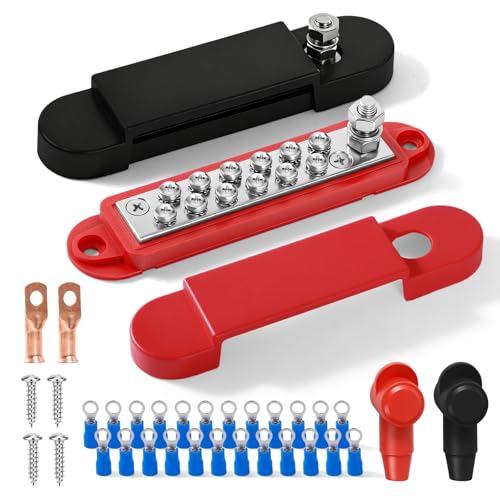
Avelis combines a solid tinned copper bus bar and a rigid base, rated at 150A and up to 48V. It includes 1/4″ studs and 12 terminals, with snap-lock covers to resist vibration. Best for marine environments where vibrations and corrosion resistance matter. One limitation is to confirm cable clearance and mounting space before purchase to ensure a proper fit in restricted compartments.
Aienxn Marine Bus Bar 12V 150A

Featuring a buckle-designed bottom for secure mounting, this bus bar includes 1/4″ (M6) stud and 12 x M4 terminals for straightforward wiring. It’s suitable for automotive, marine, and solar wiring, offering a balanced combination of secure installation and reliable connections. Best for installations where secure coverage is critical. Caution: check the bottom buckle mechanism periodically to ensure it remains engaged under vibration.
Buying Guide
What to consider when choosing a marine 12V power distribution block
- Current rating: Match the block’s max current to your system’s peak draw. Higher amperage blocks (e.g., 250A) support larger boats or solar arrays but may require more space.
- Terminal types and size: Look for compatible studs (1/4″, 3/8″, etc.) and insulation for the wires you plan to connect. Ensure lug options align with your cables.
- Voltage tolerance: Ensure the block supports up to your system’s maximum DC voltage (common up to 48V in marine setups).
- Mounting stability: Consider base design (round corner, buckle bottom) and how vibration will affect the installation.
- Protection and coverage: Snap-lock or secure covers reduce accidental contact and shorts. Assess if you need integrated grounding or spare fuse storage.
- Space and layout: Compare dimensions to available compartment space and wire routing complexity.
Wiring and safety considerations
- Keep positive and negative runs clearly separate where possible to minimize crosstalk and shorting risk.
- Use appropriate gauge wires for the load and distance; larger currents require thicker cables.
- Install covers and shields to prevent accidental contact, especially in mobile environments.
- Label circuits for quick troubleshooting and maintenance.
Regional and usage perspectives
- For small to mid-size boats or compact rigs, blocks with 150A ratings and dual bus layouts offer a practical balance of space and capacity.
- For high-current solar setups or larger vessels, favor blocks with 250A ratings and multiple heavy-duty studs for easier connections.
- Marine environments demand corrosion resistance and vibration tolerance; choose copper bus bars with protective coatings and secure covers.
FAQ
- What is a marine 12V power distribution block used for?
It centralizes battery connections and distributes power to multiple circuits, reducing clutter and improving safety. - Do I need a ground bus included?
Some models include separate ground terminals; if your system requires separate grounding, choose a block with a dedicated ground layout. - Can I mix wire sizes on the same bus bar?
Most distribution blocks accommodate different terminal sizes, but verify lug and stud specifications to avoid loose connections. - Is a higher current rating always better?
Not necessarily; choose rating based on your system’s maximum expected draw to avoid excess space and cost. - Should I use a cover on the bus bar?
Yes, covers reduce the risk of shorts and protect terminals during service and transport.