Best Low Voltage Transformer Boxes for Outdoor Lighting
This guide highlights top low voltage landscape transformers that convert 120V AC to 12V (or 12/14V) safe power for outdoor lighting. Each pick targets different needs, from simple dusk-to-dawn operation to multi-zone control. Best for: homeowners seeking plug-and-play reliability, and DIY enthusiasts who want flexible timing and weatherproof construction. The table below helps compare core specs and intended use at a glance.
| Product | Best For | Power (W) | Key Feature |
|---|---|---|---|
| DEWENWILS 120W Low Voltage Transformer | Budget-friendly lighting with timer | 120 | Dusk-to-dawn sensor, countdown timer |
| SUNVIE 300W Dual Output Transformer | Two zones with independent control | 300 | Two zones, 5 modes |
| SUNVIE 100W Transformer | Compact outdoor setups | 100 | Photocell & countdown memory |
| WILAWELS 300W Transformer | Weatherproof, higher load | 300 | Six modes, ETL listed |
| DEWENWILS 60W Transformer | Small lighting schemes | 60 | Dusk-to-dawn, countdown, memory |
Each product below is accompanied by a concise summary of who it’s best for, why it was selected, and a practical caveat to consider before purchasing. All options are designed for outdoor use and aim to simplify installation and operation for American homes.
DEWENWILS 120W Low Voltage Transformer

The DEWENWILS 120W model converts 120V AC to 12V AC at up to 120 watts. Features include a built-in dusk-to-dawn sensor and a 1-9 hour countdown timer. It supports Always On, Auto, and Countdown modes, and installs with a 3.3-foot power cord and mounting holes for outdoor walls. Best for: simple, reliable outdoor lighting using a single zone. Limitation: not compatible with dimmer switches.
SUNVIE 300W Dual Output Transformer
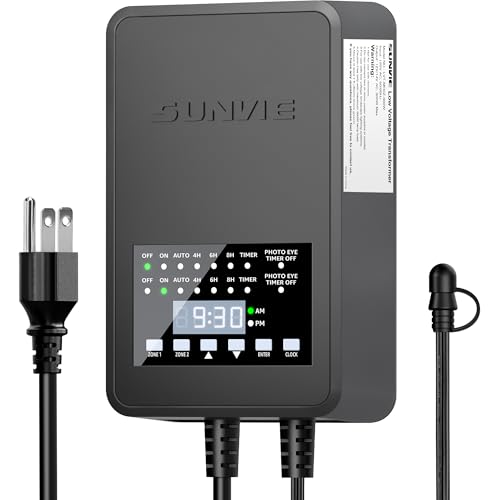
The SUNVIE 300W transformer provides two independently controlled outputs (zones) with five modes, including manual, auto dusk-to-dawn, countdown, timer, and photocell-on-timer-off. It supports LED and halogen landscape lighting and uses a 6.8ft external sensor cord. Best for: larger installations or landscapes with two separate lighting zones needing different schedules. Caution: total power must stay within 80% of rating to avoid overloading.
SUNVIE 100W Low Voltage Transformer

The 100W SUNVIE transformer outputs 12V DC for outdoor lighting, with a removable external photocell sensor and a 6.8ft sensor cord. It includes countdown modes and memory functionality to retain the last set mode after power outages. Best for: compact landscapes or smaller path lighting with automatic dusk-to-dawn control. Limitation: not for halogen lights; need to verify compatibility with your fixtures.
WILAWELS 300W Transformer

The WILAWELS 300W transformer is ETL-listed and supports 12/14V outputs with six modes, including dusk-to-dawn, countdown, and timer. It includes detachable sensor cords and a 3.3ft power cord plus a 6ft sensor cord. Best for: higher-power outdoor lighting with multiple scheduling options. Caution: outdoor-only installation is required due to cord layouts.
DEWENWILS 60W Transformer

The 60W DEWENWILS transformer delivers dusk-to-dawn operation and a countdown timer with memory. It mounts directly on outdoor walls and uses a 3.3ft power cord to simplify installation. Best for: small to medium outdoor lighting setups where energy efficiency matters. Limitation: not for halogen lights.
Buying Guide: Key Considerations For Low Voltage Landscape Transformers
What matters most when choosing a transformer is how you plan to use your landscape lighting. Consider the total wattage, number of lighting zones, and the control options that match your needs. If you have multiple lighting zones with different schedules, a dual-output model with independent zone controls is often the best choice. For straightforward setups, a single-output transformer with dusk-to-dawn and countdown features can be sufficient.
Questions to guide your decision:
- How many lights will run at once, and what is their total wattage?
- Do you need independent controls for different areas (zones)?
- Is automatic dusk-to-dawn operation important for you?
- Will you use LED or halogen fixtures, and is compatibility specified?
- Are weatherproofing and outdoor mounting important for your space?
Common Scenarios
- Small driveway or path lighting: A 60W or 100W transformer with dusk-to-dawn and memory is typically sufficient.
- Two-zone garden lighting: Look for a dual-output transformer with independent zone settings and multiple modes.
- High-load features (multiple fixtures or larger areas): A 300W transformer with ETL listing and robust weatherproof design is ideal.
Installation Tips
- Mount the transformer in a dry, sheltered location unless rated for outdoors.
- Follow the manufacturer’s wiring instructions and avoid dimmer switches unless explicitly supported.
- Check fixture compatibility with low-voltage LED or halogen requirements.
- Keep power cords clear of standing water and secure connections for weather resistance.
FAQ
- What is a low voltage landscape transformer used for?
It converts 120V AC to a safer 12V (or 12/14V) output to power outdoor lighting fixtures such as path lights, spotlights, and step lights.
- Do all transformers support two zones?
No. Some models offer single output, while others provide two or more independently controlled zones.
- Can I use a transformer with halogen lights?
Some models specify compatibility with LED and halogen; always check the product notes to verify.
- Is dusk-to-dawn always-on automatic lighting reliable?
Yes, when the transformer includes a photocell sensor designed for outdoor use and proper weatherproofing.
- What should I consider for outdoor installation?
Ensure the unit is weatherproof, rated for outdoor use, and wired according to local electrical guidelines.
- How do countdown timers help energy savings?
They turn lights off after a set period, reducing unnecessary illumination and power consumption.