Best Low Voltage Sensor Switches for LED Lighting and Cabinets
Low voltage sensor switches enable hands-free lighting in tight spaces, cabinets, closets, and under-cabinet setups. This guide highlights five reliable options, detailing how they detect motion, control brightness, and handle power at 12V–24V. Use the buying guide to compare sensors by range, timing, and compatibility with your LED strips or fixtures.
| Product | Brand | Voltage Range | Key Feature |
|---|---|---|---|
| Yogcow DC Motion Sensor Light Switch | Yogcow | 12V/24V | Adjustable delay; three light-sensitivity modes |
| MELIFE PIR Sensor Controller | MELIFE | 12V/24V | 8m detection; 1–10 min delay |
| Sensky BS011 Cabinet Sensor Switch | Sensky | 12V/24V | Easy cabinet/closet integration; adhesive tape |
| SUPERNIGHT PIR Motion Sensor Switch | SUPERNIGHT | 5V–24V | 2–360s timing; automatic ON/OFF |
| VST IR & Proximity Sensor Switch | VST | 12V/24V | PIR 120° field, 9.84 ft range; includes conversion cables |
Note: All products are suitable for low-voltage LED strips, under-cabinet lighting, and internal cabinet lighting. Look for adjustable delay, motion range, and compatibility with your fixture’s voltage to ensure reliable operation.
Yogcow DC Motion Sensor Light Switch

The Yogcow sensor detects movement within a range of 10–16 feet, turning on the light automatically upon entry. It maintains illumination while motion is detected and turns off after motion stops, with an adjustable delay. It offers three light-sensitivity modes: Deep Dark, Light Dark, and All-Day, enabling operation in complete darkness, low-light, or any ambient light condition. Delay times include 3 seconds, 45 seconds, or 4 minutes for flexible control of lighting duration.
MELIFE 2 Pack PIR Sensor Switch

The MELIFE infrared detector controls LED strips and related fixtures with a power range of 12–24V and a current rating of 6A. Features an adjustable delay from 1 to 10 minutes and an induction distance up to 8 meters. The infrared detection controller ensures automatic switching as motion is detected, delivering hands-free lighting where needed.
Sensky BS011 Cabinet Sensor Switch

The Sensk y BS011 is designed for cabinets, safes, and closets. It mounts behind a door, turning lamps on when opened and off when closed. It’s designed to plug neatly with LED cabinet lights, strips, or rigid light bars and includes adhesive tape for straightforward installation. This solution emphasizes quiet, automatic operation in compact spaces.
SUPERNIGHT PIR Motion Activated Sensor Switch
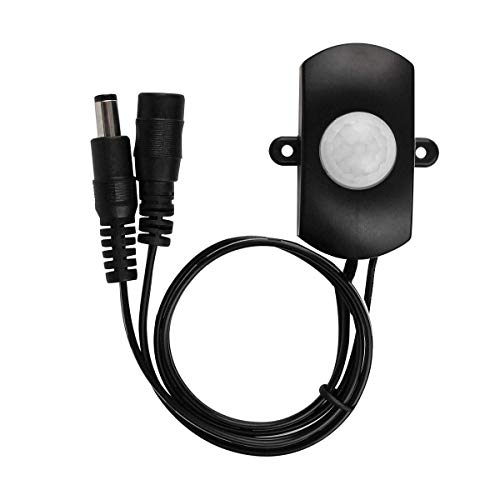
The SUPERNIGHT sensor provides automatic ON/OFF based on PIR motion detection, with a flexible timing setting ranging from 2 seconds to 360 seconds and a detection range up to 0–7 meters. It supports a wide voltage window (5V–24V) and is suitable for LED strip light applications where compact, efficient sensing is needed.
VST Motion Sensor Light Switch (DC 12/24V)

This VST model supports 12V and 24V lighting with a 120-degree PIR sensor and a practical detection range of about 9.84 feet. It includes 12V to 24V conversion cables to accommodate various fixtures, and notes compatibility details to help users avoid wiring mismatches. The sensor turns lights on with motion and off after movement stops, offering flexible cabinet and under-cabinet lighting possibilities.
VST Motion Sensor Light Switch (DC 12-24V)

This VST model doubles as a proximity sensor, with a PIR-based detection controller that activates the load switch upon movement and deactivates it after about 30 seconds of inactivity. It supports both 12V and 24V systems and maintains a 120-degree field of view. It includes conversion cables for easy integration with 24V drivers or fixtures, making it a versatile option for cabinets and under-cabinet lighting.
Buying Guide: Key Considerations For Low-Voltage Sensor Switches
- Voltage compatibility: Verify your system’s voltage (commonly 12V or 24V). Some switches also support 5V–24V, but confirm the maximum current ratings for your fixtures.
- Detection range and field of view: A wider range (roughly 8–16 feet or 3–5 meters) helps cover entryways and larger spaces; a 120-degree field of view captures movement from multiple angles.
- Delay and timing control: Look for adjustable delay settings (seconds to minutes) to tailor how long lights stay on after motion stops.
- Ambient light sensitivity: Three modes (dark, low-light, all-day) prevent unwanted activation in bright spaces and conserve energy.
- Installation method: Adhesive-backed switches or flush mounts affect ease of installation. Consider whether you prefer behind-door mounts or surface mounting for accessible controls.
- Compatibility with LED types: Ensure the device supports your LED strip or curtain-light fixtures, especially if you’re using constant-voltage vs. constant-current LEDs.
- Wiring complexity: Some units require simple plug-and-play wiring; others may need additional adapters or conversion cables to match 12V to 24V power supplies.
- Reliability and reviews: Check for consistent performance in low-profile cabinets or tight spaces, and consider models with a memory function to restore brightness after power loss.
- Durability and weather rating: For outdoor or exposed installations, select sensors with appropriate IP ratings or weatherproofing.
When selecting a low voltage sensor switch, align the product’s features with your space: motorized motion range for hallways, tight cabinet interiors, or under-cabinet lighting in kitchens or closets. A sensor with adjustable delay, ambient-light sensing, and solid installation options reduces manual switching and improves energy efficiency, while maintaining consistent illumination where you need it most.