Best Low-Level CO Detector for Early Warning at Home
The top choice for early carbon monoxide alerts is a low-level CO detector designed to sense small CO concentrations before they become dangerous. This guide highlights five reliable options ideal for homes, apartments, and travel scenarios. The best picks are suited for families, seniors, pets, and people with medical conditions who need early warnings. Each product section explains who benefits most, its strengths, and a practical caveat to consider.
| Product | Best For | Why It Stands Out |
|---|---|---|
| Kidde COBDL | Travelers and small spaces | Portable, battery-powered with advanced low-level sensing |
| Kidde COBD10 | Bedroom or living areas | 10-year battery, low maintenance, backlit display |
| Kidde COPDLG | Homes with gas appliances | Detects CO plus explosive gas, plug-in with backup |
| Kidde COPD | General home use | Plug-in with AA backup, digital display, rotating plug |
| Kidde Ultra-Sensitive | Medical considerations and pets | Low-level CO detection, battery-powered with display |
Kidde COBDL – Battery-Powered, Low-Level CO Alarm

Best for travelers or compact spaces where wiring is impractical. This model uses AA batteries and features advanced low-level CO technology, alerting at 30-70 ppm with distinct light and sound patterns, plus a separate alarm at 70 ppm for all occupants. It’s ideal for apartments, hotel stays, and small rooms where a quick, portable CO alert is needed. Caution: Battery dependence means monitoring will pause during battery failure unless replacements are on hand.
Kidde COBD10 – 10-Year Battery CO Detector

Best for bedrooms and living areas where long-term maintenance is preferred. The COBD10 features a built-in 10-year battery, a backlit digital display, and a loud 85 dB alarm. It eliminates frequent battery changes and provides clear CO level information. Limitation: The 10-year battery means replacement timing is fixed; after a decade, the unit should be replaced even if it appears functional.
Kidde COPDLG – Gas and CO Detection

Best for homes with gas appliances or areas where explosive gases may be present. COPDLG detects low CO levels and also monitors natural gas or propane, with a backlit display and a rotating plug for flexible installation. Caution: The combination of gases means it may alert to gas presence, but you should verify the room’s ventilation and gas sources after an alarm.
Kidde Plug-In with 9V Backup, Digital Display

Best for continuous home use where AC power is available and a backup is required for outages. This model provides a digital display, 9V battery backup, and a rotating plug that fits vertical or horizontal outlets. Caution: If you rely solely on the AC power, ensure the backup batteries are checked regularly to prevent gaps in detection during outages.
Kidde COBD10 – 10-Year Battery Powered (Alternate View)
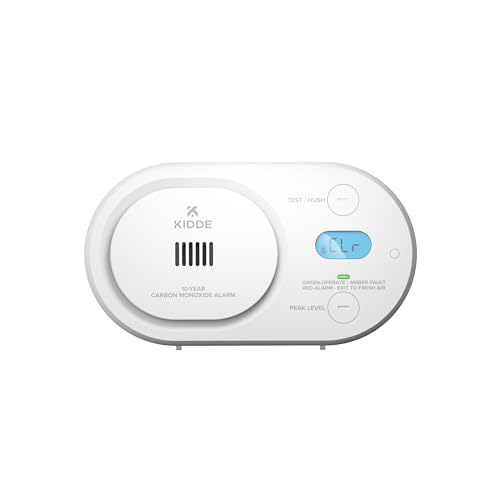
Best for risk-aware households seeking long-term reliability. This variant emphasizes the 10-year battery life and a backlit display for easy CO level reading. It’s suitable for bedrooms, living rooms, and nurseries. Limitation: After 10 years, the device should be replaced even if no alarms have occurred, to maintain safety standards.
Buying Guide
- Detection level and sensitivity: Look for devices with low-level CO detection capabilities (30-70 ppm range) to catch early warnings. Models with distinct light and sound patterns help differentiate low-level alerts from high-level warnings.
- Power source: Decide between battery-powered for portability (helpful in rentals, travel, or outages) and plug-in with battery backup for continuous operation during power failures.
- Display and readability: A digital backlit display makes CO levels easy to read at a glance, especially in low-light bedrooms or living areas.
- A 10-year sealed battery reduces maintenance but requires replacement after the period. A longer life is convenient but may limit update cycles for newer technology.
- If you also need explosive gas detection, consider devices that monitor both CO and gas (natural gas/propane) while noting their placement and ventilation requirements.
- Place detectors on each sleeping level and near sleeping areas. Avoid installing behind furniture or in very humid zones, and ensure easy access for testing and silencing alarms.
FAQs
- What is considered a low-level CO reading? Low-level CO typically refers to readings in the 30-70 ppm range. Early alerts at these levels can provide critical time to evacuate and ventilate.
- Do I need both CO and gas detectors? If you have natural gas or propane appliances, a detector that also senses gas can be beneficial, but place them in appropriate locations and follow manufacturer guidance.
- How often should I replace a CO detector? Detectors with a 10-year battery should be replaced after 10 years. Other units may require battery changes according to the manufacturer’s schedule.
- Can a CO detector protect pets? Yes. Some models advertise sensitivity improvements for families with pets and medical conditions, but devices detect CO for all occupants and should be part of a comprehensive safety plan.
- Where should detectors be installed? Install at least one on each living level, near sleeping areas, and away from cooking appliances or direct drafts to reduce nuisance alarms.
- What should I do if a CO alarm sounds? Evacuate to fresh air immediately and call emergency services. Do not re-enter until authorities declare it safe.