Best Low Force Load Cells for Precision Small-Scale Measurements
Answering common buyer questions about low force load cells, this guide highlights compact, high-accuracy options ideal for small spaces, bench testing, or delicate force measurements. The top picks cover a range of capacities from 0-5 kg up to 500 kg, each with clear strengths for specific tasks. Readers will learn which model suits light-duty precision, industrial testing, or portable field work. The following products are chosen for reliability, build quality, and ease of integration into test benches or scales.
Buying quick reference: the table below compares key attributes at a glance.
| Product | Capacity | Best For | Notes |
|---|---|---|---|
| DYMH-103 Mini Tension & Compression | 0-10 kg | Small-space testing and calibration | Stainless steel; 1.0-1.5 mV/V sensitivity |
| Load Cell Force Sensor (QILICHUANGAN) | 0-10 kg | Precision lab measurements | 0.1% accuracy; rod-type design; stainless steel |
| Load Cell Sensor With Indicator (QILICHUANGAN) | 0-5 t | Industrial weighing with peak data | Bellows sensor; five-digit display; peak hold |
| ATO 500 kg Load Cell | 0.5-500 kg | High-capacity force measurement | Low height; sealed; 0.05% F.S accuracy |
| S Type Load Cell (QILICHUANGAN) | 0.5-1 t | Tension/Compression with easy mounting | 2.0 mV/V sensitivity; 0.2% accuracy |
DYMH-103 10kg Mini Tension and Compression Sensor

The DYMH-103 is designed for small spaces, offering 0-10 kg capacity with stainless steel construction. Best for labs or hobbyists needing compact, inline force sensing where space is limited. The sensor provides high accuracy and stability with a sensitivity of 1.0-1.5 mV/V. Choose this if you require a compact solution that integrates easily into benchtop rigs without sacrificing performance. A limitation is a relatively narrow 0-10 kg range for some heavy-duty tasks.
Load Cell Force Sensor, 0-10KG (QILICHUANGAN)

This 0-10 kg sensor uses a robust rod-type design, suitable for tension and compression measurements. With 0.1% accuracy, it balances precision and durability for lab calibration, small fixtures, or test benches. Best for users who need a compact, versatile force sensor with reliable repeatability. It’s less ideal for very high loads or outdoor environments where corrosion resistance is critical without additional protection.
Load Cell With Indicator Display (0-5T)
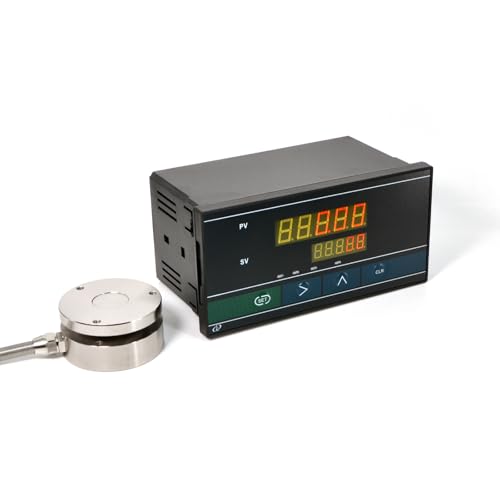
This sensor integrates a bellows weighing element with a five-digit LED display and peak hold. It suits industrial environments where quick data readouts and peak force logging are essential. Best for production lines or quality control stations that require reliable monitoring with a clear local readout. A potential limitation is the need for proper enclosure to protect the bellows when used outdoors or in harsh environments.
ATO 500 kg Load Cell (Pancake Type)

The ATO 500 kg load cell offers a low-height pancake design with good anti-eccentric load performance and sealed construction. It provides high accuracy (0.05% F.S) and a wide capacity range, making it suitable for heavier testing while still maintaining precision. Best for workshop benches and scale systems needing robust performance at higher capacities. Limitation: bulkier than micro-scale loads and requires adequate mounting space.
DYMH-103 Mini Tension & Compression (Second Listing)

This variant emphasizes high accuracy and stability with a sensitivity of 1.0-2.0 mV/V and stainless steel 17-4PH construction. Best for users who need a hardened sensor for precise force measurement in compact rigs or calibration setups. Limitations mirror the compact design; ensure your system supports the 1-2 mV/V signal range.
S Type Load Cell (1T)

The S-beam design focuses on easy installation and stable readings for tension and compression tests. With 2.0±0.05 mV/V sensitivity and 0.2% accuracy, it’s well-suited for bench setups and test rigs that require straightforward mounting and reliable data. Choose this if you need a portable, simple-to-integrate sensor with robust performance and built-in protection lines. Limitations include a lower maximum capacity than larger ATO models.
Buying Guide
What capacity do you actually need?
Consider the maximum force you expect to measure. For delicate tasks, 0-10 kg or 0-5 kg sensors are ideal. For heavier tests, look at 0.5-5 kg to 500 kg options. Higher capacity often means a larger footprint, so balance space with measurement needs.
Which mounting and form factor fit your setup?
Inline and pancake (circular) designs suit bench setups, while S-beam sensors excel in fixtures requiring easy alignment. Rod-type designs are common for tension tests, whereas bellows-based sensors are favored for stable radial loads in industrial scales.
What about accuracy and sensitivity?
Accuracy is typically expressed as a percentage of full-scale (F.S). Lower percentages indicate higher precision. Sensitivity (mV/V) affects signal strength and compatibility with instrumentation. Ensure your readout system can handle the sensor’s output.
Durability and environment
Stainless steel sensors resist corrosion and are suitable for damp or corrosive environments. If used outdoors or in rough conditions, consider sealed designs or additional enclosures. For high-precision lab work, ensure supported temperature ranges align with your needs.
Readout and data logging
Some sensors come with built-in indicators or peak-hold features, simplifying immediate data capture. If you require continuous logging, confirm compatibility with data acquisition systems or digital interfaces and ensure existing software can interpret the sensor’s signal.
Installation and maintenance
Look for sensors with straightforward mounting holes and standard thread sizes. Regular checks for calibration drift and screw torque are essential for maintaining accuracy in long-term use.
Summary of top picks by use case
- Best for small-space benches: DYMH-103 0-10 kg
- Best for precise lab measurements: QILICHUANGAN 0-10 kg
- Best for peak data in industry: QILICHUANGAN 0-5T with Indicator
- Best for high-capacity testing: ATO 500 kg Pancake
- Best for easy mounting and tension/compression tests: QILICHUANGAN S Type 1T
FAQ
Q: What is the typical response time of these load cells?
A: Response time varies by model and signal conditioning; most are suitable for static to moderate-dynamic measurements, with peak data options in some models.
Q: Can these load cells be used outdoors?
A: Some models are built with corrosion-resistant materials, but outdoor use should consider enclosure and protection from weather and dust.
Q: Do these require special amplifiers?
A: Many 0-10 kg sensors output mV/V signals and can be read with standard data acquisition hardware or signal amplifiers designed for load cells.
Q: How do I calibrate a low-force load cell?
A: Calibration involves applying known weights, noting the output, and generating a calibration curve. Follow the manufacturer’s guidance for best results.
Q: Which sensor is best for tension only tasks?
A: Rod-type and S-beam designs are versatile for both tension and compression; choose based on mounting practicality in your setup.