Best Long Range PIR Motion Sensor Selections for Home Security
Answering the need for reliable long-range motion detection, these PIR-based options cover residential security, outdoor lighting, and driveway monitoring. They’re best for homeowners who want adjustable detection zones, extended reach, and flexible mounting. The top five choices below balance range, ease of use, and versatility for porches, fences, garages, and entryways. Use this guide to compare options and choose the sensor that fits your property layout and lighting plans.
| Product | Best For | Key Benefit |
|---|---|---|
| TREEWELL 240-Degree Replacement Motion Detector, Brown | Wide-area outdoor walls and eaves | Up to 60 ft range, 240° detection, 3 modes |
| TREEWELL Motion Sensor, 180-Degree, White | Porches and entryways | 180° coverage, adjustable timer, 60 ft |
| 2 Pack Motion Sensor, 180-Degree, Black | Dual mounting points or larger entrances | Two sensors, 60 ft range, 3 modes |
| TREEWELL 2 Pack 240-Degree Replacement Motion Sensor, Brown | Multiple zones around home | 5–300 LUX adjustable, 60 ft range, 240° |
| Driveway Alarm Wireless Outside, 1 BY ONE | Driveways and perimeters with remote alert | Up to 1000 ft wireless range, 3 alert options |
TREEWELL 240-Degree Replacement Motion Detector

Best for large exterior walls or eaves where wide coverage is needed. This unit offers a 60‑foot detection range and a 240° sensor field, paired with three working modes for flexible lighting and security. The rotatable sensor neck provides 180° vertical and 300° horizontal adjustment, making it adaptable to odd angles or irregular structures. The “Auto Mode” keeps lighting active only after dark and when movement occurs, reducing energy use. It’s well suited for porches, driveways, garages, and entry paths where broad, reliable detection matters.
Who it’s best for: homeowners needing broad coverage on exterior walls with adjustable sensitivity and timing. Why selected: the 60 ft range and 240° field maximize reach while preserving options for manual override and day/night behavior. Caution: thermal or ambient lighting changes can affect detection if the sensor is aimed too high or near heat sources.
TREEWELL Motion Sensor, 180-Degree, White

Ideal for smaller exterior openings or entryways needing precise detection without overreach. It provides a 60-foot detection range with an adjustable timer and three modes for flexible operation. The 180° field keeps detection focused on critical zones, reducing false alarms from adjacent balconies or landscaping. The rotatable neck mirrors the 240-degree model’s versatility but with a narrower field that fits tighter layouts.
Best use case: entry doors, porches, and side gates where clean, targeted coverage is preferred. Why selected: balanced range and a compact 180° field help prevent detection spill into neighboring yards. Caution: in very windy or heavily vegetated areas, foliage can trigger the sensor if not aimed precisely.
2 Pack Motion Sensor, 180-Degree, Black
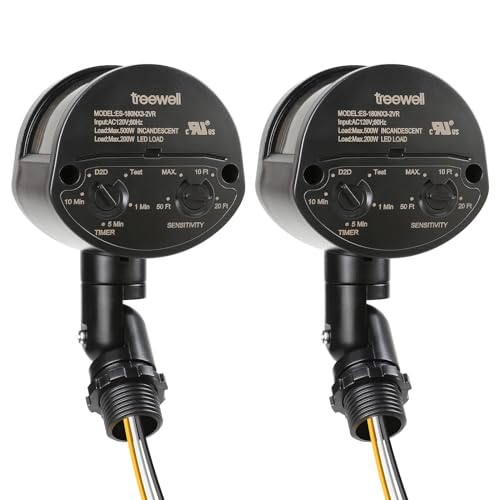
This set offers two sensors for broader coverage across multiple entry points or larger perimeters. Each unit provides a 60 ft range with 180° detection and the same three modes, allowing synchronized or independent operation between sensors. The dual-pack setup helps with symmetrical mounting on both sides of a doorway or across a garage entrance. A practical choice for households wanting scalable sensor distribution.
Who it’s for: households needing paired coverage for twin zones or wider angles. Why chosen: cost-effective way to extend long-range sensing without sacrificing performance. Caution: ensure both units are calibrated similarly to avoid staggered lighting activation times.
TREEWELL 2 Pack 240-Degree Replacement Motion Sensor

Best for multi-zone security setups or homes with larger footprints, this 2-pack expands 240° coverage to two separate areas. The unit supports 5–300 LUX adjustable ambient brightness in Auto or DTD modes, enabling light activation only when dark enough to matter. The 60 ft detection range with a wide detection arc helps cover stairs, driveways, and side yards from multiple angles. Use this set where you want consistent, synchronized sensing across adjacent entry points.
Top considerations: the LUX adjustment helps tailor when lights engage in varying dusk-to-night conditions. Caution: when ambient brightness is high, activating the sensor might require lowering the LUX threshold to ensure nighttime operation.
Driveway Alarm Wireless Outside, 1 BY ONE

Designed for long-range outdoor monitoring, this wireless system uses a motion sensor with a receiver that can be placed up to 1000 feet away. It detects movement within a defined arc and triggers one of three alert options (sound, LED flash, or both). The system is suitable for driveways, gates, and remote entrances where you want audible and visual alerts from a distance. It’s a practical complement to fixed lighting if you need immediate notification across larger properties.
Best for: properties with distant entrances or detached buildings where a remote alert is advantageous. Why selected: the 1000 ft wireless range provides flexible placement without hard-wired connections. Caution: battery life and line-of-sight can impact long-range reliability in obstructed environments.
Buying Guide
What should I consider when choosing a long-range PIR motion sensor?
- Detection range and angle: Match the sensor’s reach to the area you want to cover. A 60 ft, 240° model is ideal for broad outdoor walls, while 60 ft with 180° is better for tighter spaces.
- Mode options: Auto, D2D/DTD or manual override give you control over when lights or alarms activate, conserving energy and reducing false alarms.
- Adjustability: Look for stepless time and sensitivity controls to fine-tune responsiveness to moving people, animals, or vehicles.
- Mounting flexibility: A rotatable sensor head and versatile mounting options improve placement on walls, eaves, or porches.
- Ambient brightness control: LUX adjustment prevents lights from turning on in daylight, which helps with energy efficiency in Auto/DTD modes.
- System type: Standalone PIR sensors versus wireless door alarm systems offer different installation complexities and coverage patterns.
FAQ
- What is long-range PIR motion sensing good for?
It’s useful for driveways, perimeters, and large entryways where you need to detect movement at a distance and trigger lights or alerts.
- Can PIR sensors reduce false alarms?
Yes. Adjusting the detection angle, sensitivity, and timer helps tailor responses to legitimate movement, while avoiding triggers from branches or animals.
- Is a 240-degree sensor better than 180-degree for outdoor use?
Not always. A 240-degree sensor covers a wider arc, which is beneficial for open walls, but a 180-degree sensor may be more precise for tight spaces.
- Do these sensors require wiring?
Some models are wired (for example, 12V PIR switches), while others are wireless or battery-powered for easier installation.
- What should I consider when combining multiple sensors?
Plan placements to avoid overlap that causes false triggers, and ensure consistent timing and mode settings for predictable lighting or alerts.
- How important is the LUX setting?
Very important. LUX controls determine whether lights activate at night or in darkness, helping conserve energy during daylight.