Best Lithium-Ion Battery Cabinets for Safe Storage
Lithium-ion batteries require careful storage to prevent heat, gas release, and fire risks. This guide highlights top cabinets designed to safely house lithium-ion packs in homes, workshops, and facilities. Each option offers built-in ventilation, fire resistance, and organization features to help maintain safety standards while meeting storage needs.
Summary of selected products
| Product | Brand | Key Features |
|---|---|---|
| Securall Li145 | Securall | Integrated ventilation, UL-listed fire-resistant construction, made to order |
| DENIOS Lithium Ion Battery Storage Cabinet | DENIOS | 90-minute fireproof, 4 shelves, 1 door, blue |
| Phoenix Safe BSS6004 | PHOENIX SAFE | 32 outlets, multi-point locking, venting |
| DENIOS Under-Bench Cabinet | DENIOS | 90-minute fire resistance, compact, 1 drawer |
| DENIOS Charging Cabinet 90 Min Fireproof | DENIOS | 4 shelves, 1 door, 2 power strips |
Securall Li145 Lithium-Ion Battery Charging Cabinet
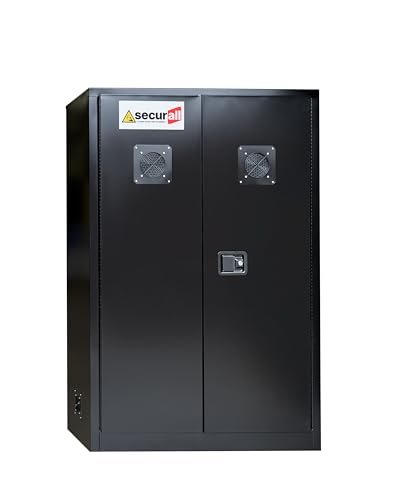
The Securall Li145 combines controlled ventilation with fire-resistant construction. It is built to order with a 30-day production window, allowing customization for specific facilities. The cabinet includes integrated ventilation to safely disperse heat and gases during charging, reducing internal pressure risks. The design emphasizes containment to protect nearby equipment and personnel.
DENIOS Lithium Ion Battery Storage Cabinet – 90 Min Fireproof
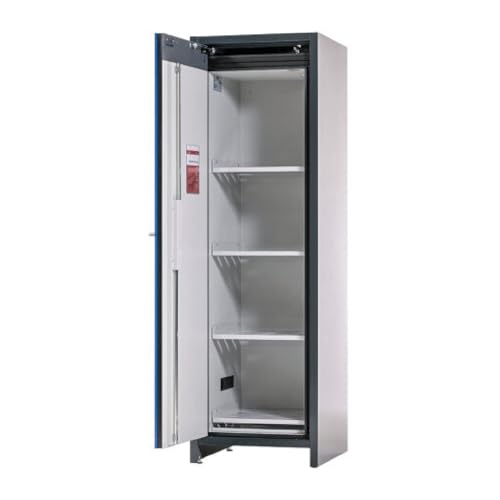
This 90-minute fireproof cabinet provides robust protection against battery-related fires. With four shelves and a single door, it is designed for safe storage of lithium-ion batteries in a dedicated enclosure. A pressure relief opening is included to manage excess pressure, enhancing overall safety in fault scenarios.
Phoenix Safe Lithium-ion Battery Charging Safe – BSS6004

The Phoenix Safe Battery Commander is engineered to contain and prevent the spread of battery fires. It features 32 outlets for charging and automatic multi-point locking to ensure doors seal securely during a fire. Ventilation ducts extract gases and help reduce internal pressure, contributing to safer operation during charging cycles.
DENIOS Under-Bench Lithium-Ion Battery Cabinet
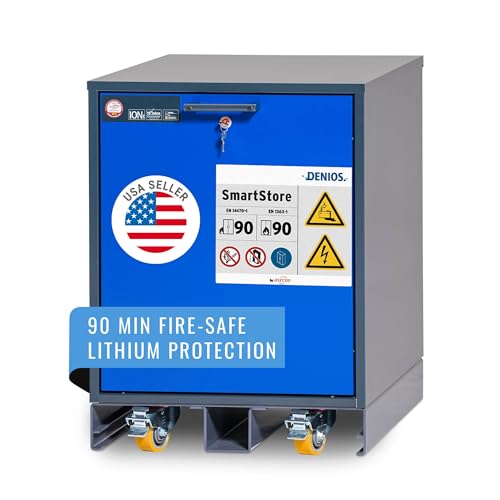
Designed for space-saving storage, this DENIOS under-bench option offers 90-minute fire resistance with a compact footprint. It includes one drawer for small items and features a blue, fireproof interior suitable for lightweight battery packs and chargers commonly used in maintenance and service environments.
DENIOS Lithium-Ion Battery Charging Cabinet – 90 Min Fireproof

This charging cabinet combines fire resistance with practical charging features. Four shelves and a single door accommodate batteries and charging equipment, while a pressure-relief mechanism helps mitigate hazards from gas buildup. It is designed for workplace safety and compliant storage of lithium-ion assets.
VERTIV External Battery Cabinet 48V 1U Rack

The Vertiv external 48V battery cabinet presents a rack-style solution suitable for data center or telecom environments. It emphasizes modularity and reliability for larger lithium-ion battery deployments, with a compact 1U rack footprint designed to maximize space while providing safe, scalable storage for critical power systems.
Buying Guide
- Fire ratings and ventilation: Look for cabinets with clear fire protection levels (e.g., 90-minute ratings) and integrated or selectable ventilation to manage heat and gas buildup during charging.
- Shelving and layout: Consider the number of shelves, drawer options, and whether a door or under-bench design better matches your workspace and workflow.
- Safety features: Prioritize cabinets with pressure relief vents, auto-closing doors, and secure locking systems to minimize risk during abnormal events.
- Charging compatibility: If you need to store and charge batteries, verify the number of outlets, power strips, and electrical certifications to fit your charging plan.
- Space and footprint: Evaluate cabinet dimensions relative to the storage area. Under-bench and compact designs save space beside workstations, while free-standing units offer more capacity.
- Compliance and labeling: Ensure the cabinet meets applicable safety standards and that labeling for hazard handling is clear and compliant with local codes.
- Maintenance and serviceability: Check for accessible venting paths, ease of cleaning, and replacement part availability for long-term use.